
Description
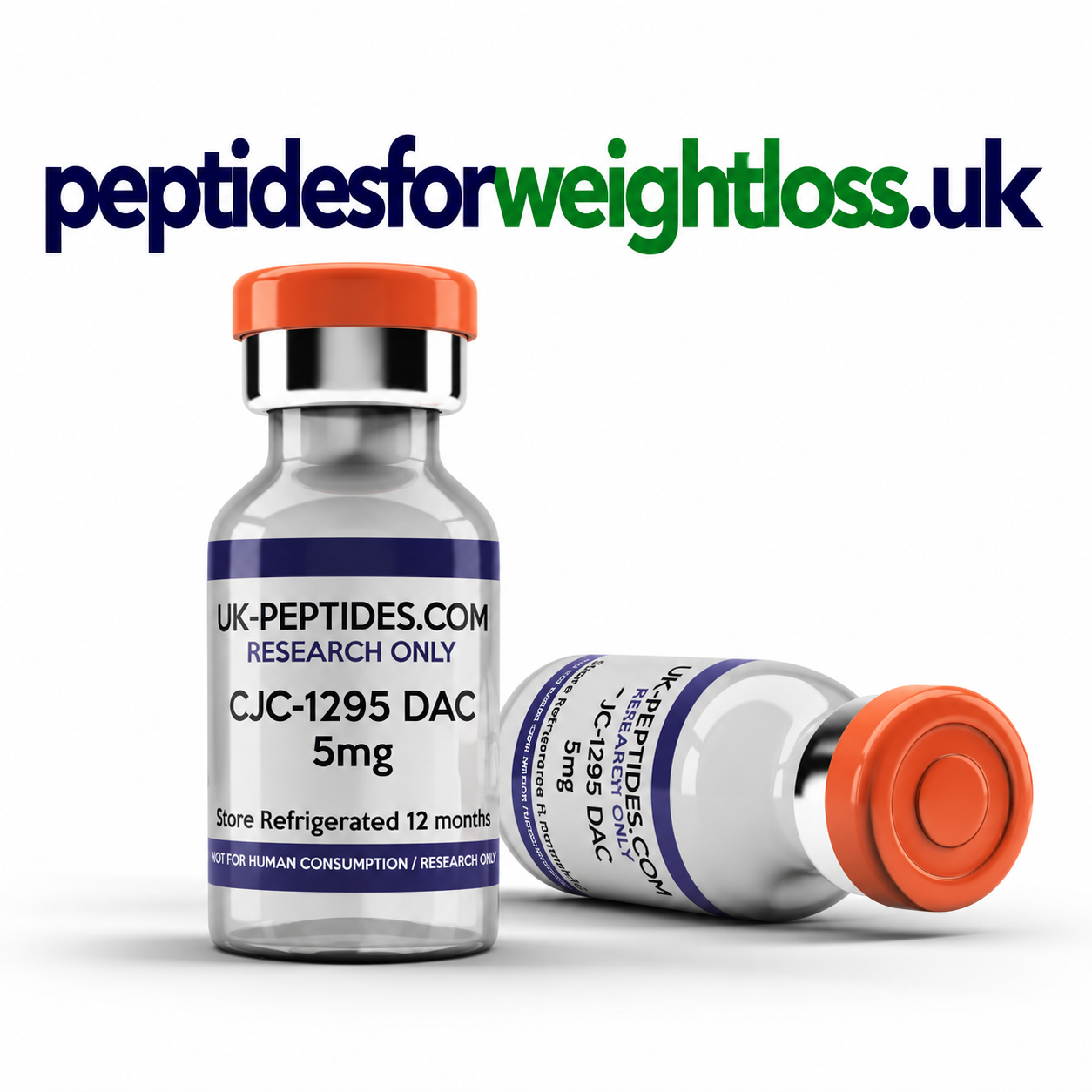
CJC-1295 With DAC 5mg – Long-Acting GHRH Research Peptide
CJC-1295 With DAC 5mg is a synthetic growth hormone-releasing hormone (GHRH) analogue investigated in scientific research involving pituitary endocrine regulation, growth hormone secretion, insulin-like growth factor 1 (IGF-1) signalling and peptide pharmacokinetics.
The defining feature of CJC-1295 with DAC is its Drug Affinity Complex modification. This chemical group is designed to support binding to circulating albumin, allowing the modified peptide to remain present in the bloodstream for longer than native growth hormone-releasing hormone.
CJC-1295 with DAC differs from Modified GRF (1-29), commonly marketed as CJC-1295 without DAC. The DAC-modified form has been investigated in controlled human studies that measured its pharmacokinetic characteristics and effects on circulating growth hormone and IGF-1 concentrations.
Although these studies demonstrated prolonged endocrine activity, they did not establish CJC-1295 with DAC as an effective treatment for obesity, muscle development, athletic recovery or ageing-related conditions.
CJC-1295 With DAC 5mg is therefore relevant to laboratory investigations involving peptide engineering, GHRH receptor signalling, albumin-binding technology and endocrine feedback mechanisms.
What Is CJC-1295 With DAC?
CJC-1295 with DAC is a chemically modified analogue of the biologically active N-terminal region of human growth hormone-releasing hormone.
The compound contains a modified 29-amino-acid GHRH peptide backbone together with an additional albumin-binding chemical structure.
Native GHRH is a hypothalamic hormone that stimulates growth hormone secretion from the anterior pituitary gland.
However, native GHRH has a relatively short duration of action because of its rapid breakdown and elimination.
CJC-1295 was developed to investigate whether molecular modifications could extend exposure to a GHRH analogue.
The DAC modification is particularly important because it enables covalent association with albumin, a major protein found in blood plasma.
Published research has demonstrated that the investigated DAC-modified construct produces prolonged growth hormone and IGF-1 responses in healthy adults.
CJC-1295 With DAC 5mg Product Specifications
- Product Name: CJC-1295 With DAC 5mg
- Alternative Names: CJC-1295 DAC, CJC-1295 With Drug Affinity Complex
- Classification: Synthetic long-acting GHRH analogue
- Peptide Backbone: Modified 29-residue GHRH fragment
- DAC Modification: Present
- DAC Function: Albumin-binding chemical modification
- Reference Molecular Weight: Approximately 3,647 g/mol for the commonly described DAC-modified construct
- Labelled Quantity: 5mg
- Primary Research Target: Growth Hormone-Releasing Hormone Receptor (GHRHR)
- Research Category: Endocrinology and peptide pharmacokinetics
- Research Focus: Growth hormone secretion, IGF-1 signalling and albumin binding
- Published Human Research Half-Life: Approximately 5.8–8.1 days for the studied preparation
- Purity: Requires batch-specific verification
- Salt Form: Confirm with manufacturer
- Physical Form: Confirm with manufacturer
- Storage: Follow verified manufacturer instructions
- Intended Use: Laboratory research only
The reference molecular weight does not establish the exact identity or composition of a particular commercial batch. Researchers should verify the complete DAC-modified structure, counterions, peptide content and formulation components using supplier documentation.
Understanding the Molecular Structure of CJC-1295 DAC
CJC-1295 with DAC is based on a modified 29-residue fragment of human growth hormone-releasing hormone.
The peptide backbone contains selected amino acid substitutions designed to alter its chemical and biological characteristics.
The additional Drug Affinity Complex structure distinguishes CJC-1295 with DAC from Modified GRF (1-29).
The DAC group includes a reactive chemical functionality designed to associate covalently with circulating albumin.
This albumin-binding approach is relevant to research into prolonged peptide exposure and molecular engineering.
Because commercial naming conventions can be inconsistent, researchers should not assume that every product labelled CJC-1295 contains the DAC modification.
Confirmation of the actual molecular structure is essential when comparing experimental findings.
How Does CJC-1295 With DAC Work?
CJC-1295 with DAC acts as a synthetic analogue of growth hormone-releasing hormone.
GHRH interacts with the growth hormone-releasing hormone receptor expressed by somatotroph cells in the anterior pituitary gland.
Receptor activation is associated with intracellular cyclic AMP signalling and the regulation of growth hormone secretion.
Growth hormone subsequently participates in multiple endocrine pathways, including regulation of circulating IGF-1.
The DAC modification changes the pharmacokinetic behaviour of CJC-1295 by supporting its association with albumin.
In published human studies, the investigated compound produced sustained elevations in growth hormone and IGF-1 concentrations.
However, prolonged hormone elevation does not independently demonstrate improved body composition, physical performance or clinical health outcomes.
Scientific Research Into CJC-1295 With DAC
1. Growth Hormone Secretion Research
Growth hormone is secreted by specialised cells in the anterior pituitary gland.
Its release is regulated by growth hormone-releasing hormone, somatostatin and other physiological signals.
CJC-1295 with DAC has been investigated because of its ability to produce prolonged growth hormone responses.
A 2006 study involving healthy adults reported dose-dependent increases in mean circulating growth hormone concentrations following exposure to the investigated compound.
Growth hormone concentrations remained elevated for six days or longer under the conditions examined.
These findings support the compound’s endocrine activity but do not establish its effectiveness for treating disease.
2. IGF-1 Signalling Research
Insulin-like growth factor 1, commonly abbreviated IGF-1, participates in growth-related signalling and endocrine regulation.
Growth hormone contributes to the regulation of IGF-1 production.
Published human research involving CJC-1295 with DAC reported increases in circulating IGF-1 concentrations.
In the studied healthy adults, mean IGF-1 levels remained elevated for approximately nine to eleven days following a single exposure.
These findings are relevant to investigations of the growth hormone and IGF-1 endocrine axis.
However, elevated IGF-1 is a biological measurement rather than proof of muscle growth, fat loss or improved health.
3. Albumin-Binding Research
Albumin is an abundant protein in blood plasma that participates in the transport of numerous molecules.
The Drug Affinity Complex modification in CJC-1295 was developed to support albumin binding.
Albumin association can influence the distribution and elimination of certain modified peptides.
Researchers have investigated this approach as a strategy for extending peptide exposure.
CJC-1295 with DAC is an important example of a peptide engineered to exploit albumin-binding chemistry.
Its pharmacokinetic properties should not be attributed to peptides that lack the same chemical modification.
4. Long-Acting Peptide Pharmacokinetics
Pharmacokinetics describes how compounds are absorbed, distributed and eliminated in biological systems.
CJC-1295 with DAC has been investigated in controlled human pharmacokinetic studies.
The published trials reported an estimated elimination half-life of approximately 5.8–8.1 days for the investigated preparation.
This extended half-life is a defining feature of the DAC-modified compound.
However, the reported range reflects specific study preparations and participants.
It does not independently verify the pharmacokinetic characteristics of every commercial CJC-1295 DAC product.
5. Growth Hormone Pulsatility Research
Growth hormone secretion normally follows a pulsatile pattern rather than remaining constant throughout the day.
This pattern is influenced by hypothalamic and pituitary regulatory signals.
A published study examined whether growth hormone secretion remained pulsatile during prolonged stimulation by CJC-1295.
The researchers reported that pulsatile secretion persisted in the healthy men studied.
These observations contribute to understanding the relationship between sustained GHRH receptor stimulation and endocrine rhythms.
They do not establish long-term therapeutic effectiveness.
6. GHRH Receptor Signalling
The growth hormone-releasing hormone receptor belongs to the G-protein-coupled receptor family.
Its activation is associated with intracellular cyclic AMP and protein kinase A signalling pathways.
These mechanisms participate in growth hormone production and secretion.
CJC-1295 with DAC has been investigated as an experimental tool for studying prolonged GHRH receptor stimulation.
However, receptor activation and downstream hormonal changes do not establish clinically meaningful treatment benefits.
7. Peptide Engineering Research
Peptide engineering involves modifying amino acid sequences or adding chemical groups to investigate molecular behaviour.
CJC-1295 with DAC combines changes to the GHRH peptide backbone with an albumin-binding modification.
This design provides a model for examining how chemical modifications affect peptide persistence.
Researchers may compare the properties of DAC-modified and unmodified analogues to investigate structure-dependent pharmacokinetic differences.
However, longer exposure can also extend unwanted biological effects and requires careful safety evaluation.
8. Endocrine Feedback Regulation
Growth hormone and IGF-1 operate within a complex endocrine regulatory network.
Feedback mechanisms influence hypothalamic signalling, pituitary hormone secretion and circulating hormone concentrations.
Research involving sustained GHRH receptor stimulation can help scientists investigate these interactions.
CJC-1295 with DAC has been studied because of its prolonged effects on growth hormone and IGF-1.
However, long-term endocrine consequences remain insufficiently characterised.
9. Human Clinical Research
Human studies of CJC-1295 with DAC have investigated pharmacokinetics, hormone responses and short-term tolerability.
Two randomised, placebo-controlled, double-blind trials published in 2006 examined the compound in healthy adults.
Researchers reported sustained changes in growth hormone and IGF-1 concentrations together with an extended elimination half-life.
Another study examined growth hormone pulsatility during prolonged stimulation.
These investigations provide direct human evidence of endocrine activity.
However, they were not designed to establish long-term safety or clinical effectiveness for obesity, muscle growth or ageing-related conditions.
CJC-1295 With DAC 5mg vs 2mg
CJC-1295 With DAC 5mg and CJC-1295 With DAC 2mg should refer to the same DAC-modified peptide at different labelled quantities.
- 5mg Product: Labelled as containing 5mg of CJC-1295 with DAC research material.
- 2mg Product: Labelled as containing 2mg of the same research compound.
- DAC Modification: Should be present in both products.
- Research Target: Both are associated with GHRH receptor signalling.
- Molecular Identity: Should be independently verified for each batch.
- Purity: Requires separate batch-specific analytical confirmation.
The labelled quantity does not determine molecular potency, purity or suitability for a particular experiment.
CJC-1295 With DAC vs Without DAC
CJC-1295 with DAC and CJC-1295 without DAC are chemically distinct.
The with-DAC compound contains an albumin-binding chemical modification.
The without-DAC form is commonly associated with Modified GRF (1-29), which lacks this modification.
The human pharmacokinetic studies reporting an estimated half-life of 5.8–8.1 days investigated the DAC-modified form.
These findings should not be transferred to Modified GRF (1-29).
Researchers should verify the exact molecular identity before comparing the two compounds.
CJC-1295 With DAC vs Sermorelin
Sermorelin is a synthetic peptide corresponding to the first 29 amino acids of human growth hormone-releasing hormone.
CJC-1295 with DAC contains additional molecular modifications.
The DAC group is particularly important because it changes the compound’s albumin-binding and pharmacokinetic characteristics.
These compounds therefore differ in chemical identity and duration of exposure.
Findings involving sermorelin cannot automatically establish the effects of CJC-1295 with DAC.
CJC-1295 With DAC vs Ipamorelin
CJC-1295 with DAC and ipamorelin are synthetic peptides associated with growth hormone-related research.
However, they interact with different receptor pathways.
CJC-1295 with DAC is a GHRH analogue associated with GHRH receptor signalling.
Ipamorelin is a growth hormone secretagogue associated with the ghrelin receptor pathway.
The compounds also differ in molecular structure and pharmacokinetic behaviour.
Research involving one peptide does not establish the safety or effectiveness of the other.
CJC-1295 With DAC and Muscle Growth Research
CJC-1295 with DAC is sometimes discussed in connection with muscle growth because of its influence on growth hormone and IGF-1 concentrations.
However, increases in circulating hormones do not establish meaningful improvements in muscle mass or strength.
There is insufficient reliable clinical evidence that CJC-1295 with DAC improves athletic performance, exercise recovery or muscle development.
It should not be described as a proven muscle-building compound.
CJC-1295 With DAC and Weight Management
CJC-1295 with DAC is not an established treatment for obesity.
Its principal research associations involve endocrine signalling and peptide pharmacokinetics.
Although growth hormone participates in metabolic regulation, there is insufficient clinical evidence that CJC-1295 with DAC produces sustained fat loss or improves long-term weight-management outcomes.
It should not be advertised as a proven fat-burning or appetite-suppressing peptide.
CJC-1295 With DAC and Anti-Ageing Research
Growth hormone and IGF-1 are involved in physiological processes that change throughout life.
However, the relationship between endocrine signalling and ageing is complex.
CJC-1295 with DAC has not been established as a treatment that reverses biological ageing or extends human lifespan.
Claims of proven anti-ageing benefits are not supported by reliable clinical evidence.
Understanding the CJC-1295 With DAC 5mg Label
The 5mg designation refers to the labelled quantity of research material.
It does not represent a recommended human dose or independently establish peptide purity, sterility or biological activity.
Researchers should verify whether the stated quantity refers to the complete DAC-modified peptide and whether the supplied material contains counterions or other formulation components.
Batch-specific analytical documentation is necessary to establish the product’s actual specifications.
CJC-1295 With DAC 5mg Research Quality and Documentation
Important considerations when evaluating CJC-1295 DAC research material include:
- Verification of the modified GHRH peptide backbone
- Confirmation that the DAC modification is present
- Verification of the albumin-binding chemical structure
- Identification of the complete molecular form
- Batch-specific certificate of analysis
- Appropriate analytical purity testing
- Mass spectrometry or another suitable identity method
- Confirmation of the labelled 5mg quantity
- Identification of the peptide salt form
- Assessment of peptide-related impurities
- Manufacturer and batch traceability
- Documentation of counterions and formulation components
- Verified packaging specifications
- Product-specific storage and stability information
- Clearly stated research-use classification
These records help distinguish verified CJC-1295 DAC research material from products identified only by commercial naming conventions.
Storage and Handling of CJC-1295 With DAC
CJC-1295 with DAC research material should be stored according to verified manufacturer instructions.
Storage requirements depend on the peptide’s molecular form, formulation, packaging and stability characteristics.
Researchers should not assume that all CJC-1295 DAC products have identical storage conditions or shelf-life characteristics.
Laboratory handling should follow applicable safety documentation and institutional procedures.
CJC-1295 With DAC Safety and Scientific Limitations
CJC-1295 with DAC is an investigational peptide with limited human clinical safety data.
Short-term human studies reported adverse effects, including injection-site reactions and systemic symptoms.
Regulatory safety assessments have also identified concerns involving increased heart rate, systemic vasodilatory reactions, peptide impurities and potential immunogenicity.
Long-term safety, particularly following repeated exposure, has not been established.
The compound’s prolonged pharmacokinetic profile may extend both its biological activity and potential unwanted effects.
CJC-1295 with DAC is not an established approved medicine for obesity, muscle growth, anti-ageing or other therapeutic indications in the United Kingdom.
Research-grade material should not be assumed suitable for human administration.
This information is intended for scientific and educational purposes only and does not provide medical advice, human dosing recommendations or administration instructions.
Frequently Asked Questions About CJC-1295 With DAC 5mg
What is CJC-1295 With DAC 5mg?
It is a product listing for a synthetic long-acting GHRH analogue with a labelled quantity of 5mg.
What does DAC mean?
DAC stands for Drug Affinity Complex, referring to the albumin-binding chemical modification.
What is the molecular weight of CJC-1295 with DAC?
The commonly described DAC-modified construct has an approximate molecular weight of 3,647 g/mol. The supplied molecular form should be verified.
What is the half-life of CJC-1295 with DAC?
Published human research reported an estimated elimination half-life of approximately 5.8–8.1 days for the investigated preparation.
Is CJC-1295 with DAC the same as without DAC?
No. The with-DAC form contains an albumin-binding modification absent from Modified GRF (1-29).
What receptor does CJC-1295 with DAC target?
It is associated with the growth hormone-releasing hormone receptor, GHRHR.
Does CJC-1295 with DAC increase growth hormone?
Controlled human studies reported sustained increases in circulating growth hormone following exposure to the investigated compound.
Does CJC-1295 with DAC increase IGF-1?
Published human research reported sustained elevations in circulating IGF-1 under specific experimental conditions.
What is the difference between CJC-1295 DAC 5mg and 2mg?
The principal labelled difference is the quantity of research material. Molecular identity and purity require separate verification.
Does CJC-1295 with DAC build muscle?
There is insufficient reliable clinical evidence demonstrating meaningful increases in muscle mass or strength.
Is CJC-1295 with DAC a weight-loss peptide?
No. It is not an established treatment for obesity or weight management.
Is CJC-1295 with DAC approved for medical use?
It is not an established approved medicine for weight loss, muscle growth or anti-ageing treatment in the United Kingdom.
What does the 5mg designation mean?
It refers to the labelled quantity of research material, not a recommended human dose.
CJC-1295 With DAC 5mg – Product Summary
CJC-1295 With DAC 5mg is a synthetic long-acting growth hormone-releasing hormone analogue investigated in endocrine and peptide pharmacokinetic research.
Its albumin-binding DAC modification distinguishes it from Modified GRF (1-29) and is associated with prolonged systemic exposure in published human studies.
Although controlled research demonstrated sustained changes in growth hormone and IGF-1 concentrations, long-term safety and clinical therapeutic effectiveness remain unestablished.
Researchers should verify the complete molecular identity, DAC modification, purity, salt form, labelled quantity and batch-specific documentation before selecting CJC-1295 With DAC 5mg for laboratory investigation.
Reviews
There are no reviews yet.