
Description
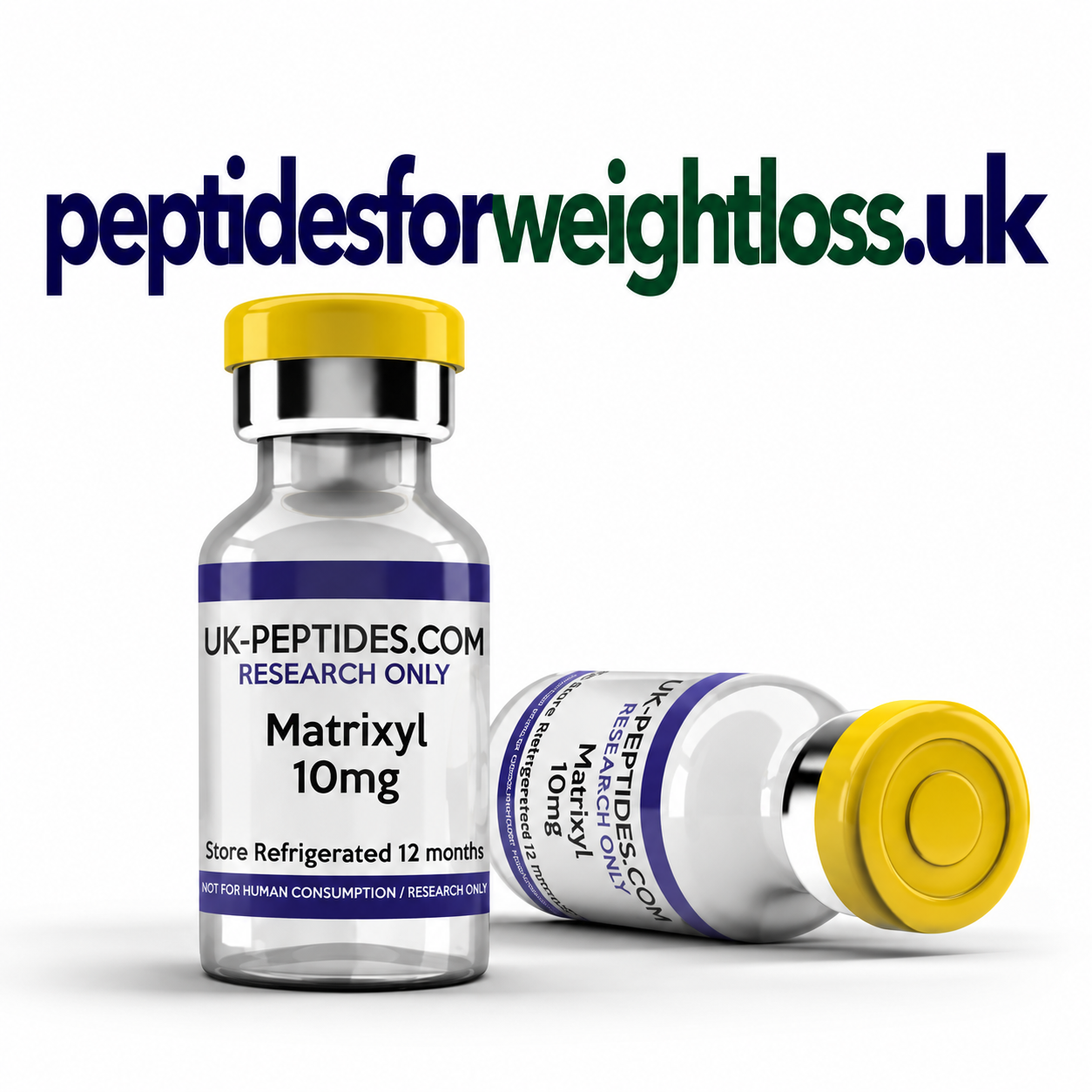
Matrixyl 10mg – Palmitoyl Pentapeptide-4 Collagen Research Peptide
Matrixyl 10mg is a cosmetic peptide research product associated with scientific investigations into skin biology, extracellular matrix signalling, collagen-related pathways and the appearance of photoaged skin. Matrixyl is the trade name associated with Palmitoyl Pentapeptide-4, a synthetic lipid-modified peptide also known as Pal-KTTKS.
Palmitoyl Pentapeptide-4 contains five amino acid residues arranged in the sequence Lys-Thr-Thr-Lys-Ser, abbreviated KTTKS. The peptide is chemically modified with a palmitoyl group attached to its N-terminus.
This structural modification produces a lipopeptide that has been investigated in topical cosmetic formulations. The underlying KTTKS sequence is associated with research into extracellular matrix signalling and collagen-related cellular responses.
Published studies have evaluated topical formulations containing Palmitoyl Pentapeptide-4 in relation to visible wrinkles, fine lines and photoaged skin. However, the results of studies involving finished cosmetic formulations do not establish equivalent effects for an isolated Matrixyl 10mg research preparation.
Matrixyl 10mg is intended for controlled laboratory research. Its exact chemical identity, purity, formulation and batch-specific specifications should be verified using manufacturer documentation.
What Is Matrixyl 10mg?
Matrixyl 10mg refers to a research product labelled as containing 10 milligrams of a compound identified as Matrixyl.
The original Matrixyl peptide is Palmitoyl Pentapeptide-4, a synthetic five-residue peptide modified with a fatty-acid-derived palmitoyl group.
The peptide portion contains the amino acids lysine, threonine, threonine, lysine and serine.
These residues are represented by the one-letter sequence KTTKS.
The N-terminal palmitoyl modification changes the physicochemical properties of the parent peptide.
Researchers investigate this structure in relation to peptide chemistry, skin penetration, fibroblast activity and extracellular matrix biology.
Matrixyl is not a growth hormone secretagogue, GLP-1 receptor agonist or established metabolic treatment.
Matrixyl 10mg Product Specifications
- Product Name: Matrixyl 10mg
- Scientific Name: Palmitoyl Pentapeptide-4
- Alternative Names: Pal-KTTKS, Palmitoyl-KTTKS, Palmitoyl Pentapeptide-3 (older designation)
- Classification: Synthetic palmitoylated pentapeptide
- Peptide Category: Cosmetic signal peptide / lipopeptide
- Peptide Length: 5 amino acid residues
- Parent Amino Acid Sequence: Lys-Thr-Thr-Lys-Ser
- One-Letter Sequence: KTTKS
- Modified Sequence: Pal-Lys-Thr-Thr-Lys-Ser-OH
- N-Terminal Modification: Palmitoylation
- C-Terminal Group: Free carboxyl group in the reference structure
- Reference Molecular Formula: C39H75N7O10
- Reference Molecular Weight: Approximately 802.1 g/mol
- Reference CAS Number: 214047-00-4
- Reference PubChem CID: 9897237
- INCI Name: Palmitoyl Pentapeptide-4
- Associated Trade Name: Matrixyl
- Primary Research Area: Skin and extracellular matrix biology
- Additional Research Areas: Collagen-related signalling, dermal fibroblasts and topical formulation research
- Labelled Quantity: 10mg
- Purity: Requires batch-specific verification
- Physical Presentation: Confirm with manufacturer
- Salt Form: Confirm with manufacturer
- Storage: Follow verified manufacturer instructions
- Intended Use: Laboratory and cosmetic ingredient research
These specifications describe the reference Palmitoyl Pentapeptide-4 molecule. Commercial materials sold under the Matrixyl name may include different formulations or ingredient blends. The supplied compound should therefore be verified before publication of product-specific purity, concentration or formulation claims.
Matrixyl Amino Acid Sequence and Molecular Structure
Matrixyl is based on a five-amino-acid sequence:
Lys-Thr-Thr-Lys-Ser
The one-letter amino acid sequence is:
KTTKS
The complete palmitoylated reference structure is represented as:
Pal-Lys-Thr-Thr-Lys-Ser-OH
The prefix Pal indicates a palmitoyl group attached to the N-terminal lysine residue.
This modification creates a molecule containing both a peptide region and a lipid-derived component.
Palmitoylation changes the molecule’s chemical properties compared with unmodified KTTKS.
The reference molecular formula of Palmitoyl Pentapeptide-4 is C39H75N7O10, with a molecular weight of approximately 802.1 g/mol.
Researchers should verify the N-terminal modification, peptide sequence, C-terminal chemistry and expected molecular mass when evaluating Matrixyl 10mg.
How Does Matrixyl Work?
Matrixyl is investigated as a cosmetic signal peptide associated with extracellular matrix biology.
The underlying KTTKS sequence is related to a fragment of type I procollagen.
Experimental research has examined whether this peptide sequence can influence the production of extracellular matrix components in dermal fibroblasts.
Palmitoylation modifies the peptide’s interaction with lipid-rich environments and is relevant to topical formulation research.
Published studies have examined Palmitoyl Pentapeptide-4 in cosmetic preparations intended to improve the appearance of photoaged skin.
However, the precise cellular effects depend on formulation, concentration, skin penetration and experimental conditions.
These findings do not establish that isolated Matrixyl 10mg has equivalent effects when used outside the tested topical formulations.
Scientific Research Into Matrixyl 10mg
1. Matrixyl 10mg and Collagen Research
Collagen is a major structural protein within the extracellular matrix.
Type I and type III collagen contribute to the organisation and mechanical properties of skin.
Research involving KTTKS-related peptides has investigated collagen-associated cellular responses.
However, changes in collagen-related laboratory measurements do not automatically establish visible improvements in human skin.
2. Matrixyl and Dermal Fibroblast Research
Dermal fibroblasts are cells involved in producing and maintaining components of the skin’s extracellular matrix.
Experimental studies have investigated how signal peptides influence fibroblast behaviour.
Palmitoyl Pentapeptide-4 has been studied in connection with collagen-related and matrix-associated responses.
However, the observed effects depend on the experimental system and formulation.
3. Matrixyl 10mg and Extracellular Matrix Biology
The extracellular matrix is a network of proteins and other molecules that provides structural support to tissues.
Its major components include collagen, elastin-associated structures, fibronectin and glycosaminoglycans.
Matrixyl-related research investigates signalling pathways associated with extracellular matrix maintenance.
These studies contribute to understanding skin biology and cosmetic ingredient development.
4. Matrixyl and KTTKS Peptide Research
KTTKS is a five-amino-acid sequence derived from a region of type I procollagen.
The sequence has been investigated as a potential signalling fragment associated with extracellular matrix production.
Matrixyl contains the same peptide sequence with an added N-terminal palmitoyl group.
However, the modified and unmodified molecules are chemically distinct.
5. Matrixyl 10mg and Palmitoylation Research
Palmitoylation is a chemical modification involving attachment of a palmitoyl group.
In Matrixyl, this modification occurs at the N-terminus of the KTTKS peptide.
The modification changes the molecule’s lipophilicity and interactions with biological environments.
Researchers investigate how these properties affect topical formulation behaviour.
6. Matrixyl and Skin Penetration Research
The skin’s outermost layer, the stratum corneum, acts as an important barrier.
Many peptides have limited penetration through intact skin.
Palmitoylation was introduced to modify the physicochemical properties of KTTKS.
However, the extent of skin penetration depends on the complete formulation and experimental conditions.
It should not be assumed that every Matrixyl preparation penetrates skin to the same extent.
7. Matrixyl 10mg and Photoaged Skin Research
Photoageing describes skin changes associated with cumulative ultraviolet exposure.
Visible features can include fine lines, wrinkles and changes in texture.
Topical Palmitoyl Pentapeptide-4 formulations have been investigated in studies involving photoaged facial skin.
Some controlled cosmetic studies reported improvements in selected wrinkle measurements.
However, these findings relate to the tested formulations and do not establish medical treatment of skin ageing.
8. Matrixyl and Fine Line Research
Fine lines are influenced by skin structure, hydration, elasticity and environmental exposure.
Cosmetic research has evaluated formulations containing Palmitoyl Pentapeptide-4 using visual grading and instrumental measurements.
Some studies reported improvements compared with control formulations.
However, results can vary according to formulation and study design.
9. Matrixyl 10mg and Wrinkle Appearance
Wrinkle appearance is influenced by several biological and environmental factors.
Published research has evaluated topical Matrixyl-containing products for changes in visible wrinkles.
These investigations support continued interest in cosmetic peptide research.
However, evidence from finished cosmetic products should not be treated as proof that an isolated research preparation produces the same outcome.
10. Matrixyl and Skin Texture Research
Skin texture is influenced by the condition of the epidermis, dermis and extracellular matrix.
Researchers use visual assessments and imaging methods to study changes in skin surface characteristics.
Matrixyl-containing topical formulations have been investigated in cosmetic research involving skin appearance.
However, the findings should be interpreted within the limitations of each study.
11. Matrixyl 10mg and Fibronectin Research
Fibronectin is an extracellular matrix glycoprotein involved in cellular adhesion and tissue organisation.
Peptide-related research has examined changes in fibronectin-associated measurements in experimental systems.
These studies help researchers understand how matrix-related signalling may influence skin biology.
However, such findings do not establish a clinical therapeutic effect.
12. Matrixyl and Glycosaminoglycan Research
Glycosaminoglycans are important components of the extracellular matrix.
They participate in tissue hydration and structural organisation.
Some experimental research involving cosmetic signal peptides has examined glycosaminoglycan-related responses.
However, these findings should not be interpreted as proof of improved skin hydration from every Matrixyl formulation.
13. Matrixyl 10mg and Cosmetic Formulation Research
Cosmetic formulation research examines how ingredients behave in creams, serums and other topical preparations.
Palmitoyl Pentapeptide-4 has been incorporated into formulations designed for skin appearance research.
Vehicle composition, concentration, stability and ingredient compatibility can influence experimental outcomes.
Researchers should not assume that an isolated 10mg preparation is equivalent to a finished cosmetic product.
14. Matrixyl and Peptide Analytical Chemistry
Analytical chemistry is important for identifying and characterising cosmetic peptides.
Techniques such as liquid chromatography and mass spectrometry can help confirm molecular identity and purity.
For Matrixyl, researchers should verify the palmitoyl modification, KTTKS sequence and expected molecular mass.
Batch-specific analytical documentation helps distinguish Palmitoyl Pentapeptide-4 from related peptides.
15. Matrixyl 10mg and Research Reproducibility
Reliable research requires consistent experimental materials and clearly documented formulations.
Commercial materials labelled Matrixyl may differ in concentration, vehicle composition or ingredient blend.
Researchers should verify whether the supplied material contains isolated Palmitoyl Pentapeptide-4 or a proprietary mixture.
Accurate documentation supports reproducibility and meaningful interpretation of results.
Matrixyl 10mg vs Palmitoyl Pentapeptide-4
The original Matrixyl trade name is associated with Palmitoyl Pentapeptide-4.
Palmitoyl Pentapeptide-4 is the scientific ingredient name, while Matrixyl is a commercial trade name.
When used to describe the same defined molecule, both names refer to Pal-KTTKS.
However, researchers should verify the actual ingredient identity rather than relying only on commercial naming.
Matrixyl 10mg vs KTTKS
Matrixyl and unmodified KTTKS are structurally related but chemically distinct.
KTTKS is the parent pentapeptide Lys-Thr-Thr-Lys-Ser.
Matrixyl contains an additional N-terminal palmitoyl group.
This modification changes the molecular formula, molecular weight and physicochemical properties.
Research findings involving one compound should not automatically be attributed to the other.
Matrixyl 10mg vs Matrixyl 3000
Matrixyl 3000 is a different proprietary cosmetic peptide blend.
It is commonly associated with Palmitoyl Tripeptide-1 and Palmitoyl Tetrapeptide-7.
Original Matrixyl is associated with Palmitoyl Pentapeptide-4.
These products differ in ingredient composition and should not be treated as interchangeable.
Matrixyl 10mg vs Matrixyl Synthe’6
Matrixyl Synthe’6 is a separate commercial cosmetic ingredient associated with Palmitoyl Tripeptide-38.
It differs from the original Matrixyl peptide in molecular structure and formulation.
Research findings involving Matrixyl Synthe’6 should not automatically be attributed to Palmitoyl Pentapeptide-4.
Matrixyl 10mg vs Copper Peptides
Matrixyl and copper peptides represent different categories of cosmetic peptide research materials.
Matrixyl is a palmitoylated pentapeptide associated with extracellular matrix signalling.
GHK-Cu is a copper complex of the tripeptide glycyl-L-histidyl-L-lysine.
Both have been investigated in skin-related research, but their molecular structures and proposed mechanisms differ.
Matrixyl 10mg and Collagen Production Claims
Laboratory studies have investigated KTTKS-related peptides in relation to extracellular matrix and collagen-associated responses.
However, collagen-related activity observed in cell culture does not establish that Matrixyl 10mg increases collagen production in human skin under all conditions.
Formulation, concentration, penetration and study design influence experimental outcomes.
Matrixyl 10mg and Anti-Ageing Claims
Topical cosmetic formulations containing Palmitoyl Pentapeptide-4 have been investigated for improvements in the appearance of photoaged skin.
However, improvements in wrinkle appearance should not be described as reversal of biological ageing.
There is no reliable evidence establishing that Matrixyl extends human lifespan or reverses systemic ageing.
Matrixyl 10mg and Weight-Loss Research
Matrixyl is not an established weight-loss peptide.
Its primary research applications concern skin biology and cosmetic formulation science.
There is insufficient reliable evidence demonstrating that Palmitoyl Pentapeptide-4 reduces body fat, suppresses appetite or treats obesity.
Matrixyl 10mg Research Quality and Documentation
Important considerations when evaluating Matrixyl 10mg include:
- Verification of Palmitoyl Pentapeptide-4 identity
- Confirmation of the complete KTTKS sequence
- Verification of N-terminal palmitoylation
- Confirmation of the C-terminal chemical form
- Verification of the expected molecular mass
- Identification of the supplied salt form
- Confirmation that the material is not Matrixyl 3000 or another blend
- Batch-specific certificate of analysis
- Suitable analytical purity testing
- Mass spectrometry or another appropriate identity method
- Assessment of synthesis-related impurities
- Confirmation of the labelled 10mg quantity
- Manufacturer and batch traceability
- Product-specific storage and stability documentation
- Clearly stated research-use classification
Storage and Handling of Matrixyl 10mg
Matrixyl 10mg should be stored according to verified manufacturer instructions.
Storage requirements depend on the supplied chemical form, formulation, packaging and stability characteristics.
Researchers should not assume that all Matrixyl preparations have identical shelf lives or storage requirements.
Laboratory handling should follow institutional procedures and product-specific safety documentation.
Matrixyl 10mg Safety and Scientific Limitations
Palmitoyl Pentapeptide-4 has been investigated as an ingredient in topical cosmetic formulations.
However, safety observations from finished topical products do not establish the safety of isolated research-grade material for other exposure routes.
Research-grade Matrixyl should not be assumed sterile, pharmaceutical grade or suitable for human injection.
Potential risks depend on formulation, concentration, impurities, exposure route and individual sensitivity.
The labelled 10mg quantity is not a recommended human dose or cosmetic formulation concentration.
Frequently Asked Questions About Matrixyl 10mg
What is Matrixyl 10mg?
Matrixyl 10mg is a research product designation for a labelled quantity of 10mg of a compound identified as Matrixyl, commonly Palmitoyl Pentapeptide-4.
What is the scientific name of Matrixyl?
The original Matrixyl peptide is known as Palmitoyl Pentapeptide-4.
What is another name for Matrixyl?
Matrixyl is also associated with Pal-KTTKS and the older designation Palmitoyl Pentapeptide-3.
How many amino acids does Matrixyl contain?
Matrixyl contains five amino acid residues.
What is the Matrixyl amino acid sequence?
The peptide sequence is KTTKS, with an N-terminal palmitoyl modification in the complete molecule.
What is the molecular formula of Matrixyl?
The reference molecular formula of Palmitoyl Pentapeptide-4 is C39H75N7O10.
What is the molecular weight of Matrixyl?
The reference molecular weight is approximately 802.1 g/mol.
What is the CAS number of Matrixyl?
The reference CAS number for Palmitoyl Pentapeptide-4 is 214047-00-4.
Is Matrixyl the same as Matrixyl 3000?
No. Matrixyl 3000 is a different proprietary cosmetic peptide blend.
Is Matrixyl a collagen peptide?
Matrixyl is a synthetic signal peptide based on a sequence associated with type I procollagen.
Has Matrixyl been studied for wrinkles?
Yes. Topical formulations containing Palmitoyl Pentapeptide-4 have been evaluated in cosmetic studies involving wrinkle appearance.
Does Matrixyl reverse skin ageing?
Cosmetic studies have examined improvements in skin appearance, but this does not establish reversal of biological ageing.
Does Matrixyl help with weight loss?
There is no established evidence demonstrating that Matrixyl produces meaningful weight loss.
Is Matrixyl suitable for injection?
Research-grade Matrixyl should not be assumed sterile or suitable for human injection.
What does Matrixyl 10mg mean?
The designation refers to a labelled quantity of 10mg of research material, not a recommended human dose or cosmetic concentration.
Matrixyl 10mg – Scientific Product Summary
Matrixyl 10mg is a cosmetic peptide research product associated with Palmitoyl Pentapeptide-4, a synthetic five-amino-acid peptide containing an N-terminal palmitoyl group.
Its reference sequence is Pal-Lys-Thr-Thr-Lys-Ser-OH, with a molecular formula of C39H75N7O10 and molecular weight of approximately 802.1 g/mol.
Published research has investigated Palmitoyl Pentapeptide-4 in relation to extracellular matrix signalling, collagen-associated responses and the appearance of photoaged skin in topical cosmetic formulations.
However, findings from finished topical formulations do not establish equivalent effects for isolated research-grade Matrixyl 10mg.
Researchers evaluating Matrixyl 10mg should verify chemical identity, palmitoylation, purity, formulation, labelled quantity and batch-specific analytical documentation.
Reviews
There are no reviews yet.