
Description
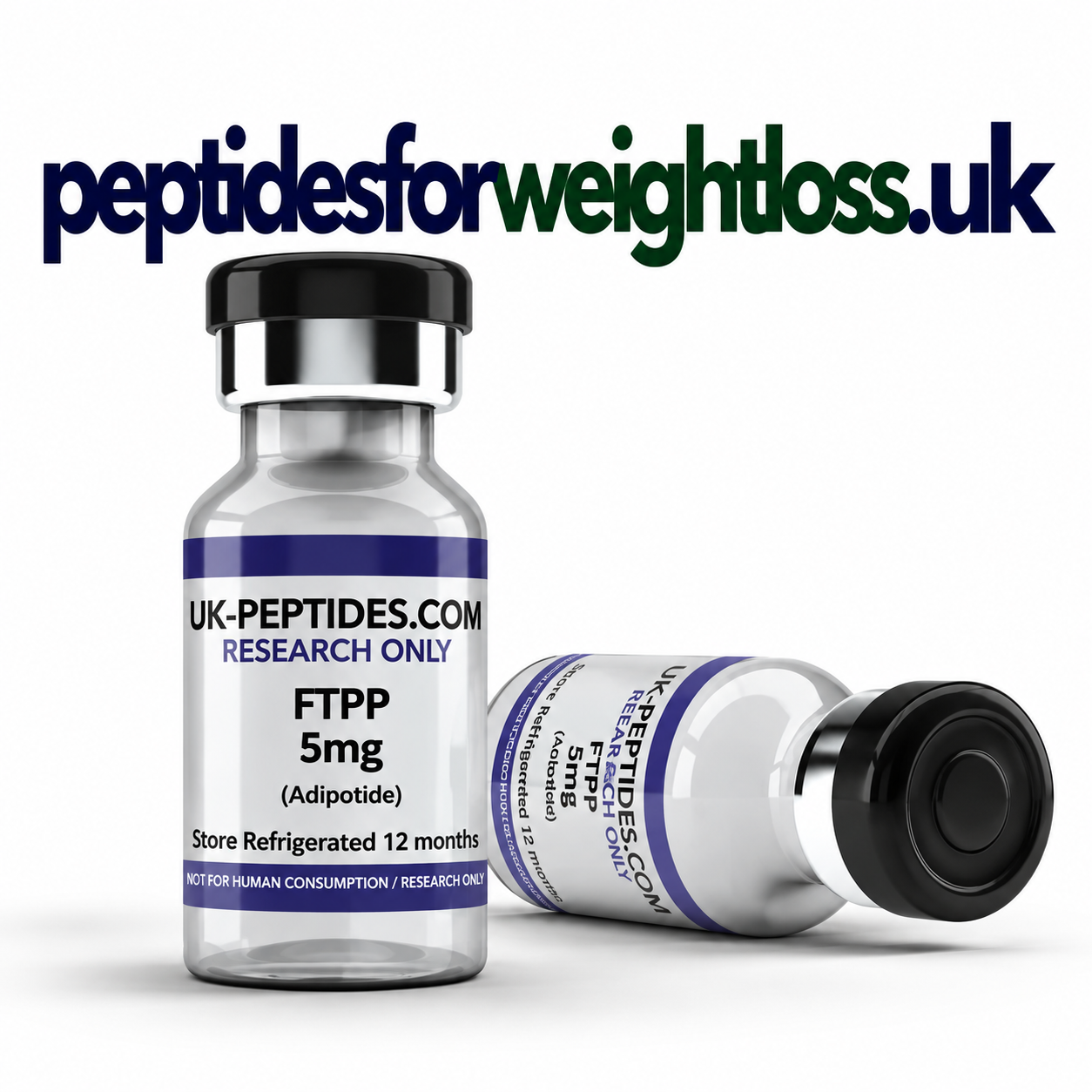
FTPP Adipotide 5mg – Fat-Targeted Proapoptotic Research Peptide
FTPP Adipotide 5mg is an experimental peptide research product associated with investigations into white adipose tissue vasculature, prohibitin-mediated targeting and programmed cell death. Also known as Adipotide or Fat-Targeted Proapoptotic Peptide, this compound was developed to study whether blood vessels supplying white adipose tissue could be selectively targeted in experimental obesity models.
Adipotide is a chimeric peptidomimetic consisting of a cyclic vascular-targeting sequence joined to a membrane-disrupting proapoptotic sequence. Its published structural notation is CKGGRAKDC-GG-D(KLAKLAK)2.
Research in mice and obese non-human primates demonstrated changes in white adipose tissue, body weight and selected metabolic measurements. However, the same investigations identified important safety concerns, particularly renal proximal tubular injury.
FTPP Adipotide 5mg is not an approved weight-loss medicine. Human therapeutic effectiveness, appropriate clinical use and long-term safety have not been established.
What Is FTPP Adipotide 5mg?
FTPP Adipotide 5mg refers to a research product labelled as containing 5 milligrams of the experimental compound Adipotide.
The abbreviation FTPP stands for Fat-Targeted Proapoptotic Peptide.
Adipotide was developed through research into the blood vessels supplying white adipose tissue.
White adipose tissue contains adipocytes, connective tissue, immune cells and an extensive vascular network.
Researchers investigated whether specific molecular markers on the vascular endothelium could be used to direct experimental compounds toward this tissue.
Adipotide combines a targeting component with a proapoptotic component designed to disrupt cellular survival after internalisation.
Its mechanism is fundamentally different from compounds that influence appetite, satiety or gastrointestinal hormone receptors.
FTPP Adipotide 5mg Product Specifications
- Product Name: FTPP Adipotide 5mg
- Scientific Name: Adipotide
- Alternative Names: FTPP, Fat-Targeted Proapoptotic Peptide, Prohibitin-Targeting Peptide
- Classification: Experimental chimeric peptidomimetic
- Research Category: Adipose tissue vascular biology
- Published Structural Notation: CKGGRAKDC-GG-D(KLAKLAK)2
- Targeting Domain: CKGGRAKDC
- Linker: Gly-Gly
- Proapoptotic Domain: D(KLAKLAK)2
- Total Residues: 25
- Targeting Domain Structure: Cyclic peptide with an intramolecular disulfide bond
- Proapoptotic Domain: Contains D-amino acid residues
- Associated Molecular Target: Prohibitin on adipose vascular endothelium
- Additional Research Context: Annexin A2 and vascular fatty acid transport
- Labelled Quantity: 5mg
- Research Focus: Targeted apoptosis and white adipose tissue vasculature
- Evidence Base: Preclinical laboratory and animal research
- Purity: Requires batch-specific verification
- Salt Form: Confirm with manufacturer
- Physical Presentation: Confirm with manufacturer
- Storage: Follow verified manufacturer instructions
- Intended Use: Laboratory research only
Commercial sources publish inconsistent molecular formulas, molecular weights and CAS identifiers for Adipotide. The complete peptide structure and batch-specific analytical documentation should be used to verify product identity rather than relying on an unconfirmed CAS number.
Understanding the Molecular Structure of Adipotide
Adipotide is a chimeric peptidomimetic containing two functionally distinct peptide regions connected by a short linker.
Its published structure is:
CKGGRAKDC-GG-D(KLAKLAK)2
The first region, CKGGRAKDC, is a nine-residue peptide associated with vascular targeting.
The two cysteine residues form an intramolecular disulfide bond, creating a cyclic targeting motif.
The second region contains a glycine-glycine linker connecting the targeting motif to a proapoptotic sequence.
The proapoptotic region is composed of D-amino acid residues and is represented by D(KLAKLAK)2.
The complete construct contains 25 amino acid residues.
The D-amino acid stereochemistry and disulfide connectivity are important for accurately identifying the published molecule.
How Does FTPP Adipotide Work?
Adipotide was designed to investigate targeted destruction of blood vessels supplying white adipose tissue.
The targeting domain recognises prohibitin associated with the surface of vascular endothelial cells in white adipose tissue.
Following receptor-associated internalisation, the proapoptotic domain can disrupt mitochondrial membranes and promote programmed cell death.
In experimental animal models, this process reduced the vascular supply supporting white adipose tissue.
Researchers subsequently observed reductions in adipose tissue mass.
However, tissue targeting was not sufficient to eliminate off-target toxicity.
Kidney injury was documented in non-human primate studies, demonstrating an important limitation of the experimental approach.
Scientific Research Into FTPP Adipotide 5mg
1. Adipotide and White Adipose Tissue Research
White adipose tissue stores energy and participates in endocrine and metabolic regulation.
Its vascular network supplies oxygen and nutrients to adipocytes and other resident cells.
Adipotide research investigated whether disrupting this vascular network could reduce adipose tissue mass in animal models.
These investigations contributed to understanding the relationship between adipose tissue biology and vascular function.
2. FTPP Adipotide and Prohibitin Research
Prohibitin is a protein involved in several cellular processes.
Researchers identified prohibitin-associated expression on the surface of endothelial cells within white adipose tissue.
The CKGGRAKDC peptide motif was developed to recognise this vascular target.
However, prohibitin also has important functions in other cellular compartments and tissues.
Targeting prohibitin-associated pathways therefore requires careful evaluation of specificity and toxicity.
3. Adipotide and Vascular Targeting
Vascular targeting involves directing experimental compounds toward molecular features associated with blood vessels.
Adipotide was developed as an example of ligand-directed vascular targeting.
Its targeting peptide was designed to recognise endothelial cells associated with white adipose tissue.
This strategy differs from conventional approaches that primarily influence food intake or energy absorption.
4. FTPP Adipotide and Apoptosis Research
Apoptosis is a regulated form of programmed cell death.
The proapoptotic domain of Adipotide was designed to disrupt mitochondrial membrane integrity following cellular internalisation.
Experimental studies investigated whether this mechanism could selectively affect targeted endothelial cells.
However, apoptosis-inducing compounds can also produce unintended tissue injury.
5. Adipotide and Mitochondrial Membrane Research
Mitochondria participate in cellular energy metabolism and several pathways regulating cell survival.
The D-amino-acid proapoptotic component of Adipotide was designed to disrupt mitochondrial membranes.
This activity contributes to its experimental cell-death mechanism.
However, mitochondrial membrane disruption is inherently capable of causing cellular injury.
6. FTPP Adipotide and Mouse Obesity Models
Early research evaluated Adipotide-related constructs in obese mouse models.
These experiments demonstrated that targeting the vasculature of white adipose tissue could reduce fat mass under selected experimental conditions.
The findings supported further investigation in larger animal models.
However, results from mice cannot establish safety or effectiveness in humans.
7. Adipotide and Non-Human Primate Research
A landmark study published in Science Translational Medicine in 2011 evaluated Adipotide in obese non-human primates.
The investigators reported reductions in body weight and white adipose tissue.
Magnetic resonance imaging and dual-energy X-ray absorptiometry were used to assess changes in body composition.
The study provided evidence that the vascular-targeting approach could influence adipose tissue in primate models.
However, these findings remain preclinical.
8. FTPP Adipotide and Insulin Resistance Research
Insulin resistance occurs when tissues respond less effectively to insulin signalling.
Obesity and adipose tissue dysfunction can contribute to insulin resistance.
In the 2011 non-human primate study, researchers reported improvements in selected insulin resistance measurements.
However, these observations do not establish that Adipotide is an effective treatment for diabetes or insulin resistance in humans.
9. Adipotide and Visceral Adipose Tissue
Visceral adipose tissue is located within the abdominal cavity around internal organs.
Excess visceral fat is associated with several metabolic risk factors.
Researchers used imaging techniques to evaluate adipose tissue changes in Adipotide-treated non-human primates.
The findings indicated reductions in white adipose tissue, including visceral fat.
However, these results cannot be translated into human weight-loss claims.
10. FTPP Adipotide and Renal Toxicity Research
Kidney toxicity is one of the most important findings in Adipotide research.
The 2011 primate study documented changes in renal proximal tubular function.
Histological examinations identified tubular degeneration and cellular injury.
Although some changes improved during recovery periods, the findings demonstrated clinically important safety concerns.
Reversibility in selected animal experiments does not establish safety in humans.
11. Adipotide and Renal Proximal Tubule Biology
The renal proximal tubule is responsible for reabsorbing many filtered substances.
Damage to proximal tubular cells can interfere with normal kidney function.
Adipotide research identified renal proximal tubular injury as an important adverse effect in non-human primates.
These findings are essential when evaluating the limitations of the compound.
12. FTPP Adipotide and Annexin A2 Research
Annexin A2 is a protein involved in several cellular and vascular processes.
Research has identified interactions between annexin A2 and prohibitin in white adipose tissue.
These interactions contribute to understanding vascular biology and fatty acid transport.
However, findings involving the annexin A2–prohibitin system should not be interpreted as evidence that Adipotide is safe for therapeutic use.
13. Adipotide and Fatty Acid Transport Research
Fatty acid transport is important in adipose tissue metabolism.
Experimental studies have examined interactions among prohibitin, annexin A2 and CD36 in fatty acid uptake.
These findings help explain aspects of adipose tissue vascular function.
However, they do not establish that disrupting these pathways is a safe treatment for obesity.
14. FTPP Adipotide and Translational Research
Translational research investigates whether findings from laboratory and animal studies can support the development of human treatments.
Adipotide demonstrates both the potential and limitations of experimental vascular-targeting strategies.
Although animal studies reported substantial biological effects, kidney toxicity created important safety concerns.
Human therapeutic effectiveness has not been established.
15. Adipotide and Research Reproducibility
Reliable Adipotide research requires accurate chemical identification.
Researchers should verify the cyclic targeting motif, glycine-glycine linker and D-amino-acid proapoptotic domain.
Differences in disulfide connectivity, stereochemistry, purity or formulation may affect experimental findings.
Batch-specific analytical documentation is therefore important.
FTPP Adipotide 5mg vs GLP-1 Research Compounds
Adipotide and GLP-1 receptor agonists act through fundamentally different biological mechanisms.
Adipotide was designed to target the vascular supply of white adipose tissue and induce apoptosis in experimental systems.
GLP-1 receptor agonists act through incretin-related signalling pathways and can influence appetite, glucose regulation and gastric emptying.
Evidence supporting approved GLP-1 medicines cannot be attributed to Adipotide.
FTPP Adipotide 5mg vs AOD-9604
Adipotide and AOD-9604 are distinct experimental compounds.
Adipotide is a chimeric peptidomimetic developed for adipose vascular targeting.
AOD-9604 is a modified peptide derived from a region of human growth hormone.
They have different molecular structures and proposed mechanisms.
Research findings involving either compound should not automatically be attributed to the other.
FTPP Adipotide 5mg vs HGH Fragment 176-191
Adipotide and HGH Fragment 176-191 are different research peptides.
Adipotide contains a vascular-targeting component and a proapoptotic component.
HGH Fragment 176-191 is derived from a portion of the human growth hormone sequence.
Their experimental mechanisms and evidence bases differ substantially.
FTPP Adipotide 5mg and Weight-Loss Claims
Adipotide has demonstrated reductions in body weight and adipose tissue in selected animal models.
However, these findings were accompanied by kidney toxicity.
There is no established evidence demonstrating that FTPP Adipotide 5mg safely produces weight loss in humans.
It should not be marketed as an approved or clinically proven fat-loss treatment.
FTPP Adipotide 5mg and Metabolic Research
Animal investigations have reported changes in insulin resistance and adipose tissue measurements.
However, the available evidence does not establish safe treatment of obesity, diabetes or metabolic syndrome in humans.
The potential consequences of damaging adipose tissue vasculature require careful scientific evaluation.
FTPP Adipotide 5mg Research Quality and Documentation
Important considerations when evaluating Adipotide research material include:
- Verification of the complete published peptide structure
- Confirmation of the cyclic CKGGRAKDC targeting motif
- Verification of the intramolecular disulfide bond
- Confirmation of the glycine-glycine linker
- Verification of the D-amino-acid proapoptotic domain
- Confirmation of the expected molecular mass
- Identification of the supplied salt form
- Batch-specific certificate of analysis
- Appropriate analytical purity testing
- Mass spectrometry or another suitable identity method
- Confirmation of the labelled 5mg quantity
- Assessment of synthesis-related impurities
- Manufacturer and batch traceability
- Product-specific storage and stability documentation
- Clearly stated laboratory research classification
Storage and Handling of FTPP Adipotide 5mg
FTPP Adipotide 5mg should be stored according to verified manufacturer instructions.
Storage requirements depend on formulation, salt form, packaging and stability characteristics.
Researchers should not assume that all Adipotide preparations have identical storage requirements or shelf lives.
Laboratory handling should follow institutional safety procedures and product-specific documentation.
FTPP Adipotide 5mg Safety and Scientific Limitations
Adipotide is an experimental proapoptotic compound with documented kidney toxicity in non-human primate studies.
The published research identified changes in renal proximal tubular function and histological evidence of kidney injury.
Although some renal changes improved after experimental exposure ended, these observations do not establish human safety.
Adipotide has not been established as an effective or approved human obesity treatment.
Human pharmacokinetics, long-term toxicity, therapeutic effectiveness and safe clinical exposure remain unestablished.
Research-grade Adipotide should not be assumed suitable for human administration.
The labelled 5mg quantity is not a recommended human dose.
Frequently Asked Questions About FTPP Adipotide 5mg
What is FTPP Adipotide 5mg?
FTPP Adipotide 5mg is a product designation for an experimental fat-targeted proapoptotic peptidomimetic with a labelled quantity of 5mg.
What does FTPP stand for?
FTPP stands for Fat-Targeted Proapoptotic Peptide.
What is another name for FTPP?
FTPP is also known as Adipotide or a prohibitin-targeting peptide.
What is the Adipotide peptide structure?
The published structural notation is CKGGRAKDC-GG-D(KLAKLAK)2.
How many amino acid residues does Adipotide contain?
The complete construct contains 25 amino acid residues.
What is the main research target of Adipotide?
The targeting domain recognises prohibitin associated with the vasculature of white adipose tissue.
How does Adipotide work in experimental models?
It was designed to direct a proapoptotic component toward vascular endothelial cells supplying white adipose tissue.
Has Adipotide been studied in monkeys?
Yes. A 2011 study evaluated Adipotide in obese non-human primates.
Did Adipotide cause weight loss in animal studies?
Selected mouse and non-human primate studies reported reductions in body weight and adipose tissue.
Does Adipotide damage the kidneys?
Kidney injury, including renal proximal tubular changes, was documented in non-human primate studies.
Is Adipotide the same as a GLP-1 medicine?
No. Adipotide has a different molecular structure and experimental mechanism.
Is Adipotide approved for human weight loss?
No. Adipotide is not an established approved human weight-loss medicine.
Is FTPP Adipotide safe for human use?
Human safety has not been established, and preclinical studies identified significant renal toxicity concerns.
What does FTPP Adipotide 5mg mean?
The designation refers to a labelled quantity of 5mg of research material, not a recommended human dose.
FTPP Adipotide 5mg – Scientific Product Summary
FTPP Adipotide 5mg is an experimental chimeric peptidomimetic investigated in research involving white adipose tissue vasculature, prohibitin targeting and programmed cell death.
Its published structure, CKGGRAKDC-GG-D(KLAKLAK)2, combines a cyclic vascular-targeting motif with a D-amino-acid proapoptotic domain.
Preclinical studies reported reductions in adipose tissue and selected metabolic measurements, but also documented renal proximal tubular injury.
Human therapeutic effectiveness and long-term safety remain unestablished.
Researchers evaluating FTPP Adipotide 5mg should verify chemical identity, stereochemistry, disulfide connectivity, purity, labelled quantity and batch-specific analytical documentation.

Reviews
There are no reviews yet.