
Description
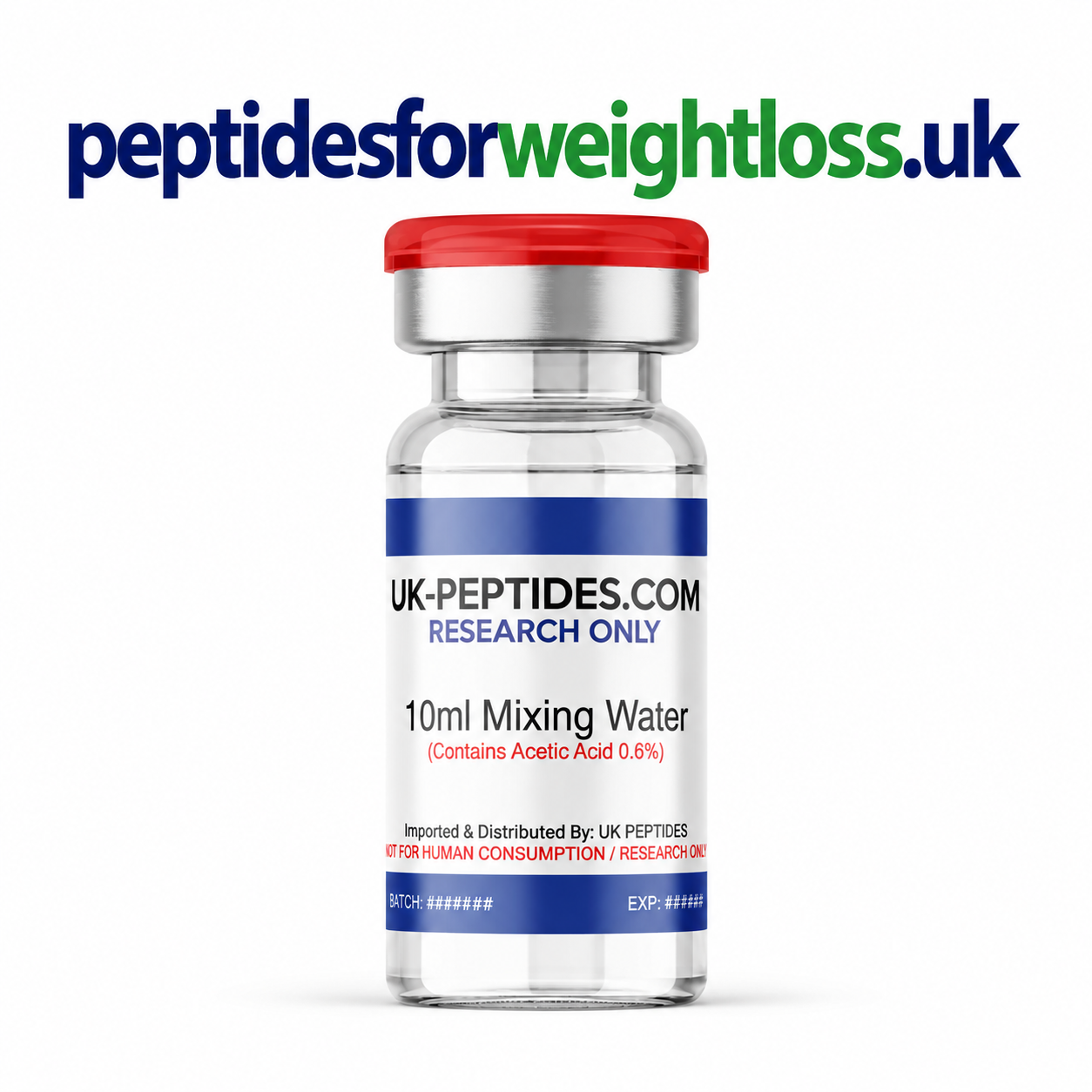
10ml Acetic Acid 0.6% – Laboratory Peptide Research Solvent
10ml Acetic Acid 0.6% is a dilute aqueous acetic acid solution associated with laboratory research, peptide solubility studies and analytical chemistry applications. Acetic acid, also known as ethanoic acid, is a weak organic acid commonly used in scientific laboratories for controlling solution acidity and investigating the behaviour of chemical compounds.
A 0.6% acetic acid solution provides an acidic environment that may be relevant to laboratory procedures involving selected peptides and other research materials. Its suitability depends on the chemical properties of the compound being studied and the requirements of the experimental protocol.
This 10ml Acetic Acid 0.6% product listing provides information about the solution’s chemical characteristics, research applications, compatibility considerations and laboratory handling requirements.
What Is Acetic Acid 0.6% Solution?
Acetic Acid 0.6% Solution is a diluted preparation of acetic acid in water. Acetic acid is a simple carboxylic acid with the molecular formula CH3COOH and a molecular weight of approximately 60.05 g/mol.
The 0.6% concentration describes the proportion of acetic acid in the solution. The exact meaning depends on whether the manufacturer specifies weight per volume (w/v), volume per volume (v/v) or another concentration convention.
Acetic acid is widely used in laboratory chemistry because its acidic properties can influence the charge, solubility and behaviour of molecules in aqueous environments.
Unlike bacteriostatic water, an ordinary acetic acid solution does not necessarily contain a preservative. Sterility and antimicrobial preservation must be verified separately.
10ml Acetic Acid 0.6% Product Specifications
- Product Name: 10ml Acetic Acid 0.6%
- Chemical Name: Acetic Acid / Ethanoic Acid
- Product Type: Dilute aqueous laboratory solution
- Labelled Volume: 10ml
- Labelled Concentration: 0.6% Acetic Acid
- Acetic Acid Formula: CH3COOH / C2H4O2
- Acetic Acid Molecular Weight: Approximately 60.05 g/mol
- Acetic Acid CAS Number: 64-19-7
- Research Category: Laboratory solvents and research solutions
- Research Applications: Peptide solubility investigations and acidic aqueous chemistry
- Exact Concentration Basis: Confirm whether w/v or v/v
- Sterility and Preservative Status: Requires manufacturer verification
- Storage: Follow verified manufacturer instructions
Understanding the Chemistry of Acetic Acid 0.6%
Acetic acid is classified as a weak acid because it partially dissociates into hydrogen ions and acetate ions in aqueous solution.
The extent of this dissociation depends on the solution’s concentration, temperature and surrounding chemical environment.
In peptide research, solution pH can influence the electrical charge of amino acid side chains and affect interactions between peptide molecules.
These changes may alter solubility, aggregation behaviour and stability, although the effects are highly dependent on the individual peptide.
Scientific and Laboratory Applications of 10ml Acetic Acid 0.6%
1. Peptide Solubility Research
One important application of dilute acetic acid solutions involves laboratory investigations of peptide solubility.
Some peptides have limited solubility in neutral aqueous environments because of their amino acid composition, molecular charge or tendency to aggregate.
Researchers may evaluate acidic solvents when investigating whether changes in pH influence the dissolution behaviour of a particular peptide.
However, Acetic Acid 0.6% is not a universal solvent for all peptides. Compatibility must be established using compound-specific solubility and stability information.
2. Acidic Aqueous Research Environments
Acetic acid solutions are useful in scientific experiments requiring an acidic aqueous environment.
The concentration of acetic acid contributes to the chemical conditions of the solution, which can affect molecular interactions and experimental measurements.
Researchers should distinguish the concentration of the acid from the measured pH of a finished experimental preparation.
3. Peptide Aggregation Studies
Peptide aggregation occurs when individual peptide molecules associate to form larger molecular assemblies.
Aggregation behaviour may be influenced by pH, ionic strength, concentration, temperature and peptide sequence.
Dilute acetic acid can be relevant to experiments investigating the relationship between solution acidity and peptide aggregation.
It should not be assumed that acidic conditions prevent aggregation in every peptide system.
4. Analytical Chemistry Research
Acetic acid is used in a range of analytical chemistry applications because it can influence solution acidity and molecular ionisation.
Acetic acid-containing aqueous mixtures may be relevant to selected analytical methods, depending on the instrument, separation technique and validated method.
A commercially supplied 0.6% solution should not automatically be described as chromatography-grade or mass-spectrometry-grade without appropriate quality documentation.
5. Peptide Stability Investigations
Peptide stability can depend strongly on environmental conditions, including pH.
Researchers may investigate acidic solutions to determine how particular peptides behave under different chemical conditions.
However, acidic environments can also accelerate degradation of certain compounds. Solubility and long-term stability are separate characteristics and must be evaluated independently.
Acetic Acid 0.6% vs Bacteriostatic Water
Acetic Acid 0.6% and bacteriostatic water are different laboratory solutions with different compositions and intended applications.
- Acetic Acid 0.6%: A dilute acidic solution that may be relevant to selected peptide solubility and laboratory chemistry studies.
- Bacteriostatic Water: A water-based pharmaceutical preparation containing an antimicrobial preservative, commonly benzyl alcohol, when supplied as a genuine approved product.
- Ordinary Laboratory Water: Water used in research, with quality specifications that depend on its grade and intended application.
These solutions are not universally interchangeable. Researchers should select materials according to verified chemical compatibility and applicable laboratory protocols.
Is Acetic Acid 0.6% Suitable for Every Peptide?
No. The appropriate solvent for a peptide depends on its molecular structure, solubility profile and stability requirements.
Some peptides may dissolve more readily under acidic conditions, while others may require neutral, buffered or alternative solvent systems.
Using an unsuitable solvent can lead to precipitation, aggregation or chemical degradation.
Researchers should consult peptide-specific technical documentation before selecting a solvent for laboratory experiments.
Understanding the 10ml Volume and 0.6% Concentration
The 10ml designation refers to the labelled volume of solution.
The 0.6% designation identifies the labelled concentration of acetic acid. It does not indicate peptide purity, sterility or pharmaceutical suitability.
For accurate chemical documentation, the manufacturer should specify whether the concentration is expressed as weight per volume, volume per volume or another measurement basis.
Product-specific analytical records should be used to verify the composition of the supplied solution.
Laboratory Quality and Product Documentation
Important considerations when evaluating 10ml Acetic Acid 0.6% include:
- Verified acetic acid concentration
- Clearly stated concentration basis
- Confirmed solvent composition
- Batch-specific product identification
- Manufacturer and batch traceability
- Appropriate analytical quality documentation
- Verified sterility status, if claimed
- Preservative information, if applicable
- Packaging integrity
- Manufacturer-specified storage conditions
- Product-specific expiry or stability information
These details help laboratories evaluate the suitability of a research solution without relying on unsupported quality claims.
Storage and Handling of Acetic Acid 0.6%
Acetic Acid 0.6% should be stored in accordance with verified manufacturer instructions and the product’s safety data sheet.
Storage requirements may vary according to container material, formulation, packaging and validated stability data.
Laboratory personnel should follow appropriate chemical handling procedures, including suitable eye protection and protective gloves where indicated by the risk assessment.
Do not use a solution if its packaging is damaged or if its appearance differs from the manufacturer’s stated specifications.
Safety and Intended-Use Information
Acetic Acid 0.6% is a dilute chemical solution. Although substantially less concentrated than glacial acetic acid, it remains acidic and may cause irritation under certain exposure conditions.
Its suitability for laboratory work depends on the formulation, material quality and applicable safety procedures.
A research-grade acetic acid solution must not be assumed suitable for injection, ingestion or other medical applications.
Claims such as sterile, pharmaceutical-grade, preservative-free or suitable for repeated vial access should only be made when supported by manufacturer documentation.
This product information is intended for scientific and educational purposes and does not provide medical advice or instructions for human administration.
Frequently Asked Questions About 10ml Acetic Acid 0.6%
What is 10ml Acetic Acid 0.6%?
It is a product listing for 10ml of dilute aqueous acetic acid solution with a labelled concentration of 0.6%.
What is Acetic Acid 0.6% used for?
It may be used in suitable laboratory applications involving acidic aqueous environments, peptide solubility investigations and selected chemical research procedures.
Is Acetic Acid 0.6% a peptide?
No. Acetic acid is a small organic acid, not a peptide or protein.
Can Acetic Acid 0.6% dissolve research peptides?
It may be suitable for selected peptides whose solubility is improved under acidic conditions. Compatibility must be verified for the specific compound.
Is Acetic Acid 0.6% the same as bacteriostatic water?
No. Acetic acid solution is acidic, while bacteriostatic water is a separate preparation containing an antimicrobial preservative.
Does Acetic Acid 0.6% contain benzyl alcohol?
Not necessarily. The presence or absence of benzyl alcohol must be confirmed from the actual product formulation.
Is Acetic Acid 0.6% sterile?
Sterility cannot be established from the concentration or product name alone. It requires appropriate manufacturer verification.
Does 0.6% describe purity?
No. The 0.6% designation refers to the labelled acid concentration, not an analytical purity percentage.
How should Acetic Acid 0.6% be stored?
Follow the verified manufacturer storage instructions and safety data sheet for the specific product.
Is this product suitable for human administration?
A laboratory research solution must not be assumed suitable for human or veterinary administration.
10ml Acetic Acid 0.6% – Product Summary
10ml Acetic Acid 0.6% is a dilute aqueous laboratory solution associated with peptide solubility research, acidic chemical environments and selected analytical applications.
Its usefulness depends on the compatibility of the research material and the conditions required by the laboratory protocol.
Before selecting Acetic Acid 0.6% for laboratory use, verify its concentration basis, solvent composition, analytical quality, packaging, storage conditions and intended-use classification.
Reviews
There are no reviews yet.