
Description
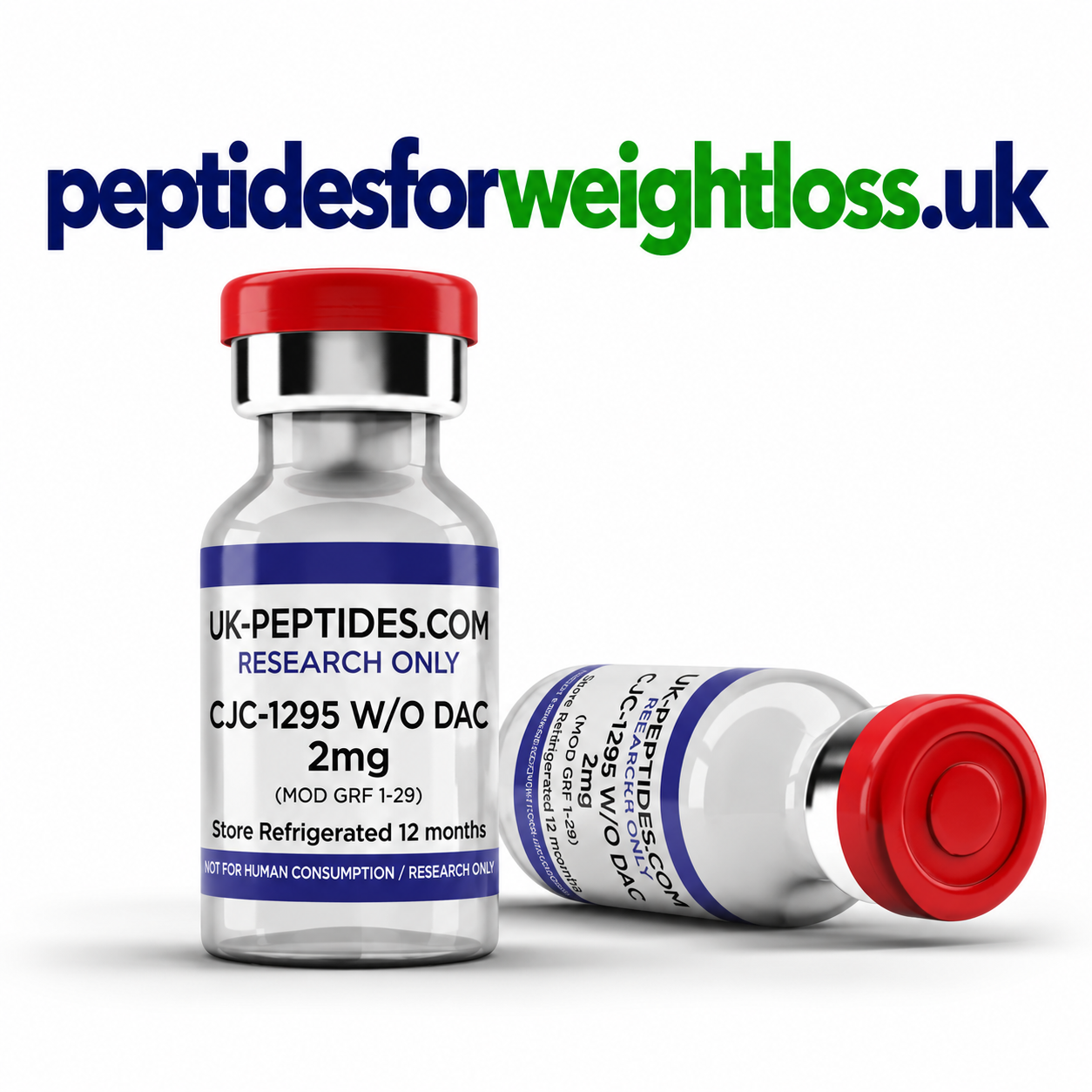
CJC-1295 Without DAC 2mg – Modified GRF 1-29 Research Peptide
CJC-1295 Without DAC 2mg, also known as Modified GRF (1-29) or Mod GRF 1-29, is a synthetic 29-amino-acid research peptide derived from the growth hormone-releasing hormone (GHRH) signalling family. It is investigated in relation to pituitary endocrine signalling, growth hormone receptor pathways and the molecular design of modified peptide hormones.
The peptide is a tetrasubstituted analogue of the first 29 amino acids of growth hormone-releasing hormone. Four amino acid modifications distinguish it from the corresponding naturally derived GHRH fragment.
Unlike CJC-1295 with DAC, Modified GRF 1-29 does not contain the additional albumin-binding drug affinity complex. This structural difference is essential when comparing chemical identity, experimental pharmacology and published research evidence.
Although related GHRH analogues have demonstrated growth hormone secretagogue activity in experimental settings, clinical safety, pharmacokinetics and therapeutic effectiveness have not been established for CJC-1295 without DAC as a distinct research compound.
What Is CJC-1295 Without DAC?
CJC-1295 without DAC is the commercial name commonly used for Modified Growth Hormone-Releasing Factor 1-29.
It is based on a 29-residue fragment of growth hormone-releasing hormone, a hypothalamic hormone involved in regulating growth hormone secretion from the anterior pituitary gland.
Modified GRF 1-29 differs from the unmodified fragment through four amino acid substitutions at positions 2, 8, 15 and 27.
These modifications were developed in peptide research to investigate molecular stability and biological activity.
The term without DAC indicates that the peptide does not include the albumin-binding modification associated with the original CJC-1295 DAC construct.
CJC-1295 Without DAC 2mg Product Specifications
- Product Name: CJC-1295 Without DAC 2mg
- Alternative Names: Modified GRF (1-29), Mod GRF 1-29, CJC-1295 No DAC
- Classification: Synthetic growth hormone-releasing hormone analogue
- Peptide Length: 29 amino acid residues
- Reference Molecular Formula: C152H252N44O42
- Approximate Molecular Weight: 3,367.9 g/mol
- Structural Modifications: D-Ala2, Gln8, Ala15 and Leu27
- C-Terminal Structure: Amidated
- DAC Modification: Absent
- Labelled Quantity: 2mg
- Research Category: GHRH analogue and endocrine signalling research
- Research Focus: GHRH receptor biology, pituitary signalling and peptide structure
- Purity: Requires batch-specific verification
- Salt Form: Requires manufacturer confirmation
- Physical Form: Requires manufacturer confirmation
- Storage: Follow verified manufacturer instructions
- Intended Use: Laboratory research only
The molecular formula and molecular weight describe the reference unconjugated peptide. Commercial preparations containing acetate, trifluoroacetate, water or other components may have different analytical characteristics.
Understanding the Modified GRF 1-29 Peptide Structure
Modified GRF 1-29 contains 29 amino acid residues and is based on the active N-terminal region of growth hormone-releasing hormone.
Four substitutions distinguish it from the unmodified GHRH(1-29) fragment:
- Position 2: D-alanine replaces L-alanine.
- Position 8: Glutamine replaces asparagine.
- Position 15: Alanine replaces glycine.
- Position 27: Leucine replaces methionine.
These substitutions are relevant to peptide identity, molecular stability and experimental receptor activity.
The molecule also has an amidated C-terminus, which is an important part of the reference chemical structure.
Researchers should confirm the full sequence and stereochemistry using suitable analytical documentation.
How Does Modified GRF 1-29 Work?
Modified GRF 1-29 is designed around the biological activity of growth hormone-releasing hormone.
GHRH acts through the growth hormone-releasing hormone receptor (GHRHR), a G-protein-coupled receptor expressed by pituitary somatotroph cells.
Activation of this receptor is associated with intracellular cyclic AMP signalling and the regulation of growth hormone secretion.
The structural relationship between Modified GRF 1-29 and GHRH provides the scientific rationale for investigating the modified peptide in endocrine research.
However, the exact human pharmacokinetic properties and clinical effects of the without-DAC compound have not been established through published controlled human studies.
Scientific Research Into CJC-1295 Without DAC
1. Growth Hormone-Releasing Hormone Research
Growth hormone-releasing hormone is a naturally occurring peptide involved in endocrine regulation.
It is released by the hypothalamus and interacts with receptors on pituitary somatotroph cells.
Research into GHRH and related analogues has helped scientists understand the mechanisms controlling growth hormone secretion.
Modified GRF 1-29 is relevant to this field because its molecular design preserves the core structure of the GHRH(1-29) fragment while introducing selected amino acid modifications.
Findings involving native GHRH or other analogues cannot automatically be treated as direct clinical evidence for Modified GRF 1-29.
2. GHRH Receptor Signalling
The GHRH receptor is involved in the regulation of growth hormone production and secretion.
Its activation stimulates intracellular signalling mechanisms that include cyclic AMP and protein kinase A.
These pathways influence the activity of pituitary somatotroph cells.
Modified GRF 1-29 is associated with research into how changes in peptide structure may affect receptor-associated biological activity.
Direct experimental measurements are required to establish the receptor activity of any specific preparation.
3. Peptide Stability Research
Peptide stability is an important consideration in biochemical research.
Natural peptides may undergo degradation through the activity of enzymes and other chemical processes.
Modified GRF 1-29 contains substitutions intended to alter properties of the parent GHRH fragment.
Researchers investigate how changes in amino acid composition and stereochemistry affect stability and biological activity.
However, molecular modifications alone do not establish a precise half-life in humans.
4. Pituitary Endocrine Research
The anterior pituitary gland produces several hormones involved in physiological regulation.
Growth hormone secretion is influenced by stimulatory and inhibitory signals, including GHRH and somatostatin.
GHRH analogues provide experimental models for studying the interaction between these regulatory systems.
Modified GRF 1-29 is relevant to this area because of its structural relationship to the endogenous GHRH signalling system.
However, direct human endocrine response data for the without-DAC form remain limited or unavailable.
5. Growth Hormone and IGF-1 Research
Growth hormone participates in the regulation of insulin-like growth factor 1, commonly abbreviated IGF-1.
The relationship between growth hormone and IGF-1 is an important subject in endocrinology.
Clinical studies involving the DAC-modified CJC-1295 compound reported increases in growth hormone and IGF-1 concentrations.
However, those results involved a chemically different molecule.
They cannot establish equivalent hormonal responses, exposure duration or safety for CJC-1295 without DAC.
6. Growth Hormone Secretagogue Research
Growth hormone secretagogues are compounds investigated for their ability to influence growth hormone secretion.
Some act through the GHRH receptor, while others interact with the ghrelin-associated growth hormone secretagogue receptor.
Modified GRF 1-29 belongs to the GHRH analogue category.
Peptides such as GHRP-2, GHRP-6 and ipamorelin are associated with a different receptor pathway.
These differences are important when comparing molecular mechanisms and interpreting experimental research.
7. Peptide Structure-Activity Research
Structure-activity relationship research examines how changes in molecular structure influence biological properties.
Modified GRF 1-29 is an example of a peptide containing selected substitutions relative to a naturally occurring hormone fragment.
The four substitutions can be studied in relation to chemical stability, receptor interaction and peptide characterisation.
Researchers may compare the modified sequence with the corresponding native GHRH fragment.
Such comparisons require properly characterised research materials and appropriate experimental controls.
8. Albumin-Binding Peptide Research
The distinction between CJC-1295 with DAC and without DAC is relevant to the study of peptide pharmacokinetics.
The DAC-modified form contains an additional chemical group designed to interact with circulating albumin.
Albumin binding can influence the distribution and persistence of certain molecules in biological systems.
Modified GRF 1-29 does not contain that additional albumin-binding structure.
Consequently, the two compounds should not be treated as chemically or pharmacokinetically interchangeable.
CJC-1295 With DAC vs Without DAC
CJC-1295 with DAC and CJC-1295 without DAC are structurally related but chemically distinct.
- Without DAC: A 29-residue peptide commonly known as Modified GRF 1-29.
- With DAC: A modified construct containing an additional albumin-binding group.
- Reference Molecular Weight Without DAC: Approximately 3,367.9 g/mol.
- Reference Molecular Weight With DAC: Approximately 3,647.2 g/mol.
- Albumin-Binding Modification: Absent from Modified GRF 1-29 and present in the DAC form.
- Human Clinical Evidence: Published human pharmacokinetic studies primarily concern the DAC-modified compound.
The long elimination half-life reported for CJC-1295 with DAC must not be attributed to the without-DAC form.
Modified GRF 1-29 vs Sermorelin
Sermorelin is a 29-amino-acid fragment of growth hormone-releasing hormone.
Modified GRF 1-29 is based on the same general fragment but contains four amino acid substitutions.
These structural differences produce distinct molecular identities.
Both compounds are associated with GHRH receptor research, but their experimental and clinical evidence should be evaluated separately.
CJC-1295 Without DAC vs Ipamorelin
Modified GRF 1-29 and ipamorelin are different synthetic research peptides.
Modified GRF 1-29 is a 29-amino-acid GHRH analogue.
Ipamorelin is a shorter synthetic peptide associated with growth hormone secretagogue receptor signalling.
They differ in molecular structure, receptor targets and research evidence.
Findings involving ipamorelin do not establish the clinical effects or safety of Modified GRF 1-29.
CJC-1295 Without DAC and Muscle Growth Research
Modified GRF 1-29 is sometimes discussed in relation to muscle growth because of its association with growth hormone signalling.
However, stimulation of a hormone pathway is not equivalent to demonstrated increases in muscle mass or strength.
There is insufficient reliable human clinical evidence establishing that CJC-1295 without DAC produces sustained muscle development, improved athletic performance or enhanced recovery.
Such claims should not be presented as proven product benefits.
CJC-1295 Without DAC and Weight Management
CJC-1295 without DAC is not an established weight-loss treatment.
Its primary research association is growth hormone-releasing hormone signalling.
There is insufficient clinical evidence that Modified GRF 1-29 reliably reduces body fat, suppresses appetite or treats obesity in humans.
Results from other growth hormone-related compounds should not be transferred to this peptide without direct supporting evidence.
Understanding the CJC-1295 Without DAC 2mg Label
The 2mg designation refers to the labelled quantity of research material.
It does not represent a recommended human dose or independently verify molecular identity, purity, sterility or biological activity.
Researchers should confirm the complete peptide sequence, salt form, analytical identity and batch-specific documentation.
Research Quality and Product Documentation
Important considerations when evaluating Modified GRF 1-29 research material include:
- Verification of the 29-residue peptide sequence
- Confirmation of D-alanine at position 2
- Verification of substitutions at positions 8, 15 and 27
- Confirmation of C-terminal amidation
- Verification that the DAC modification is absent
- Identification of the peptide salt form
- Batch-specific certificate of analysis
- Analytical purity testing using an appropriate method
- Mass spectrometry or another suitable identity test
- Accurate labelled peptide quantity
- Manufacturer and batch traceability
- Documentation of counterions and formulation components
- Verified packaging and storage specifications
- Clearly stated research-use classification
Storage and Handling of Modified GRF 1-29
CJC-1295 without DAC research material should be stored according to verified manufacturer instructions.
Storage requirements depend on the supplied salt form, physical state, formulation and packaging.
Researchers should not assume that all Modified GRF 1-29 products have identical storage conditions or stability characteristics.
Laboratory handling should follow applicable safety documentation and institutional procedures.
Safety and Scientific Limitations
Modified GRF 1-29 is an investigational peptide without an established human clinical safety profile.
Potential concerns include endocrine effects, changes in growth hormone and IGF-1 signalling, formulation-related impurities and unknown long-term consequences.
The published human evidence for CJC-1295 with DAC does not establish the safety or effectiveness of CJC-1295 without DAC.
Research-grade material must not be assumed suitable for human administration.
CJC-1295 without DAC is not an established approved treatment for muscle growth, weight management or other medical conditions in the United Kingdom.
This information is intended for scientific and educational purposes only and does not provide medical advice, human dosing recommendations or administration instructions.
Frequently Asked Questions About CJC-1295 Without DAC 2mg
What is CJC-1295 Without DAC 2mg?
It is a product listing for Modified GRF 1-29, a synthetic 29-amino-acid GHRH analogue with a labelled quantity of 2mg.
What is another name for CJC-1295 without DAC?
It is commonly called Modified GRF (1-29) or Mod GRF 1-29.
How many amino acids are in Modified GRF 1-29?
The reference peptide contains 29 amino acid residues.
What is the molecular weight of CJC-1295 without DAC?
The reference peptide has an approximate molecular weight of 3,367.9 g/mol.
What does without DAC mean?
It means the peptide lacks the albumin-binding drug affinity complex associated with CJC-1295 DAC.
Is CJC-1295 without DAC the same as CJC-1295 with DAC?
No. They are structurally related but chemically distinct molecules.
Is Modified GRF 1-29 the same as sermorelin?
No. Modified GRF 1-29 contains four amino acid substitutions relative to sermorelin.
What is CJC-1295 without DAC researched for?
It is associated with research into GHRH receptor signalling, peptide structure and endocrine regulation.
Does CJC-1295 without DAC increase muscle mass?
There is insufficient reliable clinical evidence establishing sustained muscle growth in humans.
Is CJC-1295 without DAC a weight-loss peptide?
No. It is not an established treatment for obesity or weight management.
What does the 2mg designation mean?
It refers to the labelled quantity of peptide material, not a recommended human dose.
CJC-1295 Without DAC 2mg – Product Summary
CJC-1295 Without DAC 2mg, also known as Modified GRF 1-29, is a synthetic 29-amino-acid research peptide derived from the GHRH signalling family.
Its four amino acid substitutions and absence of the albumin-binding DAC modification distinguish it from both native GHRH(1-29) and CJC-1295 with DAC.
Although it is relevant to endocrine and peptide structure research, direct human clinical evidence for the without-DAC form remains insufficient.
Researchers should verify the complete sequence, molecular identity, purity, salt form and batch-specific documentation before selecting this material for laboratory investigation.
Reviews
There are no reviews yet.