
Description
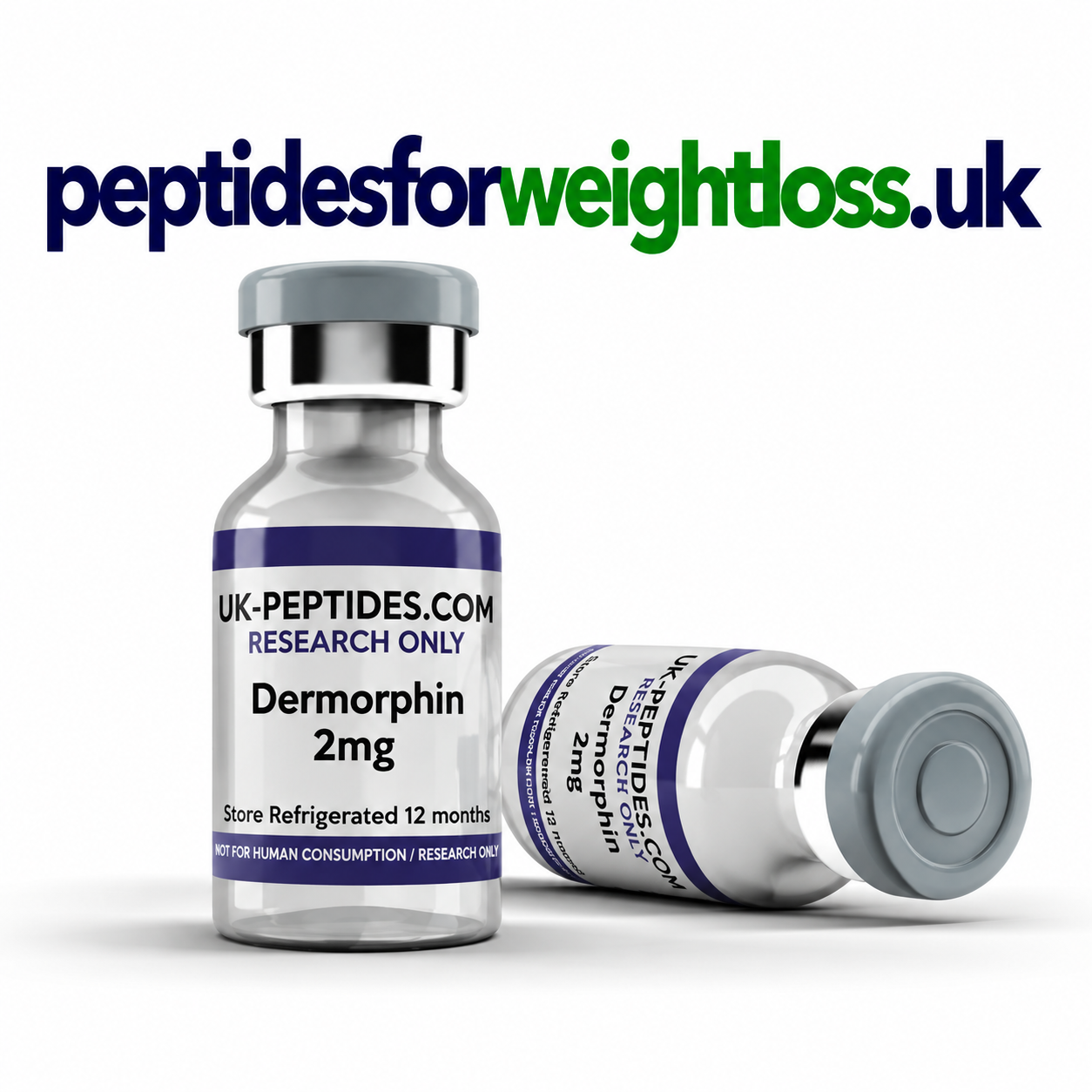
Dermorphin 2mg – Opioid Heptapeptide Research Information
Dermorphin is a naturally occurring opioid peptide originally identified in the skin secretions of certain South American tree frogs. It is a seven-amino-acid peptide, also called a heptapeptide, that has attracted scientific interest because of its high affinity for the mu-opioid receptor.
The Dermorphin 2mg designation refers to a labelled quantity of 2mg of research material. This label does not independently establish the identity, purity, sterility or suitability of a particular preparation.
Dermorphin has been investigated in opioid receptor pharmacology, peptide stereochemistry, receptor selectivity and experimental pain-signalling research. Its powerful opioid activity makes it fundamentally different from peptides studied primarily for endocrine or tissue-regulatory processes.
Dermorphin is not an established weight-loss treatment. It is also not an approved medicine for pain management or other therapeutic purposes in the United Kingdom.
What Is Dermorphin?
Dermorphin is a naturally occurring opioid heptapeptide first characterised through research involving the skin of the frog Phyllomedusa sauvagei.
The peptide contains seven amino acid residues and is notable for incorporating a D-alanine residue at its second position.
This stereochemical feature is unusual among naturally occurring vertebrate peptides and contributes to dermorphin’s distinctive biological properties.
Dermorphin has been investigated as a high-affinity agonist of the mu-opioid receptor, an important molecular target in opioid pharmacology.
Dermorphin Molecular Specifications
- Compound Name: Dermorphin
- Peptide Classification: Opioid heptapeptide
- Peptide Length: 7 amino acid residues
- Reference Sequence: Tyr-D-Ala-Phe-Gly-Tyr-Pro-Ser-NH2
- Reference Molecular Formula: C40H50N8O10
- Reference Molecular Weight: Approximately 802.9 g/mol
- CAS Number: 77614-16-5
- PubChem CID: 5485199
- Principal Research Target: Mu-opioid receptor (MOR)
- Labelled Quantity: 2mg
- Research Category: Opioid receptor pharmacology and peptide biochemistry
- Batch Purity: Requires independent verification
- Physical Form: Not verified
- Storage Requirements: Require manufacturer documentation
Understanding the Dermorphin Amino Acid Sequence
The reference amino acid sequence of dermorphin is:
H-Tyr-D-Ala-Phe-Gly-Tyr-Pro-Ser-NH2
The sequence includes tyrosine, D-alanine, phenylalanine, glycine, tyrosine, proline and serine.
The peptide contains a C-terminal amide group.
The D-alanine residue at position two is particularly important in research involving opioid receptor recognition and peptide stereochemistry.
Replacing or modifying amino acid residues can substantially change receptor affinity and biological activity.
Dermorphin and Mu-Opioid Receptor Research
The mu-opioid receptor is a G-protein-coupled receptor involved in the regulation of pain signalling and several other physiological processes.
Dermorphin has demonstrated high affinity and selectivity for this receptor in experimental studies.
Activation of mu-opioid receptors can alter neuronal signalling and reduce pain transmission, but it can also suppress breathing and produce other dangerous opioid effects.
Consequently, experimental opioid receptor activity should not be interpreted as evidence of clinical safety.
Scientific Research Involving Dermorphin
1. Opioid Receptor Selectivity
Researchers have investigated how dermorphin interacts with different opioid receptor subtypes.
Published binding studies demonstrate a preference for mu-opioid receptors over certain other opioid receptor subtypes.
These experiments have contributed to the understanding of receptor recognition and peptide structure-activity relationships.
2. Peptide Stereochemistry
Stereochemistry describes the three-dimensional arrangement of atoms within molecules.
Dermorphin contains a D-alanine residue, which differs in spatial configuration from the L-alanine normally incorporated into proteins.
This feature has been investigated for its influence on receptor interactions and peptide activity.
3. Experimental Pain-Signalling Research
Dermorphin has been studied in preclinical models of opioid-mediated pain signalling.
Researchers have examined its pharmacological properties and compared them with other opioid peptides.
However, preclinical antinociceptive activity does not establish an acceptable safety profile or support its use as a human pain treatment.
4. Opioid Peptide Structure-Activity Relationships
Scientific studies have examined how alterations to dermorphin’s amino acid sequence influence receptor affinity and selectivity.
These investigations help researchers understand the molecular features associated with opioid receptor recognition.
Findings involving modified dermorphin analogues should not automatically be attributed to the original peptide.
5. Amphibian Peptide Biology
Dermorphin is also relevant to the study of biologically active peptides found in amphibian skin.
Such peptides provide models for investigating naturally occurring molecular diversity and receptor interactions.
The original isolation and sequence characterisation of dermorphin were reported in 1981.
Dermorphin Safety and Toxicology
Dermorphin’s potent mu-opioid receptor activity presents significant safety concerns.
Potential opioid-related hazards include respiratory depression, sedation, impaired consciousness, nausea, dependence and overdose.
Combining opioid-active substances with alcohol, benzodiazepines or other central nervous system depressants can increase the risk of dangerous respiratory suppression.
There is no established safe human dosing regimen for dermorphin, and its clinical safety has not been adequately demonstrated.
A research-use label does not establish that a preparation is safe for human administration.
Dermorphin and Weight Management
Dermorphin is not an established treatment for obesity or weight management.
Its principal research applications concern opioid receptor pharmacology, peptide stereochemistry and experimental pain signalling.
There is no reliable clinical evidence supporting dermorphin for weight loss or metabolic improvement.
Research Material Verification
Scientific evaluation of a dermorphin preparation requires reliable information about molecular identity and material quality.
Relevant documentation includes:
- Confirmation of the complete seven-residue sequence
- Verification of D-alanine stereochemistry
- Confirmation of the C-terminal amide
- Mass spectrometry identity testing
- Appropriate analytical purity data
- Batch-specific certificate of analysis
- Information about counterions and impurities
- Verified labelled quantity
- Manufacturer traceability
- Product-specific stability documentation
These records are particularly important because the compound has potent opioid pharmacological activity.
Frequently Asked Questions About Dermorphin
What is dermorphin?
Dermorphin is a naturally occurring seven-amino-acid opioid peptide originally identified in amphibian skin.
What is the dermorphin amino acid sequence?
The reference sequence is Tyr-D-Ala-Phe-Gly-Tyr-Pro-Ser-NH2.
How many amino acids does dermorphin contain?
Dermorphin contains seven amino acid residues.
What is the molecular weight of dermorphin?
Its reference molecular weight is approximately 802.9 g/mol.
What is the CAS number for dermorphin?
The reference CAS number is 77614-16-5.
What receptor does dermorphin activate?
Dermorphin is a potent agonist of the mu-opioid receptor.
Why is D-alanine important in dermorphin?
The D-alanine residue influences peptide stereochemistry and contributes to the compound’s distinctive receptor-related properties.
Is dermorphin a weight-loss peptide?
No. Dermorphin is not an established weight-loss or obesity treatment.
Is dermorphin approved for medical use?
Dermorphin is not an established approved medicine for human therapeutic use in the United Kingdom.
What does Dermorphin 2mg mean?
It indicates a labelled quantity of 2mg of research material, not a recommended human dose.
Dermorphin – Scientific Summary
Dermorphin is a potent opioid heptapeptide with the sequence Tyr-D-Ala-Phe-Gly-Tyr-Pro-Ser-NH2.
It has contributed to scientific investigations involving mu-opioid receptor selectivity, peptide stereochemistry and experimental pain signalling.
Its potent opioid activity presents substantial safety concerns, and its effectiveness and safety for human therapeutic use have not been established.


Reviews
There are no reviews yet.