
Description
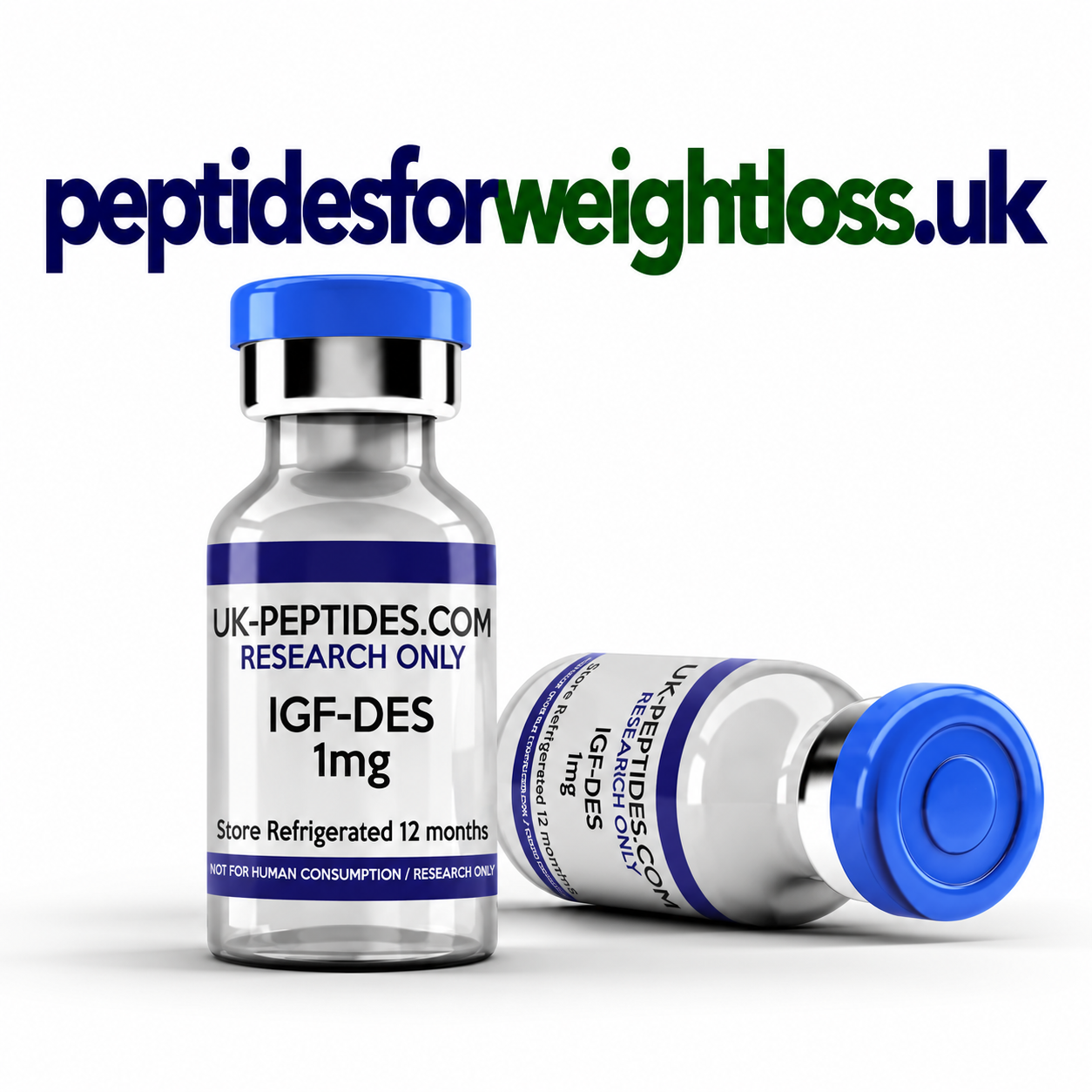
IGF1-DES 1mg – Des(1-3) IGF-1 Research Peptide
IGF1-DES 1mg is a research-grade product designation for des(1-3) insulin-like growth factor 1, a 67-amino-acid variant of human IGF-1. Also known as IGF-1 DES, des(1-3)IGF-I or truncated IGF-1, this molecule has been investigated in laboratory studies of growth factor signalling, insulin-like growth factor binding proteins, cellular proliferation and tissue metabolism.
IGF1-DES 1mg differs from mature human IGF-1 because its first three amino acids—glycine, proline and glutamic acid—are absent. This structural difference substantially reduces binding to several insulin-like growth factor binding proteins (IGFBPs), while retaining activity at the type 1 IGF receptor in experimental systems.
Published studies have investigated des(1-3)IGF-1 in cultured cells, isolated tissues and animal models. Researchers have reported changes in cell proliferation, protein metabolism and blood glucose regulation. However, these experimental findings do not establish that IGF1-DES 1mg safely improves muscle growth, athletic performance, fat loss or recovery in humans.
IGF1-DES 1mg is intended for appropriately controlled laboratory research. Its human therapeutic safety and effectiveness have not been established.
What Is IGF1-DES 1mg?
IGF1-DES 1mg refers to a product labelled as containing 1mg of des(1-3)IGF-1, a truncated form of insulin-like growth factor 1.
Mature human IGF-1 contains 70 amino acid residues. Removing the N-terminal Gly-Pro-Glu tripeptide produces the 67-residue molecule known as IGF-1 DES.
Unlike some entirely engineered IGF-1 analogues, des(1-3)IGF-1 has also been identified in biological tissues, including bovine colostrum, human brain and porcine uterus.
Researchers have investigated its molecular properties to understand how changes in the IGF-1 sequence affect interactions with binding proteins and receptors.
The name IGF1-DES does not indicate a distinct receptor or a clinically established treatment. It identifies a specific N-terminal truncation of the IGF-1 molecule.
IGF1-DES 1mg Product Specifications
- Product Name: IGF1-DES 1mg
- Scientific Name: Des(1-3) insulin-like growth factor 1
- Alternative Names: IGF-1 DES, des(1-3)IGF-I, truncated IGF-1
- Classification: IGF-1-derived research polypeptide
- Reference Sequence: TLCGAELVDALQFVCGDRGFYFNKPTGYGSSSRRAPQTGIVDECCFRSCDLRRLEMYCAPLKPAKSA
- Peptide Length: 67 amino acid residues
- Reference Molecular Formula: C319H495N91O96S7, for the three-disulfide oxidised form
- Reference Molecular Weight: Approximately 7,365.4 g/mol for the oxidised form
- Commonly Listed CAS Number: 112603-35-7
- Parent Molecule: Human insulin-like growth factor 1
- Structural Difference: Removal of Gly-Pro-Glu from the N-terminus
- Reference Disulfide Bonds: Three intramolecular disulfide bonds
- Primary Research Target: IGF-1 receptor signalling
- Labelled Quantity: 1mg
- Research Category: Growth factor biology and molecular endocrinology
- Purity: Requires batch-specific verification
- Production Method: Confirm with manufacturer
- Salt or Formulation: Confirm with manufacturer
- Storage: Follow verified manufacturer instructions
- Intended Use: Laboratory research only
The molecular formula and molecular weight refer to a specified oxidised reference structure. Reduced forms, counterions and other formulation components may alter the measured mass. Batch-specific analytical documentation is necessary to confirm the supplied material.
Understanding the Molecular Structure of IGF-1 DES
IGF-1 DES is a 67-residue polypeptide derived from mature human IGF-1.
Its reference sequence is:
TLCGAELVDALQFVCGDRGFYFNKPTGYGSSSRRAPQTGIVDECCFRSCDLRRLEMYCAPLKPAKSA
The parent IGF-1 molecule contains 70 amino acids and is stabilised by three intramolecular disulfide bonds.
Removal of the first three residues changes the molecule’s N-terminal region without removing its core cysteine framework.
This structural change is important because the N-terminal region contributes to interactions between IGF-1 and its binding proteins.
Researchers should verify the complete sequence, molecular mass and disulfide-bonded structure when characterising IGF1-DES 1mg.
How Does IGF1-DES Work?
IGF1-DES acts through the insulin-like growth factor signalling system in experimental models.
The type 1 insulin-like growth factor receptor, abbreviated IGF-1R, is a receptor tyrosine kinase involved in cellular growth, survival and metabolic signalling.
Binding of IGF-related ligands to IGF-1R can activate intracellular signalling pathways, including PI3K-AKT and MAPK-related pathways.
IGF-1 DES retains the ability to interact with the IGF-1 receptor while displaying substantially reduced affinity for several IGF-binding proteins.
Because binding proteins influence the availability of IGF-1, reduced binding can produce different biological responses in experimental systems.
However, these findings do not establish predictable tissue-specific activity or therapeutic safety in humans.
Scientific Research Into IGF1-DES 1mg
1. IGF1-DES 1mg and IGF-1 Receptor Research
The IGF-1 receptor is involved in regulating cell growth, survival and metabolic responses.
Researchers have investigated how des(1-3)IGF-1 interacts with this receptor compared with full-length IGF-1.
Binding studies indicate that removal of the first three amino acids markedly alters IGF-binding-protein interactions without eliminating IGF-1 receptor activity.
These findings make IGF1-DES 1mg relevant to investigations of receptor specificity and growth factor bioavailability.
2. IGF1-DES and IGF-Binding Protein Research
Insulin-like growth factor binding proteins regulate the distribution and availability of IGF-1 and IGF-2.
They can influence how much growth factor remains accessible to cellular receptors.
Des(1-3)IGF-1 has substantially reduced binding affinity for several IGFBPs compared with native IGF-1.
This property is one of the principal reasons the truncated molecule has been investigated in laboratory research.
However, reduced binding to IGFBPs should not be interpreted as proof of improved human clinical outcomes.
3. IGF1-DES 1mg and Cellular Proliferation
Cellular proliferation is the process through which cells grow and divide.
IGF-1 receptor signalling contributes to proliferation in several cell types.
Early studies reported that des(1-3)IGF-1 could produce stronger proliferation responses than full-length IGF-1 in selected cultured-cell systems.
The magnitude of the difference depended on the presence and activity of IGF-binding proteins.
These observations concern experimental cell biology and do not establish safe tissue growth in humans.
4. IGF1-DES and Protein Synthesis Research
Protein synthesis is essential for cellular maintenance, tissue growth and repair.
IGF-related signalling pathways participate in the regulation of protein metabolism.
Researchers have examined des(1-3)IGF-1 in cell and animal models involving protein synthesis and protein breakdown.
Selected studies reported changes in protein metabolism under experimental conditions.
However, these findings do not establish that IGF1-DES 1mg safely increases human muscle mass.
5. IGF1-DES 1mg and Skeletal Muscle Research
Skeletal muscle is regulated by mechanical loading, nutrition, endocrine signalling and local growth factors.
IGF-1 receptor pathways have been investigated in muscle cell development and adaptation.
Des(1-3)IGF-1 has been used in experimental studies involving myoblasts and muscle-related cellular processes.
These investigations are relevant to understanding growth factor signalling.
However, cell culture and animal observations cannot establish clinically meaningful improvements in muscle size or strength in humans.
6. IGF1-DES and PI3K-AKT Signalling
The PI3K-AKT pathway is involved in cellular metabolism, growth and survival.
IGF-1 receptor activation can influence this signalling network.
Researchers studying IGF1-DES may examine downstream phosphorylation and related molecular markers.
However, pathway activation is not equivalent to demonstrating a beneficial therapeutic effect.
7. IGF1-DES 1mg and MAPK Signalling
The MAPK signalling network participates in cellular proliferation, differentiation and responses to external signals.
IGF-1 receptor activity can influence MAPK-related pathways.
Des(1-3)IGF-1 is relevant to research investigating how altered ligand availability affects these responses.
However, cellular signalling outcomes depend on tissue type, receptor expression and experimental conditions.
8. IGF1-DES and Tissue Growth Research
Growth factors influence tissue development and maintenance through complex regulatory mechanisms.
Des(1-3)IGF-1 has been investigated in animal studies examining growth-related responses in selected tissues.
A 1996 scientific review discussed experimental findings involving intestinal tissues.
However, these results do not establish a safe treatment for tissue injury, inflammatory bowel disease or other human conditions.
9. IGF1-DES 1mg and Intestinal Research
The intestinal lining undergoes continuous cellular renewal.
Growth factor signalling participates in maintaining this tissue.
Animal research involving des(1-3)IGF-1 has investigated intestinal growth and related biological responses.
These studies contribute to understanding tissue-specific growth factor activity.
However, they do not establish therapeutic effectiveness in human gastrointestinal disease.
10. IGF1-DES and Blood Glucose Research
IGF-related signalling can influence glucose metabolism.
Des(1-3)IGF-1 has been studied in animal experiments examining changes in blood glucose.
A study involving pigs and marmoset monkeys reported stronger glucose-lowering responses with certain IGF-1 variants, including des(1-3)IGF-1, compared with native IGF-1.
These findings are scientifically important because excessive reductions in blood glucose can be dangerous.
They do not establish safe treatment of diabetes or other metabolic conditions.
11. IGF1-DES 1mg and Hypoglycaemia Research
Hypoglycaemia refers to abnormally low blood glucose.
Severe hypoglycaemia can cause confusion, seizures, loss of consciousness and other serious complications.
Animal research indicates that des(1-3)IGF-1 can produce substantial glucose-lowering effects.
Consequently, potential hypoglycaemia is an important safety concern when interpreting the compound’s biological activity.
Its effects in humans have not been adequately characterised.
12. IGF1-DES and Growth Factor Bioavailability
Bioavailability describes the amount of a substance accessible to its biological targets.
IGF-binding proteins influence growth factor availability and distribution.
Because des(1-3)IGF-1 binds less strongly to several IGFBPs, its experimental activity can differ from full-length IGF-1.
However, reduced binding-protein affinity does not guarantee selective localisation in muscle or any other tissue.
13. IGF1-DES 1mg and Protein Structure Research
Protein structure influences receptor interactions, stability and biological function.
IGF-1 DES retains a compact protein fold supported by three disulfide bonds.
Researchers may examine how removal of the N-terminal tripeptide changes binding behaviour.
Such investigations contribute to understanding the relationship between amino acid sequence and molecular function.
14. IGF1-DES and Molecular Endocrinology
Molecular endocrinology examines the interactions between hormones, receptors and intracellular signalling pathways.
IGF1-DES is relevant to investigations of growth factor regulation and receptor activity.
Researchers can compare its biochemical behaviour with native IGF-1 and other structurally modified variants.
However, differences in laboratory potency should not be interpreted as proof of improved clinical effectiveness.
15. IGF1-DES 1mg and Research Reproducibility
Reliable research requires accurately identified experimental materials.
Differences in peptide sequence, disulfide bonding, purity, aggregation and formulation may affect experimental results.
IGF1-DES 1mg should therefore be characterised using suitable analytical methods and batch-specific documentation.
Researchers should also distinguish des(1-3)IGF-1 from full-length IGF-1 and other modified analogues.
IGF1-DES 1mg vs Full-Length IGF-1
IGF1-DES and full-length IGF-1 are closely related but chemically distinct molecules.
- IGF1-DES: Contains 67 amino acid residues.
- Full-Length IGF-1: Contains 70 amino acid residues.
- Structural Difference: IGF1-DES lacks the N-terminal Gly-Pro-Glu sequence.
- Binding Proteins: IGF1-DES has reduced affinity for several IGF-binding proteins.
- Research Activity: Selected cell studies report stronger responses with IGF1-DES under particular experimental conditions.
- Clinical Interpretation: Laboratory potency differences do not establish improved safety or therapeutic effectiveness.
IGF1-DES 1mg vs IGF-1 LR3
IGF1-DES and IGF-1 LR3 are different IGF-1-related research molecules.
IGF1-DES is a 67-amino-acid truncated form of IGF-1.
IGF-1 LR3 is an engineered analogue containing an N-terminal extension and an amino acid substitution.
Both have been investigated for altered interactions with IGF-binding proteins.
However, their molecular structures and experimental pharmacology differ.
Findings involving IGF-1 LR3 cannot automatically establish the activity or safety of IGF1-DES 1mg.
IGF1-DES 1mg vs Mecasermin
Mecasermin is a pharmaceutical form of recombinant human IGF-1 used for specific approved medical indications.
IGF1-DES is a truncated research variant with a different molecular sequence.
The existence of an approved IGF-1 medicine does not establish that IGF1-DES is approved or suitable for human administration.
Clinical evidence and prescribing information for mecasermin should not be applied to unapproved IGF1-DES preparations.
IGF1-DES 1mg and Muscle Growth Claims
IGF1-DES 1mg is sometimes discussed online in connection with muscle growth and recovery.
However, there is insufficient reliable human clinical evidence demonstrating that the compound safely increases muscle mass, strength or athletic performance.
Laboratory findings involving cell proliferation and protein metabolism cannot establish these outcomes in humans.
IGF1-DES 1mg and Weight Management
IGF1-DES 1mg is not an established treatment for obesity or weight loss.
Although IGF-related signalling participates in metabolic regulation, the compound has not been shown to safely produce clinically meaningful fat reduction in humans.
Its glucose-lowering activity in animal models is a potential safety concern rather than evidence of a beneficial weight-loss effect.
IGF1-DES 1mg Research Quality and Documentation
Important considerations when evaluating IGF1-DES 1mg include:
- Verification of the complete 67-amino-acid sequence
- Confirmation that the N-terminal Gly-Pro-Glu residues are absent
- Verification of the three intramolecular disulfide bonds
- Confirmation of the expected molecular mass
- Assessment of oxidation and aggregation
- Batch-specific certificate of analysis
- Appropriate analytical purity testing
- Mass spectrometry or another suitable identity method
- Confirmation of the labelled 1mg quantity
- Assessment of protein-related impurities
- Verification of the production method
- Manufacturer and batch traceability
- Documentation of formulation components
- Product-specific storage and stability information
- Clearly stated research-use classification
Storage and Handling of IGF1-DES 1mg
IGF1-DES 1mg should be stored according to verified manufacturer instructions.
Stability depends on the material’s formulation, physical presentation, temperature exposure and packaging.
Researchers should not assume that all IGF1-DES preparations have identical storage requirements or shelf lives.
Appropriate laboratory handling should follow institutional procedures and product-specific safety documentation.
IGF1-DES 1mg Safety and Scientific Limitations
IGF1-DES 1mg is an investigational research material without an established human clinical safety profile.
Published animal studies indicate that des(1-3)IGF-1 can cause substantial reductions in blood glucose.
Potential safety concerns include hypoglycaemia, unintended growth factor signalling and unknown long-term effects.
Because IGF-1 receptor signalling is involved in cell growth and survival, unintended effects on proliferating tissues also require careful investigation.
There is insufficient reliable evidence demonstrating safe and effective use for muscle growth, recovery, obesity or anti-ageing in humans.
IGF1-DES is not an established approved UK medicine for these purposes.
Research-grade material should not be assumed suitable for human administration.
The labelled 1mg quantity is not a human dosing recommendation.
Frequently Asked Questions About IGF1-DES 1mg
What is IGF1-DES 1mg?
IGF1-DES 1mg is a product listing for des(1-3) insulin-like growth factor 1, a 67-amino-acid research polypeptide, with a labelled quantity of 1mg.
What does DES mean in IGF1-DES?
DES refers to the deletion of the first three amino acid residues from mature IGF-1.
How many amino acids does IGF1-DES contain?
IGF1-DES contains 67 amino acid residues.
What is the IGF1-DES peptide sequence?
The reference sequence is TLCGAELVDALQFVCGDRGFYFNKPTGYGSSSRRAPQTGIVDECCFRSCDLRRLEMYCAPLKPAKSA.
What is the molecular weight of IGF1-DES?
The calculated molecular weight is approximately 7,365.4 g/mol for the oxidised three-disulfide reference structure.
What is the CAS number for IGF1-DES?
A commonly listed CAS number is 112603-35-7.
Is IGF1-DES the same as IGF-1 LR3?
No. IGF1-DES is a truncated form of IGF-1, while IGF-1 LR3 is a different engineered analogue.
Does IGF1-DES bind to IGF-binding proteins?
It has substantially reduced affinity for several IGF-binding proteins compared with full-length IGF-1.
Does IGF1-DES stimulate cell growth?
Selected laboratory studies reported enhanced cellular growth responses, but these results do not establish safe tissue growth in humans.
Does IGF1-DES lower blood glucose?
Animal studies reported significant glucose-lowering activity. Human safety and response patterns remain insufficiently characterised.
Does IGF1-DES build muscle?
There is insufficient reliable human clinical evidence demonstrating safe increases in muscle mass or strength.
Is IGF1-DES a weight-loss peptide?
No. IGF1-DES is not an established obesity or weight-management treatment.
Is IGF1-DES approved for human use?
IGF1-DES is not an established approved UK medicine for muscle growth, weight loss or anti-ageing.
What does IGF1-DES 1mg mean?
The designation refers to a labelled quantity of 1mg of research material, not a recommended human dose.
IGF1-DES 1mg – Scientific Product Summary
IGF1-DES 1mg is a research polypeptide corresponding to des(1-3) insulin-like growth factor 1, a 67-amino-acid variant of mature human IGF-1.
Its defining feature is the absence of the N-terminal Gly-Pro-Glu sequence, which substantially reduces binding to several IGF-binding proteins while preserving IGF-1 receptor activity in experimental systems.
Published research has examined the molecule in relation to cell proliferation, protein metabolism, tissue growth and blood glucose regulation.
However, human therapeutic effectiveness and long-term safety remain insufficiently established.
Researchers evaluating IGF1-DES 1mg should verify molecular identity, disulfide bonding, purity, formulation, labelled quantity and batch-specific analytical documentation.
Reviews
There are no reviews yet.