
Description
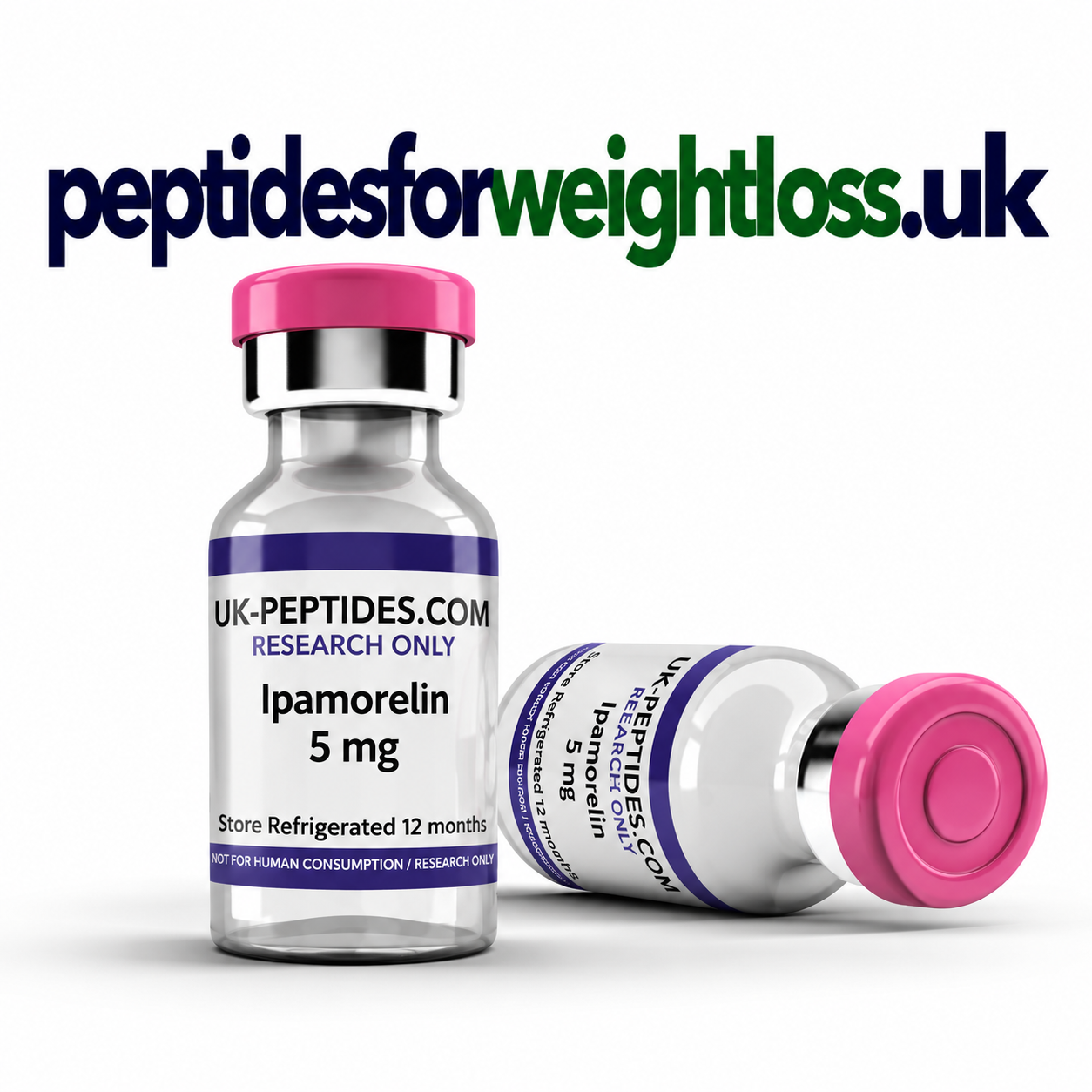
Ipamorelin 5mg – Growth Hormone Secretagogue Research Peptide
Ipamorelin 5mg is a synthetic pentapeptide research compound investigated for its activity at the growth hormone secretagogue receptor, also known as the ghrelin receptor or GHSR. The peptide is identified by the development code NNC 26-0161 and is studied in research involving growth hormone signalling, receptor activation, neuroendocrine physiology and gastrointestinal function.
Ipamorelin contains five amino acid residues, including non-standard amino acids and residues with defined D-stereochemistry. Its reference sequence is Aib-His-D-2-Nal-D-Phe-Lys-NH2.
In experimental studies, ipamorelin has demonstrated growth hormone-releasing activity through activation of the ghrelin receptor. This mechanism differs from the direct action of growth hormone and from growth hormone-releasing hormone (GHRH) receptor agonists.
Ipamorelin 5mg is intended for laboratory research. Although its pharmacological activity has been investigated in preclinical and limited clinical studies, its long-term human safety and effectiveness for muscle growth, fat loss, anti-ageing or general wellness have not been established.
What Is Ipamorelin 5mg?
Ipamorelin 5mg refers to a research product labelled as containing 5 milligrams of the synthetic growth hormone secretagogue ipamorelin.
Ipamorelin is a short peptide consisting of five residues and a C-terminal amide group.
It was developed as a synthetic agonist of the growth hormone secretagogue receptor.
This receptor is also activated by ghrelin, a naturally occurring hormone involved in several physiological processes.
Research involving ipamorelin has examined growth hormone release, receptor selectivity, gastrointestinal motility and neuroendocrine responses.
However, evidence of receptor activity does not establish that a commercial Ipamorelin 5mg preparation is safe or effective for human treatment.
Ipamorelin 5mg Product Specifications
- Product Name: Ipamorelin 5mg
- Scientific Name: Ipamorelin
- Development Code: NNC 26-0161
- Classification: Synthetic growth hormone secretagogue peptide
- Peptide Type: Pentapeptide
- Peptide Length: 5 amino acid residues
- Reference Sequence: H-Aib-His-D-2-Nal-D-Phe-Lys-NH2
- C-Terminal Modification: Amidation
- Reference Molecular Formula: C38H49N9O5
- Reference Molecular Weight: Approximately 711.9 g/mol
- Free-Base CAS Number: 170851-70-4
- Reference PubChem CID: 9831659
- Primary Molecular Target: Growth hormone secretagogue receptor (GHSR)
- Alternative Receptor Name: Ghrelin receptor, GHS-R1a
- Research Category: Growth hormone secretagogue research
- Primary Research Focus: GHSR activation and growth hormone signalling
- Additional Research Areas: Neuroendocrine signalling and gastrointestinal motility
- Labelled Quantity: 5mg
- Salt Form: Confirm with manufacturer
- Purity: Requires batch-specific verification
- Physical Presentation: Confirm with manufacturer
- Storage: Follow verified manufacturer instructions
- Intended Use: Laboratory research only
The molecular formula, molecular weight and CAS number above refer to ipamorelin free base. Ipamorelin acetate is a different chemical presentation, and its total formula mass depends on acetate content. Researchers should confirm the supplied chemical form before interpreting product specifications.
Ipamorelin Amino Acid Sequence and Molecular Structure
Ipamorelin is a synthetic pentapeptide with the reference sequence:
H-Aib-His-D-2-Nal-D-Phe-Lys-NH2
The sequence contains five residues:
- Aib: Alpha-aminoisobutyric acid, a non-standard amino acid
- His: L-histidine
- D-2-Nal: D-2-naphthylalanine
- D-Phe: D-phenylalanine
- Lys: L-lysine
The C-terminal lysine is amidated.
These structural characteristics are important for receptor binding and pharmacological activity.
The presence of D-amino acid residues means that the peptide’s stereochemistry must be verified during analytical characterisation.
Compounds with similar molecular masses but different stereochemistry may have different biological properties.
How Does Ipamorelin Work?
Ipamorelin acts as an agonist at the growth hormone secretagogue receptor, GHSR.
GHSR is a G-protein-coupled receptor expressed in several regions of the central nervous system and in peripheral tissues.
Activation of this receptor can influence intracellular signalling pathways involved in neuroendocrine function.
In experimental studies, ipamorelin has been shown to stimulate growth hormone release through receptor-mediated mechanisms.
The resulting response depends on biological context, experimental conditions and receptor function.
However, stimulation of growth hormone release is not equivalent to demonstrated improvements in muscle mass, fat loss, physical performance or healthy ageing.
Scientific Research Into Ipamorelin 5mg
1. Ipamorelin 5mg and Growth Hormone Signalling
Growth hormone is a peptide hormone released by the anterior pituitary gland.
Its secretion is regulated by several hormonal and neural signals.
Ipamorelin has been investigated as a synthetic compound capable of stimulating growth hormone release through GHSR activation.
Early pharmacological studies reported growth hormone-releasing activity in experimental models.
However, changes in hormone concentrations do not establish clinical benefits for body composition or metabolic health.
2. Ipamorelin and Ghrelin Receptor Research
The ghrelin receptor, also called GHSR, is a G-protein-coupled receptor involved in several physiological processes.
Its endogenous ligand is ghrelin.
Ipamorelin is a synthetic agonist of this receptor.
Researchers investigate receptor binding, intracellular signalling and physiological responses to understand the pharmacology of growth hormone secretagogues.
3. Ipamorelin 5mg and GHS-R1a Activation
GHS-R1a is the functional receptor isoform associated with ghrelin signalling.
Activation can influence phospholipase-associated pathways and intracellular calcium signalling.
Experimental investigations use GHSR agonists to study receptor activation and downstream responses.
However, receptor activation does not establish safe or effective human use.
4. Ipamorelin and Pituitary Research
The pituitary gland is an important component of the endocrine system.
Growth hormone secretion is influenced by hypothalamic and peripheral signalling pathways.
Ipamorelin has been investigated for its capacity to stimulate pituitary growth hormone release.
These findings contribute to research on neuroendocrine regulation.
5. Ipamorelin 5mg and Hormone Selectivity
Early studies characterised ipamorelin as a relatively selective growth hormone secretagogue under the experimental conditions investigated.
Researchers compared its hormonal effects with those of other growth hormone-releasing peptides.
However, selectivity in a particular study does not establish the absence of off-target effects or long-term safety.
6. Ipamorelin and Gastrointestinal Motility
The ghrelin receptor is involved in gastrointestinal physiology.
Ipamorelin has been investigated in research involving gastric and intestinal motility.
Animal experiments have examined its effects on intestinal transit and postoperative gastrointestinal dysfunction.
However, the available evidence does not establish an approved therapeutic use for ipamorelin in gastrointestinal disorders.
7. Ipamorelin 5mg and Postoperative Ileus Research
Postoperative ileus refers to impaired gastrointestinal motility following surgery.
Ipamorelin has been evaluated experimentally in relation to this condition.
Clinical and preclinical investigations have explored whether GHSR activation can influence gastrointestinal recovery.
However, ipamorelin has not become an established approved treatment for postoperative ileus.
8. Ipamorelin and Neuroendocrine Research
Neuroendocrine systems coordinate interactions between the nervous system and hormone-producing tissues.
Ghrelin-related signalling participates in several neuroendocrine processes.
Ipamorelin research contributes to understanding how synthetic receptor agonists influence these pathways.
However, results from controlled experimental settings should not be interpreted as general wellness benefits.
9. Ipamorelin 5mg and IGF-1 Research
Insulin-like growth factor 1, commonly called IGF-1, participates in growth-related endocrine signalling.
Growth hormone can influence IGF-1 production through physiological pathways.
Researchers examine relationships among growth hormone, IGF-1 and growth hormone secretagogues.
However, an increase in growth hormone does not guarantee a specific IGF-1 response or beneficial clinical outcome.
10. Ipamorelin and Metabolic Research
Growth hormone and ghrelin signalling interact with metabolic regulation.
Researchers have investigated growth hormone secretagogues in relation to energy balance, substrate metabolism and endocrine physiology.
However, the metabolic effects of GHSR activation can be complex.
Ipamorelin should not be described as a proven fat-burning or weight-loss treatment.
11. Ipamorelin 5mg and Appetite Research
Ghrelin is involved in appetite-related signalling.
Because ipamorelin activates GHSR, its pharmacology is relevant to investigations of feeding behaviour.
Some animal research has reported increased food intake and body weight under particular experimental conditions.
These observations reinforce the importance of distinguishing receptor pharmacology from marketing claims about weight loss.
12. Ipamorelin and Receptor Selectivity Research
Receptor selectivity is important when evaluating experimental signalling compounds.
Ipamorelin has been studied as a relatively selective growth hormone secretagogue.
However, selectivity depends on the receptors and experimental endpoints examined.
Researchers should not assume that selective growth hormone release eliminates other physiological effects.
13. Ipamorelin 5mg and Peptide Stereochemistry
Ipamorelin contains both standard and non-standard amino acid residues.
The D-stereochemistry of selected residues is essential to its defined molecular identity.
Researchers should confirm that analytical documentation supports the expected sequence and stereochemical composition.
Mass spectrometry alone may not distinguish every stereochemical isomer.
14. Ipamorelin and Analytical Chemistry
Peptide characterisation may involve chromatography, mass spectrometry and other analytical techniques.
For ipamorelin, important considerations include molecular identity, chemical form, purity and peptide-related impurities.
Researchers should distinguish ipamorelin free base from ipamorelin acetate when reviewing supplier specifications.
15. Ipamorelin 5mg and Research Reproducibility
Reliable research requires accurately characterised materials.
Ipamorelin preparations may differ in salt form, purity, water content and formulation.
Batch-specific analytical documentation helps establish the identity and composition of a supplied research material.
Researchers should verify the labelled 5mg quantity and whether it refers to total material mass or the ipamorelin active moiety.
Ipamorelin 5mg vs Ipamorelin 2mg
Ipamorelin 5mg and Ipamorelin 2mg refer to different labelled quantities of the same peptide, provided that both preparations contain the same chemical form.
The difference in labelled quantity does not change the peptide’s molecular sequence or receptor target.
A larger labelled quantity does not establish greater effectiveness or a recommended human dose.
Researchers should compare purity, chemical form, formulation and batch-specific documentation.
Ipamorelin 5mg vs GHRP-2
Ipamorelin and GHRP-2 are synthetic growth hormone secretagogues.
Both have been investigated for their ability to stimulate growth hormone release through GHSR-related mechanisms.
However, their molecular structures and pharmacological profiles differ.
Experimental results involving GHRP-2 should not automatically be attributed to ipamorelin.
Ipamorelin 5mg vs GHRP-6
GHRP-6 is another synthetic growth hormone secretagogue peptide.
It differs from ipamorelin in amino acid sequence and experimental pharmacology.
Research has investigated differences among growth hormone secretagogues in hormone responses and receptor-mediated effects.
These findings do not establish that one compound is clinically safer or more effective for general wellness.
Ipamorelin 5mg vs Sermorelin
Ipamorelin and sermorelin act through different receptor systems.
Ipamorelin is a GHSR agonist.
Sermorelin is an analogue of growth hormone-releasing hormone and acts through the GHRH receptor.
Both are relevant to growth hormone research, but their molecular targets and signalling pathways differ.
Ipamorelin 5mg vs CJC-1295
CJC-1295 is a synthetic peptide analogue associated with GHRH receptor signalling.
Ipamorelin acts through the growth hormone secretagogue receptor.
These compounds are not interchangeable and have different molecular structures.
Claims about combining them require direct evidence of safety and effectiveness rather than assumptions based on their individual receptor mechanisms.
Ipamorelin 5mg and Weight-Loss Claims
Ipamorelin is sometimes discussed in connection with body composition and fat metabolism because it can stimulate growth hormone release in experimental settings.
However, this does not establish that ipamorelin safely produces meaningful fat loss in humans.
Ghrelin receptor activation may also influence appetite and gastrointestinal physiology.
There is insufficient reliable clinical evidence to market Ipamorelin 5mg as a proven weight-loss treatment.
Ipamorelin 5mg and Muscle Growth Claims
Growth hormone participates in growth and metabolic regulation.
However, stimulation of growth hormone release does not establish that ipamorelin increases muscle strength or produces clinically meaningful muscle growth in healthy adults.
Such outcomes require controlled human studies with appropriate functional measurements.
Ipamorelin 5mg and Anti-Ageing Research
Growth hormone signalling has been investigated in ageing biology.
However, there is no reliable clinical evidence demonstrating that ipamorelin reverses human ageing or extends lifespan.
Hormonal changes should not be equated with demonstrated improvements in long-term health.
Ipamorelin 5mg Research Quality and Documentation
Important considerations when evaluating Ipamorelin 5mg include:
- Verification of the complete five-residue peptide sequence
- Confirmation of the Aib residue
- Verification of D-2-naphthylalanine stereochemistry
- Verification of D-phenylalanine stereochemistry
- Confirmation of C-terminal amidation
- Verification of the expected molecular mass
- Identification of free-base or acetate form
- Batch-specific certificate of analysis
- Suitable analytical purity testing
- Assessment of synthesis-related impurities
- Confirmation of the labelled 5mg quantity
- Manufacturer and batch traceability
- Product-specific storage and stability information
- Clearly stated laboratory research classification
Storage and Handling of Ipamorelin 5mg
Ipamorelin 5mg should be stored according to verified manufacturer instructions.
Stability depends on chemical form, formulation, packaging, temperature and environmental conditions.
Researchers should not assume that all ipamorelin preparations have identical storage requirements or shelf lives.
Laboratory handling should follow institutional procedures and product-specific safety documentation.
Ipamorelin 5mg Safety and Scientific Limitations
Ipamorelin is an investigational growth hormone secretagogue without an established long-term human safety profile for weight loss, muscle growth or anti-ageing purposes.
Its effects on growth hormone signalling and other physiological processes require appropriate evaluation.
Potential concerns include endocrine effects, glucose-related changes, gastrointestinal responses and uncertainties associated with formulation or impurities.
Clinical and preclinical research has not established the safety of routine use for general wellness or body composition enhancement.
Research-grade material should not be assumed sterile, pharmaceutical grade or suitable for human administration.
The labelled 5mg quantity is not a recommended human dose.
Frequently Asked Questions About Ipamorelin 5mg
What is Ipamorelin 5mg?
Ipamorelin 5mg is a research product designation for a synthetic growth hormone secretagogue pentapeptide with a labelled quantity of 5mg.
What is another name for ipamorelin?
Ipamorelin is also identified by the development code NNC 26-0161.
How many amino acids does ipamorelin contain?
Ipamorelin contains five amino acid residues.
What is the ipamorelin peptide sequence?
The reference sequence is H-Aib-His-D-2-Nal-D-Phe-Lys-NH2.
What is the molecular formula of ipamorelin?
The reference molecular formula of ipamorelin free base is C38H49N9O5.
What is the molecular weight of ipamorelin?
Ipamorelin free base has a reference molecular weight of approximately 711.9 g/mol.
What is the CAS number of ipamorelin?
The reference CAS number for ipamorelin free base is 170851-70-4.
Is ipamorelin the same as ipamorelin acetate?
No. Ipamorelin acetate is a salt form containing acetate counterions. Its total chemical composition differs from the free-base reference form.
Which receptor does ipamorelin activate?
Ipamorelin activates the growth hormone secretagogue receptor, also known as the ghrelin receptor or GHSR.
Does ipamorelin stimulate growth hormone release?
Experimental studies have demonstrated growth hormone-releasing activity through GHSR activation.
Is ipamorelin the same as growth hormone?
No. Ipamorelin is a synthetic secretagogue that acts through a receptor pathway associated with growth hormone release.
Does ipamorelin cause weight loss?
There is insufficient reliable clinical evidence establishing that ipamorelin safely produces meaningful weight loss in humans.
Does ipamorelin build muscle?
Controlled clinical evidence has not established that ipamorelin produces clinically meaningful muscle growth or strength improvements in healthy adults.
Is ipamorelin approved for human weight management?
Ipamorelin is not an established approved medicine for human weight management.
What does Ipamorelin 5mg mean?
The designation refers to a labelled quantity of 5mg of research material, not a recommended human dose.
Ipamorelin 5mg – Scientific Product Summary
Ipamorelin 5mg is a synthetic pentapeptide research compound investigated for its activity at the growth hormone secretagogue receptor.
Its reference sequence is H-Aib-His-D-2-Nal-D-Phe-Lys-NH2, with a molecular formula of C38H49N9O5 and molecular weight of approximately 711.9 g/mol for the free-base form.
Published research has investigated ipamorelin in relation to growth hormone signalling, ghrelin receptor pharmacology and gastrointestinal motility.
However, long-term human safety and effectiveness for weight loss, muscle growth, anti-ageing or general wellness have not been established.
Researchers evaluating Ipamorelin 5mg should verify chemical identity, stereochemistry, salt form, purity, labelled quantity and batch-specific analytical documentation.

Reviews
There are no reviews yet.