
Description
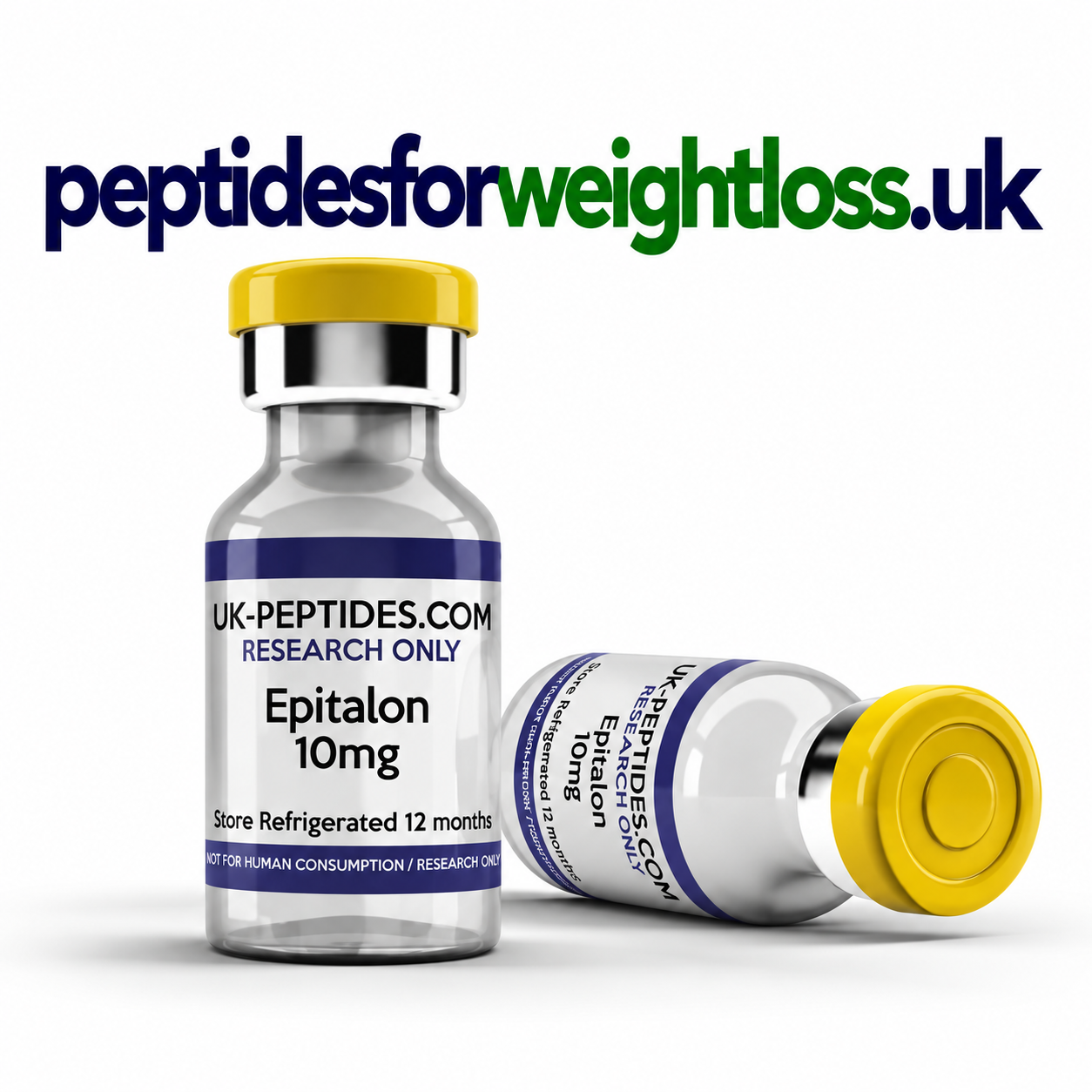
Epitalon 10mg – AEDG Tetrapeptide for Telomerase and Cellular Ageing Research
Epitalon 10mg is a synthetic tetrapeptide investigated in scientific research involving telomerase activity, telomere biology, cellular ageing and short-peptide bioregulation. Also known as Epithalon, Epithalone or the AEDG peptide, Epitalon contains four amino acid residues: alanine, glutamic acid, aspartic acid and glycine.
Epitalon 10mg is associated with the Khavinson peptide bioregulator research programme, which examined short synthetic peptides and their potential influence on cellular processes. The peptide was developed in the context of earlier investigations involving Epithalamin, a complex peptide preparation derived from pineal gland tissue.
Scientific interest in Epitalon increased following laboratory studies reporting changes in telomerase activity and telomere length in cultured human cells. These experiments provided an important basis for research into the relationship between short peptides, cell division and cellular senescence.
However, Epitalon 10mg remains an investigational research material. Published cell-culture findings do not establish that Epitalon reverses biological ageing, extends human lifespan or prevents age-related diseases.
Epitalon 10mg is relevant to laboratory investigations involving peptide chemistry, telomere biology, gene expression, cellular proliferation and experimental ageing mechanisms.
What Is Epitalon 10mg?
Epitalon 10mg refers to a product labelled as containing 10mg of the synthetic AEDG tetrapeptide.
Epitalon is a short peptide containing four amino acid residues connected through peptide bonds.
Its reference sequence is Ala-Glu-Asp-Gly, abbreviated AEDG using the standard one-letter amino acid code.
The compound is also known as Epithalon or Epithalone in scientific and commercial literature.
Epitalon was investigated by researchers associated with the St. Petersburg Institute of Bioregulation and Gerontology.
The peptide’s research history includes studies examining telomerase expression, telomere length and proliferative activity in cultured human fibroblasts.
Researchers should distinguish the chemically defined Epitalon peptide from Epithalamin, which refers to a complex pineal-derived peptide preparation rather than the isolated AEDG sequence.
Epitalon 10mg Product Specifications
- Product Name: Epitalon 10mg
- Alternative Names: Epithalon, Epithalone, AEDG peptide
- Peptide Classification: Synthetic short-peptide bioregulator
- Peptide Type: Tetrapeptide
- Reference Sequence: Ala-Glu-Asp-Gly
- One-Letter Sequence: AEDG
- Peptide Length: 4 amino acid residues
- Reference Structure: H-Ala-Glu-Asp-Gly-OH
- Reference Molecular Formula: C14H22N4O9
- Reference Molecular Weight: 390.35 g/mol
- CAS Number: 307297-39-8
- PubChem CID: 219042
- Labelled Quantity: 10mg
- Research Category: Cellular ageing and peptide biochemistry
- Research Focus: Telomerase activity, telomere biology and cellular senescence
- Purity: Requires batch-specific verification
- Salt Form: Confirm with manufacturer
- Physical Form: Confirm with manufacturer
- Storage: Follow verified manufacturer instructions
- Intended Use: Laboratory research only
The molecular formula and molecular weight describe the unmodified free-acid Epitalon peptide. Commercial preparations containing counterions, residual water or other formulation components may have different analytical characteristics.
Understanding the Molecular Structure of Epitalon
Epitalon contains four amino acid residues arranged in a defined sequence.
The reference sequence is:
H-Ala-Glu-Asp-Gly-OH
The four residues are:
- Alanine (Ala): A small amino acid with a methyl-containing side chain.
- Glutamic Acid (Glu): An acidic amino acid containing a carboxyl-bearing side chain.
- Aspartic Acid (Asp): An acidic amino acid with a shorter carboxyl-containing side chain.
- Glycine (Gly): The smallest amino acid, containing hydrogen as its side chain.
The order of these amino acids determines the peptide’s chemical identity.
Epitalon 10mg should therefore be verified using analytical methods capable of confirming the complete AEDG sequence and expected molecular mass.
The peptide’s molecular identity should not be confused with other short peptides containing similar amino acid residues.
How Does Epitalon Work?
Epitalon has been investigated in relation to telomerase activity, telomere length and cellular proliferation.
Telomerase is an enzyme complex that can add repeated DNA sequences to the ends of chromosomes.
These protective chromosome ends are called telomeres.
In many somatic cells, telomeres shorten during successive rounds of cell division.
Published research reported that Epitalon exposure induced expression of a telomerase-associated catalytic subunit and increased telomerase activity in selected cultured human cells.
The researchers also reported telomere elongation under the experimental conditions examined.
However, the precise molecular mechanism by which Epitalon produced these observations remains incompletely established.
Telomerase activation in cultured cells should not be interpreted as evidence of safe or beneficial anti-ageing effects in humans.
Scientific Research Into Epitalon 10mg
1. Epitalon 10mg and Telomerase Activity Research
Telomerase is a specialised enzyme complex involved in maintaining telomeric DNA sequences.
Its activity varies across different cell types and biological conditions.
A 2003 study investigated Epitalon in cultures of human fetal fibroblasts.
The researchers reported that Epitalon exposure induced telomerase activity and changes in telomere length.
These observations generated interest in the peptide as an experimental compound for investigating cellular ageing mechanisms.
However, this was a cell-culture study rather than a clinical trial.
It did not demonstrate that Epitalon 10mg improves human health, prevents age-related disease or extends lifespan.
2. Epitalon and Telomere Length Research
Telomeres are repeated DNA sequences located at the ends of chromosomes.
They help protect chromosome integrity during cellular replication.
Telomere shortening is associated with some forms of cellular ageing, although telomere biology is considerably more complex than a single ageing measurement.
Published research involving Epitalon reported elongation of telomeres in selected cultured human cells.
These findings support further investigation into the relationship between the AEDG peptide and telomere maintenance.
However, longer telomeres do not automatically establish improved health or increased lifespan.
3. Epitalon 10mg and Cellular Senescence Research
Cellular senescence is a biological state in which cells undergo changes associated with prolonged growth arrest and altered cellular signalling.
Senescence can be influenced by telomere shortening, DNA damage and other forms of cellular stress.
Epitalon has been investigated in cell models relevant to replicative ageing.
A 2004 study reported that Epitalon-treated human fibroblasts continued dividing beyond the passage limit observed in untreated control cultures.
The investigators also reported telomere elongation.
These results are relevant to experimental cellular senescence research.
However, overcoming a cell-culture division limit is not equivalent to reversing ageing in a whole organism.
4. Epitalon and Human Fibroblast Research
Fibroblasts are connective tissue cells involved in producing components of the extracellular matrix.
They are commonly used in laboratory studies of cellular proliferation and ageing.
Research involving Epitalon has examined human fibroblast cultures during successive passages.
The 2004 study reported that treated cells underwent additional divisions compared with untreated controls.
The experimental findings suggested changes in replicative potential under the conditions examined.
However, these observations do not establish that Epitalon 10mg rejuvenates human skin, improves wound healing or restores connective tissue function.
5. Epitalon 10mg and Cell Division Research
Cell division is regulated by complex molecular pathways that help maintain tissue integrity.
Normal somatic cells generally have limitations on their replicative potential.
These limitations can involve telomere shortening and other cellular regulatory mechanisms.
Epitalon has been investigated for its influence on the proliferative lifespan of selected cultured cells.
Although experimental studies reported additional cell divisions, the broader biological consequences remain uncertain.
Increased cell proliferation is not universally beneficial and requires careful interpretation.
6. Epitalon and Gene Expression Research
Gene expression is the process through which genetic information is used to produce functional RNA and proteins.
Researchers studying short-peptide bioregulators have investigated whether selected peptide sequences influence gene expression.
Epitalon research has included observations involving expression of a telomerase-associated catalytic subunit.
These findings are relevant to understanding the relationship between peptide exposure and cellular regulatory pathways.
However, a complete and independently validated molecular mechanism for Epitalon has not been established.
7. Epitalon 10mg and Chromatin Research
Chromatin consists of DNA associated with proteins that help organise genetic material within the cell nucleus.
Chromatin structure can influence access to genes and affect transcriptional activity.
The broader Khavinson short-peptide research programme has investigated interactions between selected peptides and chromatin-associated processes.
Epitalon belongs to this family of synthetic peptides.
However, findings involving other peptide sequences should not automatically be attributed to Epitalon.
Direct evidence is necessary before assigning a specific chromatin-binding mechanism to Epitalon 10mg.
8. Epitalon and Pineal Peptide Research
The pineal gland is an endocrine structure involved in circadian biology.
Earlier investigations into pineal-derived peptide preparations contributed to the development of short synthetic peptides such as Epitalon.
Epitalon was developed in the context of research involving Epithalamin.
However, Epithalamin is a complex peptide preparation rather than a single chemically defined molecule.
Its experimental effects cannot automatically be assigned to the isolated AEDG tetrapeptide.
9. Epitalon 10mg and Melatonin Research
Melatonin is a hormone involved in the regulation of circadian rhythms.
Because Epitalon is historically associated with pineal peptide research, it is sometimes discussed in connection with melatonin regulation.
However, evidence involving pineal-derived peptide mixtures should not be treated as proof that isolated Epitalon reliably increases melatonin production.
There is insufficient robust human clinical evidence that Epitalon 10mg improves sleep quality or treats circadian rhythm disorders.
10. Epitalon and Oxidative Stress Research
Oxidative stress involves an imbalance between reactive chemical species and cellular protective mechanisms.
It is one of several processes investigated in ageing-related research.
Some studies within the broader short-peptide bioregulator literature have examined oxidative stress-related outcomes.
However, the available evidence does not establish Epitalon as a clinically effective antioxidant treatment.
Claims that Epitalon prevents oxidative damage or age-related disease in humans require stronger direct evidence.
11. Epitalon 10mg and Longevity Research
Longevity research investigates the biological processes associated with lifespan and healthspan.
Epitalon has attracted attention because of its reported effects on telomerase activity and replicative potential in cultured cells.
These findings are relevant to basic research into cellular ageing.
However, cellular lifespan and organism lifespan are different outcomes.
There is insufficient reliable clinical evidence that Epitalon 10mg extends human lifespan or improves healthspan.
It should not be described as a clinically proven longevity treatment.
12. Epitalon and Cancer Biology Research
Telomerase activity is relevant to cancer biology because many cancer cells maintain telomeres through telomerase-associated mechanisms.
However, telomerase regulation differs across cell types and biological contexts.
Research into compounds that influence telomerase requires careful evaluation of potential unintended effects.
Epitalon’s reported effects on telomerase in cultured cells should not be interpreted as evidence that it prevents or treats cancer.
Its long-term safety, including potential effects on abnormal cell proliferation, remains insufficiently established.
13. Epitalon 10mg and Peptide Structure-Activity Research
Structure-activity relationship research examines how molecular features influence chemical and biological behaviour.
Epitalon contains the four-residue sequence AEDG.
Its short structure provides a defined model for investigations involving peptide chemistry and cellular interactions.
Researchers may compare Epitalon with other synthetic short peptides to investigate sequence-dependent properties.
However, shared amino acid residues do not establish identical biological activity.
Epitalon 10mg vs Epithalon
Epitalon and Epithalon are alternative names for the same AEDG tetrapeptide.
Epithalone is another spelling used in scientific and commercial literature.
These names generally refer to the sequence Ala-Glu-Asp-Gly.
Researchers should nevertheless verify the exact chemical identity of the supplied material.
The labelled quantity, purity, salt form and other batch characteristics may differ between products.
Epitalon 10mg vs Epithalamin
Epitalon and Epithalamin should not be treated as identical materials.
- Epitalon: A chemically defined synthetic tetrapeptide containing the sequence AEDG.
- Epithalamin: A complex peptide preparation historically derived from pineal gland tissue.
- Molecular Identity: Epitalon has a single defined amino acid sequence, while Epithalamin contains multiple components.
- Research Interpretation: Findings involving Epithalamin cannot automatically establish the effects of isolated Epitalon.
Epitalon vs Pinealon
Pinealon is another synthetic peptide associated with the Khavinson short-peptide research programme.
Pinealon contains the sequence Glu-Asp-Arg, abbreviated EDR.
Epitalon contains the sequence Ala-Glu-Asp-Gly, abbreviated AEDG.
These compounds differ in amino acid sequence, molecular size and research history.
Findings involving Pinealon should not automatically be attributed to Epitalon.
Epitalon vs Cartalax
Cartalax is a synthetic tripeptide containing the sequence Ala-Glu-Asp, abbreviated AED.
Epitalon is a tetrapeptide containing the sequence Ala-Glu-Asp-Gly.
Although both peptides share the AED sequence, Epitalon contains an additional C-terminal glycine residue.
This difference changes molecular identity and may influence biological properties.
Researchers should evaluate each peptide using compound-specific evidence.
Epitalon 10mg and Anti-Ageing Claims
Epitalon 10mg is frequently discussed in relation to anti-ageing research.
However, published cell-culture findings do not demonstrate reversal of human biological ageing.
There is insufficient reliable clinical evidence that Epitalon prevents age-related disease, improves physical performance, restores youthful hormone levels or extends lifespan.
Descriptions of Epitalon as a proven anti-ageing treatment are not supported by established clinical evidence.
Epitalon 10mg and Weight Management
Epitalon 10mg is not an established weight-loss peptide.
Its principal research associations involve telomerase activity, cellular ageing and short-peptide bioregulation.
There is insufficient clinical evidence that Epitalon reduces body fat, suppresses appetite or treats obesity.
It should not be marketed as a proven fat-burning or metabolic weight-management compound.
Understanding the Epitalon 10mg Label
The 10mg designation refers to the labelled quantity of research material.
It does not represent a recommended human dose or independently establish purity, identity or biological activity.
Researchers should verify whether the stated quantity refers to the free peptide or includes counterions and other formulation components.
Batch-specific analytical documentation is necessary to establish the actual characteristics of the supplied material.
Epitalon 10mg Research Quality and Documentation
Important considerations when evaluating Epitalon 10mg research material include:
- Verification of the complete Ala-Glu-Asp-Gly sequence
- Confirmation that the peptide contains four amino acid residues
- Verification of the expected molecular mass
- Confirmation of peptide stereochemistry
- Distinction from Epithalamin and other short peptides
- Identification of the supplied salt form
- Batch-specific certificate of analysis
- Appropriate analytical purity testing
- Mass spectrometry or another suitable identity method
- Confirmation of the labelled 10mg quantity
- Assessment of synthesis-related impurities
- Manufacturer and batch traceability
- Documentation of counterions and formulation components
- Verified packaging specifications
- Product-specific storage and stability information
- Clearly stated research-use classification
These records help distinguish accurately characterised Epitalon 10mg from products identified only by commercial naming conventions.
Storage and Handling of Epitalon 10mg
Epitalon 10mg research material should be stored according to verified manufacturer instructions.
Storage requirements depend on the peptide’s salt form, physical presentation, formulation and packaging.
Researchers should not assume that all Epitalon products have identical stability or shelf-life characteristics.
Laboratory handling should follow relevant safety documentation and institutional procedures.
Epitalon 10mg Safety and Scientific Limitations
Epitalon 10mg is an investigational research material without an adequately established human clinical safety profile.
Much of the published compound-specific research involves cell-culture experiments and preclinical models.
Potential concerns include peptide-related impurities, formulation-dependent reactions, immunogenicity and unknown long-term biological effects.
Because telomerase is involved in cellular proliferation and cancer biology, claims concerning its activation require careful interpretation.
Epitalon is not an established approved medicine for anti-ageing, sleep disorders, longevity or weight management in the United Kingdom.
Research-grade material should not be assumed suitable for human administration.
This information is intended for scientific and educational purposes only and does not provide medical advice, human dosing recommendations or administration instructions.
Frequently Asked Questions About Epitalon 10mg
What is Epitalon 10mg?
Epitalon 10mg is a product listing for the synthetic AEDG tetrapeptide with a labelled quantity of 10mg.
What is the Epitalon peptide sequence?
The reference sequence is Ala-Glu-Asp-Gly, abbreviated AEDG.
How many amino acids does Epitalon contain?
Epitalon contains four amino acid residues.
What is the molecular weight of Epitalon?
The reference free-acid peptide has a molecular weight of approximately 390.35 g/mol.
What is the molecular formula of Epitalon?
The reference molecular formula is C14H22N4O9.
What is the CAS number for Epitalon?
A commonly used CAS number is 307297-39-8.
Is Epitalon the same as Epithalon?
Yes. Epitalon, Epithalon and Epithalone are names commonly used for the AEDG tetrapeptide.
Is Epitalon the same as Epithalamin?
No. Epitalon is a defined synthetic peptide, while Epithalamin is a complex pineal-derived preparation.
Does Epitalon activate telomerase?
Selected cell-culture studies reported telomerase activation following Epitalon exposure. These findings have not established a clinically beneficial effect in humans.
Does Epitalon lengthen telomeres?
Published research reported telomere elongation in selected cultured human cells, but human therapeutic benefits remain unestablished.
Does Epitalon reverse ageing?
There is insufficient reliable clinical evidence that Epitalon reverses biological ageing in humans.
Does Epitalon increase lifespan?
There is insufficient reliable human clinical evidence demonstrating increased lifespan following Epitalon exposure.
Does Epitalon improve sleep?
There is insufficient robust clinical evidence establishing Epitalon as an effective treatment for sleep disorders.
Is Epitalon a weight-loss peptide?
No. Epitalon is not an established treatment for obesity or weight management.
What does Epitalon 10mg mean?
The designation refers to a labelled quantity of 10mg of research material, not a recommended human dose.
Epitalon 10mg – Product Summary
Epitalon 10mg is a synthetic four-amino-acid research peptide containing the sequence Ala-Glu-Asp-Gly.
Also known as Epithalon or the AEDG peptide, Epitalon has been investigated in laboratory research involving telomerase activity, telomere length and cellular proliferation.
Although selected cell-culture studies reported changes in telomerase activity and replicative potential, human therapeutic effectiveness and long-term safety remain unestablished.
Researchers evaluating Epitalon 10mg should verify the complete peptide sequence, molecular identity, purity, salt form, labelled quantity and batch-specific documentation.

Reviews
There are no reviews yet.