
Description
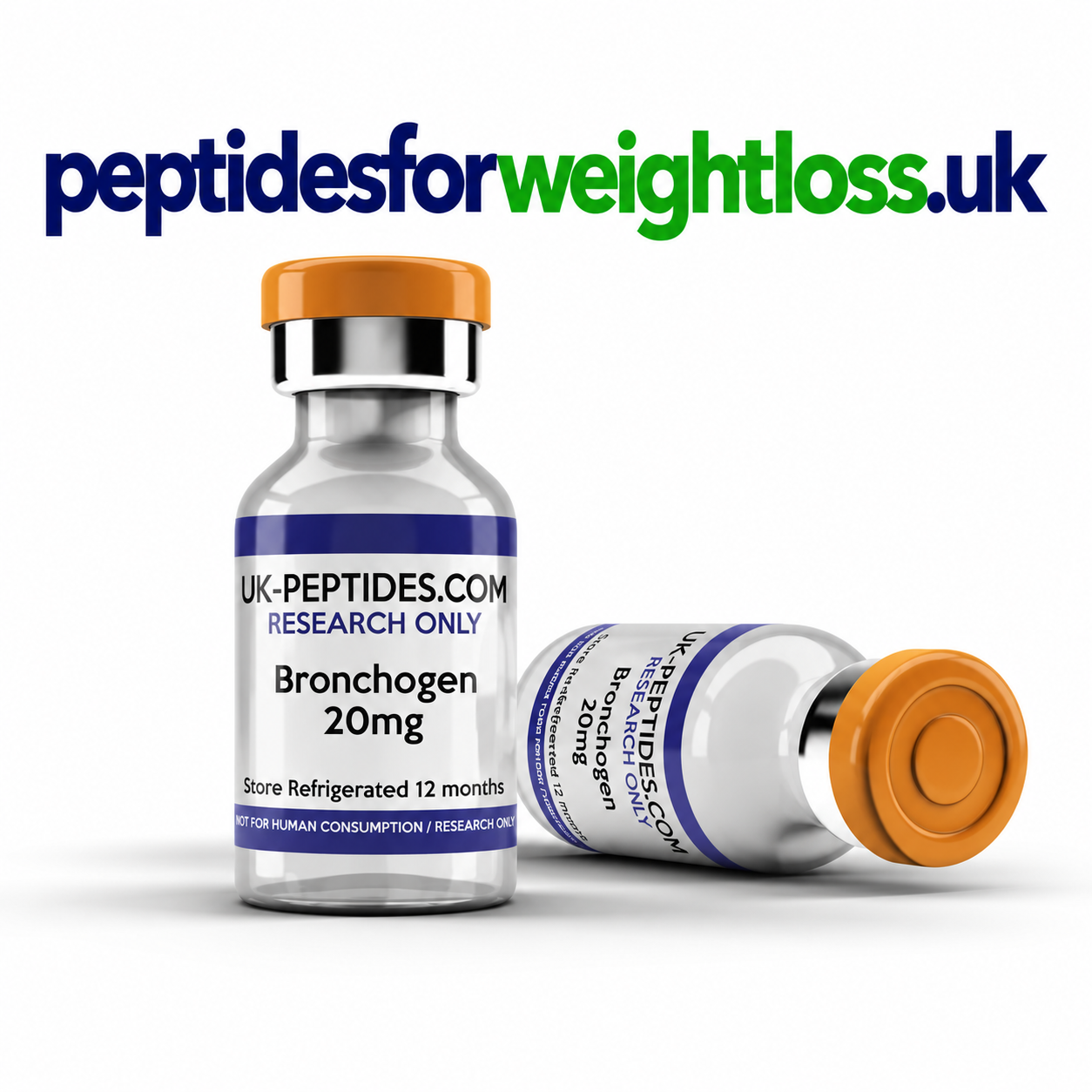
Bronchogen 20mg – AEDL Bioregulator Research Peptide
Bronchogen 20mg is a synthetic tetrapeptide associated with scientific investigations into short peptide bioregulation, respiratory tissue biology and molecular interactions involving DNA. Commonly identified by the amino acid sequence Ala-Glu-Asp-Leu (AEDL), Bronchogen belongs to the family of short regulatory peptides investigated within the Khavinson research programme.
Bronchogen has attracted interest in experimental biology because researchers have investigated related tetrapeptide sequences in studies involving bronchial epithelial cells, cellular differentiation and molecular regulation.
Published research remains limited and primarily preclinical. In addition, some scientific papers identify the investigated peptide as Ala-Asp-Glu-Leu (ADEL), which differs in amino acid order from the commonly marketed AEDL sequence.
This Bronchogen 20mg product description provides an overview of its chemical structure, research background, experimental applications, evidence limitations and important laboratory quality considerations.
What Is Bronchogen Peptide?
Bronchogen is commonly described as a synthetic tetrapeptide consisting of four amino acids: alanine, glutamic acid, aspartic acid and leucine.
The sequence most commonly associated with commercially marketed Bronchogen is Ala-Glu-Asp-Leu, abbreviated AEDL.
It is classified within a group of short synthetic peptides studied for possible effects on cellular regulation and molecular interactions.
Bronchogen has been associated with respiratory tissue research, particularly the biology of bronchial epithelial cells.
However, its classification as a bronchial bioregulator does not establish that it improves lung function or treats respiratory disease in humans.
Bronchogen 20mg Product Specifications
- Product Name: Bronchogen 20mg
- Alternative Name: AEDL Peptide
- Commonly Reported Sequence: Ala-Glu-Asp-Leu
- One-Letter Sequence: AEDL
- Peptide Classification: Synthetic tetrapeptide
- Labelled Quantity: 20mg
- Molecular Formula: C18H30N4O9 (unmodified free peptide)
- Approximate Molecular Weight: 446.45 g/mol (unmodified free peptide)
- Research Category: Short peptide bioregulation
- Research Focus: Peptide-DNA interactions and respiratory epithelial cell biology
- Exact Supplied Sequence: Requires manufacturer verification
- Purity: Confirm using batch-specific analytical documentation
- Storage: Follow verified manufacturer instructions
Understanding the Bronchogen AEDL Peptide Structure
The commonly reported Bronchogen sequence contains four amino acid residues linked together by peptide bonds.
- Alanine (A): A small amino acid with a nonpolar side chain.
- Glutamic Acid (E): An amino acid containing an acidic side chain.
- Aspartic Acid (D): Another acidic amino acid found in many biological proteins and peptides.
- Leucine (L): A hydrophobic amino acid involved in protein structure and molecular interactions.
These residues form the AEDL tetrapeptide when arranged in the sequence Ala-Glu-Asp-Leu.
Some published papers instead describe Bronchogen as Ala-Asp-Glu-Leu (ADEL). Because amino acid order determines peptide identity, researchers should not treat AEDL and ADEL as interchangeable.
Both sequences have the same elemental composition and molecular weight, meaning mass measurement alone may not distinguish them.
Scientific Research Associated With Bronchogen
1. Bronchial Epithelial Cell Research
Bronchial epithelial cells line the airways and contribute to the respiratory system’s protective barrier.
They participate in mucus production, tissue maintenance and responses to environmental exposures.
A published study investigated the ADEL tetrapeptide in cultures of human embryonic bronchial epithelial cells.
The researchers measured changes in selected proteins and genes associated with cellular proliferation and epithelial differentiation.
These findings are relevant to basic respiratory cell biology, but they do not demonstrate therapeutic effectiveness in humans.
Importantly, the tested ADEL sequence must not automatically be equated with a commercial product identified as AEDL.
2. Cellular Proliferation Research
Cellular proliferation refers to the process through which cells grow and divide.
In experimental bronchial epithelial cultures, researchers investigated proteins including Ki67 and Mcl-1.
Ki67 is commonly used as a marker associated with cell proliferation, while Mcl-1 participates in the regulation of cell survival.
The published ADEL study reported changes in these proteins under specific cell-culture conditions.
Such observations describe laboratory responses and do not establish that Bronchogen regenerates lung tissue in humans.
3. Respiratory Gene Expression Research
Gene expression refers to the processes through which genetic information contributes to the production of RNA and proteins.
Researchers studying bronchial epithelial cells have examined genes involved in respiratory tissue differentiation and function.
The published ADEL investigation measured genes including NKX2-1, SCGB1A1, SCGB3A2, FOXA1, FOXA2, MUC4, MUC5AC and SFTPA1.
Changes were reported in several of these experimental measurements.
These findings provide preliminary evidence of molecular activity for the tested peptide sequence but do not establish predictable effects in living humans.
4. Peptide and DNA Interaction Research
Short peptide bioregulator research has included investigations into whether certain peptide sequences can interact with DNA.
Laboratory techniques such as spectrophotometry, circular dichroism and thermal stability measurements have been used to examine peptide-DNA interactions.
Published research associated with Bronchogen has reported changes in DNA physical properties under defined experimental conditions.
These observations may help researchers formulate hypotheses about molecular binding.
However, a measurable interaction with isolated DNA does not independently demonstrate meaningful gene regulation or therapeutic activity in humans.
5. Airway Differentiation Research
Cell differentiation is the process through which cells develop specialised characteristics.
Bronchial epithelial differentiation is important for maintaining the structure and function of the respiratory tract.
Experimental studies of the ADEL sequence have investigated molecular markers associated with epithelial cell differentiation.
Although changes in selected gene-expression measurements were observed, these results require further investigation and independent replication.
The findings do not establish that Bronchogen restores damaged airways or improves respiratory performance.
6. Experimental Respiratory Disease Models
Some literature associated with the Khavinson research programme discusses short peptides in experimental models of respiratory tissue injury and inflammation.
These investigations have explored biological responses under controlled laboratory or animal conditions.
However, evidence for a particular peptide sequence must be evaluated separately from findings involving peptide mixtures or related compounds.
There is insufficient reliable clinical evidence that Bronchogen treats asthma, chronic obstructive pulmonary disease, pulmonary fibrosis or other respiratory disorders.
Bronchogen and Lung Health: What Does the Evidence Show?
Bronchogen is sometimes described commercially as a lung or bronchial bioregulator.
Its association with respiratory research originates from a relatively small body of experimental literature.
Laboratory findings involving cellular markers or DNA interactions are not equivalent to clinical evidence of improved breathing, lung capacity or respiratory health.
No reliable controlled human clinical programme has established Bronchogen as an effective respiratory treatment.
Product descriptions should therefore distinguish proposed research applications from proven medical benefits.
Bronchogen vs Chonluten
Bronchogen and Chonluten are different short peptides associated with research into respiratory biology.
- Bronchogen: Commonly identified as the AEDL tetrapeptide, Ala-Glu-Asp-Leu.
- Chonluten: Identified as the EDG tripeptide, Glu-Asp-Gly.
- Peptide Length: Bronchogen contains four amino acids, while Chonluten contains three.
- Research Background: Both have been discussed within short peptide bioregulator research, but their molecular structures and evidence bases differ.
Research findings involving one compound should not be attributed automatically to the other.
Bronchogen vs Other Khavinson Bioregulators
Bronchogen belongs to a wider group of short synthetic peptides investigated for possible interactions with biological systems.
Other compounds within this research field include Pinealon (EDR), Ovagen (EDL), Pancragen (KEDW) and Epitalon (AEDG).
Each has a distinct amino acid sequence and separate experimental research background.
The fact that these peptides belong to a common research tradition does not establish that they share identical biological properties.
Understanding the Bronchogen 20mg Label
The 20mg designation refers to the labelled quantity of peptide material.
It does not represent a recommended human dose or independently establish chemical identity, purity, sterility or pharmaceutical suitability.
Because the published literature contains an important AEDL/ADEL sequence inconsistency, researchers should confirm the exact supplied peptide sequence through appropriate manufacturer documentation.
Research Quality and Product Documentation
Important considerations when evaluating Bronchogen 20mg research material include:
- Verification of the exact amino acid sequence
- Clear distinction between AEDL and ADEL
- Confirmation of the molecular form and terminal groups
- Batch-specific certificate of analysis
- Appropriate peptide identity testing
- Analytical purity testing
- Accurate labelled peptide quantity
- Manufacturer and batch traceability
- Formulation and counterion information
- Packaging integrity
- Verified storage and stability instructions
- Clearly stated intended-use restrictions
These details are especially important when the same research name has been associated with different peptide sequences in published sources.
Storage and Handling Considerations
Bronchogen research material should be stored and handled according to verified manufacturer instructions.
Appropriate storage conditions may depend on the peptide’s physical form, formulation, packaging and available stability data.
Researchers should not assume that every Bronchogen product has identical storage requirements or stability characteristics.
Bronchogen Safety and Research Limitations
Bronchogen remains an investigational peptide with limited preclinical evidence and insufficient human clinical safety data.
Its long-term effects, pharmacokinetics, potential adverse reactions and therapeutic effectiveness have not been adequately established.
Experimental findings involving bronchial epithelial cells or DNA interactions do not demonstrate that Bronchogen prevents, treats or reverses respiratory disease in people.
Bronchogen is not an established FDA-, EMA- or MHRA-approved medicine for respiratory treatment.
This information is intended for scientific and educational purposes and does not provide medical advice, human dosing recommendations or administration instructions.
Frequently Asked Questions About Bronchogen 20mg
What is Bronchogen 20mg?
Bronchogen 20mg is a product listing for a synthetic tetrapeptide commonly identified as Ala-Glu-Asp-Leu (AEDL), with a labelled quantity of 20mg.
What does AEDL stand for?
AEDL represents alanine, glutamic acid, aspartic acid and leucine.
What is Bronchogen researched for?
Bronchogen is associated with preclinical research into short peptide bioregulation, peptide-DNA interactions and respiratory epithelial cell biology.
Is Bronchogen a lung peptide?
Bronchogen is commonly classified as a bronchial bioregulator, but this classification does not establish clinically proven lung benefits.
Does Bronchogen improve breathing?
There is insufficient reliable human clinical evidence demonstrating that Bronchogen improves breathing or lung function.
Is Bronchogen the same as Chonluten?
No. Bronchogen is commonly identified as the AEDL tetrapeptide, while Chonluten is the EDG tripeptide.
Why do some studies use the sequence ADEL?
Some published papers describe the investigated Bronchogen-related peptide as Ala-Asp-Glu-Leu (ADEL). This differs from the commonly marketed AEDL sequence, so researchers should verify which compound was actually tested.
What is the molecular weight of Bronchogen?
The unmodified free AEDL tetrapeptide has an approximate molecular weight of 446.45 g/mol.
What does Bronchogen 20mg mean?
The 20mg designation identifies the labelled quantity of material, not a recommended human dose.
Is Bronchogen approved for medical use?
Bronchogen is not an established approved medicine for human respiratory treatment.
Bronchogen 20mg – Product Summary
Bronchogen 20mg is a synthetic tetrapeptide commonly associated with the AEDL sequence and the Khavinson short peptide bioregulator research programme.
Its scientific background includes investigations into molecular interactions, cellular regulation and bronchial epithelial biology.
However, the published evidence is limited, and some relevant studies identify the tested peptide as ADEL rather than AEDL. This distinction should be considered when evaluating the research literature.
Researchers should verify the exact molecular identity, purity, batch documentation, formulation and intended use before selecting Bronchogen 20mg for laboratory investigation.


Reviews
There are no reviews yet.