
Description
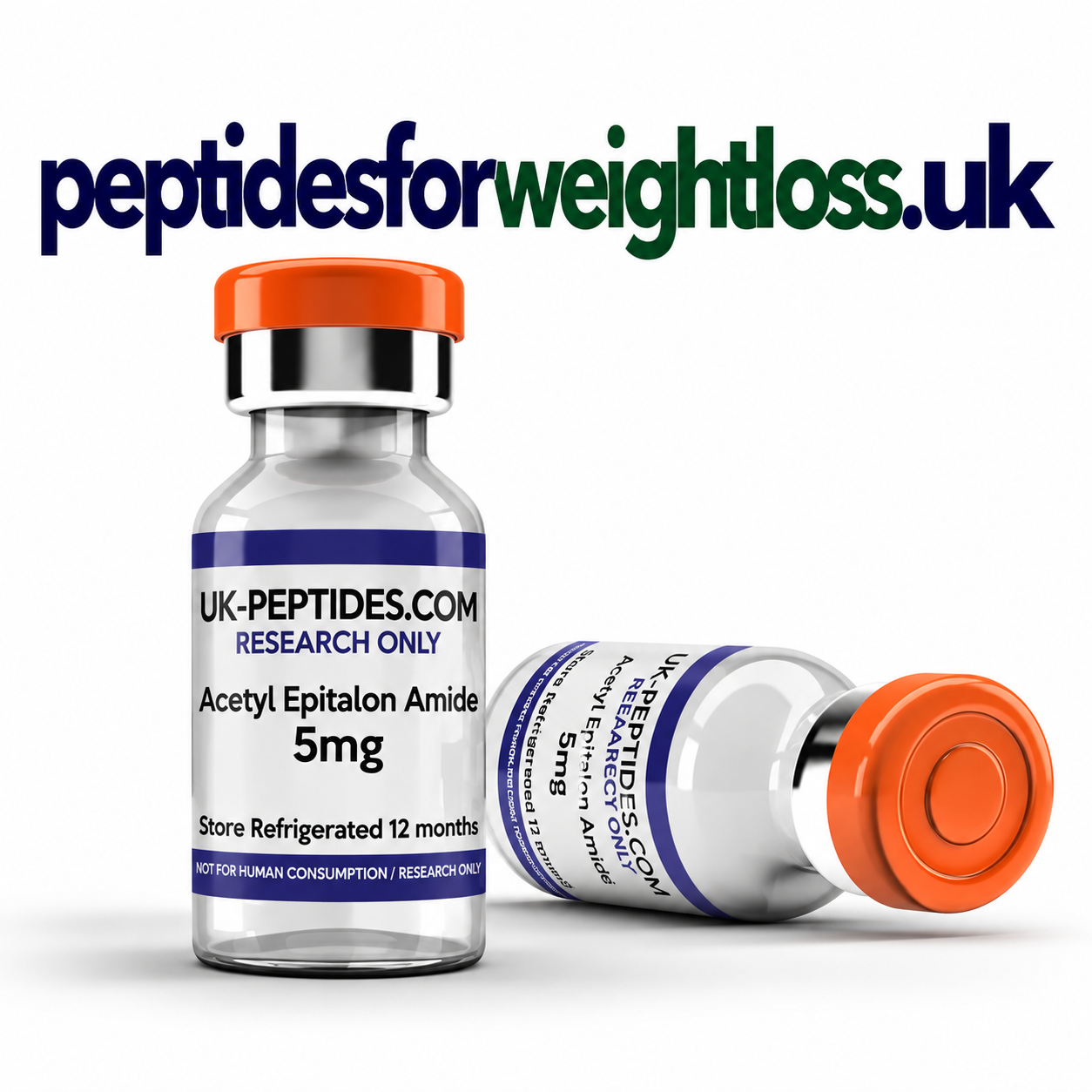
N-Acetyl Epitalon 5mg – Acetylated AEDG Research Peptide
N-Acetyl Epitalon 5mg is an experimental tetrapeptide research product based on a chemically modified form of Epitalon, also known as Epithalon. The compound is commonly represented as Ac-Ala-Glu-Asp-Gly, or Ac-AEDG, indicating the addition of an acetyl group to the N-terminus of the original four-amino-acid peptide.
N-Acetyl Epitalon has attracted interest in peptide chemistry because N-terminal acetylation can alter the chemical properties of short peptides. However, whether this modification improves the stability, biological activity or cellular availability of Epitalon has not been established through published compound-specific studies.
The unmodified parent peptide, Epitalon, has been investigated in experimental research involving telomerase, telomere maintenance, cellular ageing and neuroendocrine regulation. These findings provide scientific background for studying related peptide structures but do not demonstrate equivalent effects for N-Acetyl Epitalon.
N-Acetyl Epitalon 5mg is intended for controlled laboratory research. It is not an established treatment for ageing, sleep disorders, metabolic conditions or any other human disease.
What Is N-Acetyl Epitalon 5mg?
N-Acetyl Epitalon 5mg refers to a research product labelled as containing 5 milligrams of an N-terminally acetylated derivative of the tetrapeptide Epitalon.
Epitalon consists of four amino acid residues arranged in the sequence alanine-glutamate-aspartate-glycine, abbreviated AEDG.
In N-Acetyl Epitalon, an acetyl group is attached to the N-terminal amino group of alanine.
This produces a chemically distinct compound with a different molecular formula and molecular mass from the unmodified parent peptide.
Although the modification is relatively small, its biological consequences cannot be assumed.
Researchers should verify whether a supplied product is N-Acetyl Epitalon with a free C-terminal carboxyl group or a separately modified C-terminal amidated analogue.
N-Acetyl Epitalon 5mg Product Specifications
- Product Name: N-Acetyl Epitalon 5mg
- Alternative Names: N-Acetyl Epithalon, Acetyl Epitalon, Ac-AEDG
- Scientific Classification: Modified synthetic tetrapeptide
- Parent Peptide: Epitalon (Epithalon)
- Parent Sequence: Ala-Glu-Asp-Gly (AEDG)
- Proposed Modified Sequence: Ac-Ala-Glu-Asp-Gly-OH
- Peptide Length: 4 amino acid residues
- N-Terminal Modification: Acetylation
- C-Terminal Group: Free carboxyl group for the specified reference structure
- Reference Molecular Formula: C16H24N4O10
- Reference Molecular Weight: Approximately 432.38 g/mol
- Reference PubChem CID: 171390141
- CAS Number: Confirm against the exact supplied derivative
- Labelled Quantity: 5mg
- Research Category: Peptide chemistry and cellular ageing research
- Primary Research Focus: N-terminal peptide modification and chemical characterisation
- Related Research Topics: Peptide stability, analytical chemistry and Epitalon literature
- Compound-Specific Clinical Evidence: Not established
- Purity: Requires batch-specific verification
- Salt Form: Confirm with manufacturer
- Physical Presentation: Confirm with manufacturer
- Storage: Follow verified manufacturer instructions
- Intended Use: Laboratory research only
These chemical specifications refer to the N-terminally acetylated peptide with an unmodified C-terminal carboxyl group. Products described as N-Acetyl Epitalon Amidate have different terminal chemistry and should not be assumed to share the same molecular formula or mass.
N-Acetyl Epitalon Amino Acid Sequence and Molecular Structure
The unmodified Epitalon peptide consists of four amino acids:
Ala-Glu-Asp-Gly
This sequence is commonly abbreviated AEDG.
The N-acetylated derivative is represented as:
Ac-Ala-Glu-Asp-Gly-OH
The prefix Ac indicates an acetyl group attached to the N-terminal amino group.
The OH suffix indicates a free C-terminal carboxyl group.
N-terminal acetylation changes the chemical properties of the peptide by modifying its terminal amino group.
In peptide chemistry, this modification may affect charge, interactions with enzymes and analytical behaviour.
However, the effects of acetylation depend on the specific peptide sequence and experimental environment.
No reliable published evidence establishes that N-Acetyl Epitalon has a longer biological half-life or greater activity than unmodified Epitalon.
How Does N-Acetyl Epitalon Work?
A specific biological mechanism of action has not been established for N-Acetyl Epitalon.
The rationale for studying the compound comes partly from its relationship to Epitalon, a synthetic tetrapeptide investigated in cellular and animal research.
Studies involving the parent peptide have explored telomerase activity, telomere regulation and selected neuroendocrine processes.
However, N-terminal acetylation may change molecular interactions, transport properties and enzyme susceptibility.
Consequently, researchers cannot assume that the modified compound reproduces the biological effects reported for unmodified Epitalon.
Compound-specific experiments would be necessary to establish its receptor interactions, intracellular effects, pharmacokinetics and safety.
Scientific Research Into N-Acetyl Epitalon 5mg
1. N-Acetyl Epitalon and Peptide Acetylation Research
N-terminal acetylation is a common chemical modification used in peptide synthesis.
It replaces the free N-terminal amino functionality with an acetylated group.
This can influence peptide charge, enzyme recognition and chemical behaviour.
However, such effects are sequence-dependent and must be measured for the particular peptide being studied.
2. N-Acetyl Epitalon 5mg and Peptide Stability
Short peptides can be susceptible to enzymatic degradation under certain experimental conditions.
N-terminal acetylation may reduce recognition by some aminopeptidases.
However, resistance to one class of enzymes does not guarantee improved overall stability.
No established comparative pharmacokinetic study demonstrates that N-Acetyl Epitalon remains active longer than Epitalon.
3. N-Acetyl Epitalon and Epitalon Research
Epitalon is a synthetic tetrapeptide with the sequence Ala-Glu-Asp-Gly.
Published studies have investigated the parent peptide in cell cultures, animal models and selected biological systems.
Research topics include telomere biology, telomerase activity and neuroendocrine regulation.
These studies provide background for investigating structurally related derivatives.
However, they are not direct evidence of N-Acetyl Epitalon activity.
4. N-Acetyl Epitalon 5mg and Telomerase Research
Telomerase is an enzyme complex involved in maintaining telomere sequences at chromosome ends.
Published cell-culture experiments involving unmodified Epitalon have reported changes in telomerase-related measurements.
However, the magnitude and mechanisms of these effects vary across experimental systems.
There is no established evidence demonstrating that N-Acetyl Epitalon activates telomerase.
5. N-Acetyl Epitalon and Telomere Biology
Telomeres are specialised structures located at the ends of chromosomes.
They help protect chromosome integrity and participate in cellular replication biology.
Studies of unmodified Epitalon have investigated telomere length and related cellular pathways.
However, telomere changes in cultured cells do not establish increased human lifespan.
The effects of N-Acetyl Epitalon on telomeres have not been established.
6. N-Acetyl Epitalon 5mg and Cellular Senescence Research
Cellular senescence describes a state in which cells undergo persistent changes in proliferation and function.
Researchers investigate telomere biology and cellular stress responses to understand senescence.
Epitalon has appeared in research exploring selected ageing-related cellular processes.
However, there is insufficient evidence demonstrating that N-Acetyl Epitalon delays or reverses cellular senescence.
7. N-Acetyl Epitalon and Neuroendocrine Research
Neuroendocrine systems coordinate communication between the nervous system and hormone-producing tissues.
Research involving the parent Epitalon peptide has examined selected neuroendocrine processes.
Some studies have investigated relationships with pineal gland biology and melatonin-associated pathways.
However, these findings do not establish equivalent effects for the N-acetylated derivative.
8. N-Acetyl Epitalon 5mg and Pineal Gland Research
The pineal gland participates in the regulation of melatonin secretion and circadian signalling.
Epitalon was developed in connection with research involving pineal-derived peptide preparations.
However, Epitalon is a defined synthetic tetrapeptide, whereas Epithalamin is a heterogeneous pineal extract.
N-Acetyl Epitalon is a further chemically modified derivative and should be distinguished from both materials.
9. N-Acetyl Epitalon and Melatonin Research
Melatonin is a hormone involved in circadian signalling.
Some published studies involving Epitalon have investigated relationships with melatonin-associated pathways.
However, those observations do not establish that N-Acetyl Epitalon increases melatonin production or improves sleep in humans.
10. N-Acetyl Epitalon 5mg and Oxidative Stress Research
Oxidative stress involves interactions between reactive species and cellular protective mechanisms.
Research involving the parent Epitalon peptide has explored selected oxidative stress-related measurements.
However, these findings cannot be directly transferred to the N-acetylated compound.
Its antioxidant activity, if any, requires independent investigation.
11. N-Acetyl Epitalon and Gene Expression Research
Gene expression describes the processes through which genetic information contributes to the production of RNA and proteins.
Some Epitalon studies have investigated changes in gene expression and enzyme activity.
However, the N-acetylated derivative has not been established to produce the same molecular effects.
Direct comparative studies would be necessary.
12. N-Acetyl Epitalon 5mg and Cell-Culture Research
Cell-culture experiments allow researchers to investigate molecular responses under controlled laboratory conditions.
Unmodified Epitalon has been evaluated in several cell-culture models.
However, the results from those experiments cannot be assumed to apply to N-Acetyl Epitalon.
Compound-specific research would be required to establish biological activity.
13. N-Acetyl Epitalon and Peptide Analytical Chemistry
Analytical chemistry is important for confirming the identity of modified peptides.
Techniques such as mass spectrometry and chromatography can help characterise peptide preparations.
For N-Acetyl Epitalon, researchers should confirm the N-terminal acetyl group, amino acid sequence and C-terminal chemical form.
Peptide-related impurities and sequence isomers may require additional analytical methods beyond a single molecular mass measurement.
14. N-Acetyl Epitalon 5mg and Structure–Activity Relationships
Structure–activity relationship research investigates how chemical modifications influence molecular behaviour.
N-Acetyl Epitalon provides a potential subject for comparing modified and unmodified tetrapeptide structures.
Relevant questions include whether acetylation changes chemical stability, enzyme susceptibility or experimental biological activity.
These remain research questions rather than established advantages.
15. N-Acetyl Epitalon and Research Reproducibility
Reproducible research requires well-characterised experimental materials.
Researchers should verify whether a product contains N-Acetyl Epitalon, unmodified Epitalon or an N-acetylated and C-terminally amidated derivative.
These compounds differ chemically and should not be treated as interchangeable.
Batch-specific analytical documentation is important for reliable scientific interpretation.
N-Acetyl Epitalon 5mg vs Epitalon
N-Acetyl Epitalon and Epitalon are structurally related but chemically distinct compounds.
- Epitalon: A synthetic tetrapeptide with the sequence Ala-Glu-Asp-Gly.
- N-Acetyl Epitalon: A modified version with an acetyl group attached to the N-terminus.
- Reference Molecular Weight: Approximately 390.35 g/mol for unmodified Epitalon and 432.38 g/mol for N-Acetyl Epitalon with a free C-terminus.
- Research Evidence: Published experimental research exists for Epitalon, while compound-specific evidence for N-Acetyl Epitalon remains extremely limited.
- Clinical Status: Neither compound has established human anti-ageing effectiveness.
Claims that N-Acetyl Epitalon is stronger, more effective or longer-lasting than Epitalon require direct comparative evidence.
N-Acetyl Epitalon 5mg vs N-Acetyl Epitalon Amidate
N-Acetyl Epitalon and N-Acetyl Epitalon Amidate may refer to different chemical structures.
N-Acetyl Epitalon with a free C-terminal carboxyl group is represented as Ac-AEDG-OH.
An N-acetylated and C-terminally amidated derivative is represented as Ac-AEDG-NH2.
Terminal amidation changes the chemical composition and molecular mass.
Researchers should confirm which derivative is supplied rather than relying on inconsistent marketplace naming.
N-Acetyl Epitalon 5mg vs Epithalamin
Epithalamin is a heterogeneous peptide-containing preparation historically obtained from pineal tissue.
Epitalon is a defined synthetic tetrapeptide developed in connection with research on pineal-derived peptides.
N-Acetyl Epitalon is a chemically modified derivative of Epitalon.
These materials are not chemically identical, and results from one preparation should not automatically be attributed to another.
N-Acetyl Epitalon 5mg and Longevity Claims
The parent Epitalon peptide has been investigated in experimental ageing-related research.
However, cell-culture findings and animal observations do not establish that a compound extends human lifespan.
There is no reliable clinical evidence demonstrating that N-Acetyl Epitalon reverses ageing, extends human lifespan or prevents age-related disease.
It should not be marketed as a proven anti-ageing treatment.
N-Acetyl Epitalon 5mg and Sleep Research
The relationship between the pineal gland, melatonin and circadian signalling has been investigated in Epitalon-related research.
However, these findings do not establish that N-Acetyl Epitalon improves sleep quality or treats insomnia.
Human therapeutic effectiveness remains unestablished.
N-Acetyl Epitalon 5mg and Weight-Loss Research
N-Acetyl Epitalon is not an established weight-loss compound.
There is insufficient reliable evidence demonstrating that it reduces appetite, increases fat oxidation or produces clinically meaningful weight loss in humans.
Its chemical relationship to Epitalon does not establish a therapeutic role in obesity or metabolic disease.
N-Acetyl Epitalon 5mg Research Quality and Documentation
Important considerations when evaluating N-Acetyl Epitalon research material include:
- Verification of the complete AEDG amino acid sequence
- Confirmation of N-terminal acetylation
- Identification of the C-terminal group
- Verification of the expected molecular mass
- Confirmation of amino acid stereochemistry
- Identification of the supplied salt form
- Batch-specific certificate of analysis
- Suitable analytical purity testing
- Mass spectrometry or another suitable identity method
- Assessment of sequence-related impurities
- Confirmation of the labelled 5mg quantity
- Manufacturer and batch traceability
- Product-specific storage and stability documentation
- Clearly stated laboratory research classification
Storage and Handling of N-Acetyl Epitalon 5mg
N-Acetyl Epitalon 5mg should be stored according to verified manufacturer instructions.
Storage requirements depend on chemical form, formulation, packaging and stability characteristics.
Researchers should not assume that N-acetylation automatically provides improved shelf life or stability.
Laboratory handling should follow institutional procedures and product-specific safety documentation.
N-Acetyl Epitalon 5mg Safety and Scientific Limitations
N-Acetyl Epitalon is an experimental modified tetrapeptide without an established human therapeutic safety profile.
Its pharmacokinetics, biological activity, tissue distribution, metabolism and long-term toxicity remain insufficiently characterised.
Published research involving unmodified Epitalon cannot establish the safety of the N-acetylated derivative.
There is no reliable clinical evidence demonstrating that N-Acetyl Epitalon safely treats ageing-related conditions, sleep disorders, obesity or other human diseases.
Research-grade material should not be assumed sterile, pharmaceutical grade or suitable for human administration.
The labelled 5mg quantity is not a recommended human dose.
Frequently Asked Questions About N-Acetyl Epitalon 5mg
What is N-Acetyl Epitalon 5mg?
N-Acetyl Epitalon 5mg is a research product designation for an N-terminally acetylated derivative of the Epitalon tetrapeptide with a labelled quantity of 5mg.
What is another name for N-Acetyl Epitalon?
It may be called Acetyl Epitalon, N-Acetyl Epithalon or Ac-AEDG.
What is the N-Acetyl Epitalon peptide sequence?
The reference structure is Ac-Ala-Glu-Asp-Gly-OH.
How many amino acids does N-Acetyl Epitalon contain?
It contains four amino acid residues.
What is the molecular formula of N-Acetyl Epitalon?
For the specified free C-terminal structure, the reference molecular formula is C16H24N4O10.
What is the molecular weight of N-Acetyl Epitalon?
The reference molecular weight is approximately 432.38 g/mol for Ac-AEDG-OH.
Is N-Acetyl Epitalon the same as Epitalon?
No. N-Acetyl Epitalon contains an additional N-terminal acetyl group and is chemically distinct from the unmodified parent peptide.
Is N-Acetyl Epitalon stronger than regular Epitalon?
There is no established comparative evidence demonstrating greater potency or biological effectiveness.
Does N-Acetyl Epitalon have a longer half-life?
Its biological half-life has not been established through reliable compound-specific pharmacokinetic studies.
Does N-Acetyl Epitalon activate telomerase?
Telomerase-related findings have been reported for unmodified Epitalon in cell-culture studies, but equivalent activity has not been established for N-Acetyl Epitalon.
Does N-Acetyl Epitalon reverse ageing?
No reliable human clinical evidence establishes that it reverses ageing or extends lifespan.
Does N-Acetyl Epitalon improve sleep?
There is insufficient evidence demonstrating that it improves sleep or treats insomnia in humans.
Is N-Acetyl Epitalon approved for human use?
N-Acetyl Epitalon is not an established approved UK medicine for anti-ageing, sleep disorders or other therapeutic purposes.
What does N-Acetyl Epitalon 5mg mean?
The designation refers to a labelled quantity of 5mg of research material, not a recommended human dose.
N-Acetyl Epitalon 5mg – Scientific Product Summary
N-Acetyl Epitalon 5mg is an experimental modified tetrapeptide derived from the Epitalon sequence Ala-Glu-Asp-Gly.
Its reference structure, Ac-Ala-Glu-Asp-Gly-OH, contains an acetyl group attached to the N-terminus.
Published research on unmodified Epitalon provides background involving telomere biology, telomerase and neuroendocrine signalling, but does not establish the biological effects of N-Acetyl Epitalon.
Compound-specific therapeutic effectiveness, pharmacokinetics and long-term safety remain unestablished.
Researchers evaluating N-Acetyl Epitalon 5mg should verify chemical identity, terminal modifications, purity, labelled quantity and batch-specific analytical documentation.

Reviews
There are no reviews yet.