
Understanding Peptide Purity: HPLC, Mass Spectrometry & Certificates of Analysis
Peptide purity is one of the most important analytical considerations in scientific peptide research. Whether peptides are investigated for cellular signalling, molecular biology, metabolic processes, or laboratory experiments, researchers need reliable information about the composition and identity of the materials being studied.
However, understanding peptide purity involves more than reading a percentage on a product label.
A peptide described as having 98% or 99% purity may still require additional analytical testing to establish its molecular identity, chemical composition, and suitability for a particular laboratory application.
This guide explains what peptide purity means, how scientists evaluate it using High-Performance Liquid Chromatography (HPLC) and mass spectrometry, and why Certificates of Analysis (COAs) are important for scientific documentation.
What Is Peptide Purity?
Peptide purity describes the proportion of a sample attributed to the intended peptide relative to other detectable components, according to a specified analytical method.
During peptide synthesis, chemical reactions may produce unwanted substances alongside the intended peptide sequence.
These substances can include:
- Incomplete peptide sequences
- Truncated or deletion peptides
- Chemically modified peptide by-products
- Degradation products
- Residual reagents or solvents
- Other synthesis-related impurities
The type and quantity of impurities depend on the peptide sequence, synthesis process, purification techniques, storage conditions, and analytical methods used.
Peptide purity testing helps researchers characterise these materials before interpreting experimental results.
Why Does Peptide Purity Matter?
In scientific experiments, impurities can affect how a sample behaves.
For example, an unintended peptide sequence may interact differently with a biological target, while a degradation product could interfere with analytical measurements.
When researchers understand the composition of a peptide sample, they can better assess experimental variability and reproduce results.
Purity is therefore an important component of research quality, but it is not the only relevant characteristic.
Understanding Peptide Purity Percentages
Research peptide specifications frequently include percentages such as 95%, 98%, or 99%.
These figures are often derived from chromatographic analysis.
For example, an HPLC report may show that the main chromatographic peak accounts for 98% of the total integrated peak area under the conditions used.
This is commonly described as 98% HPLC purity.
However, an HPLC area percentage is not necessarily equivalent to 98% peptide by total sample mass.
Different substances may produce different detector responses, and some sample components may not be detected by the selected analytical method.
Water, salts, counterions, and certain residual substances may also contribute to the sample’s total mass without appearing in the reported chromatographic purity value.
For this reason, researchers should interpret purity percentages in the context of the analytical method and accompanying documentation.
What Is HPLC Peptide Analysis?
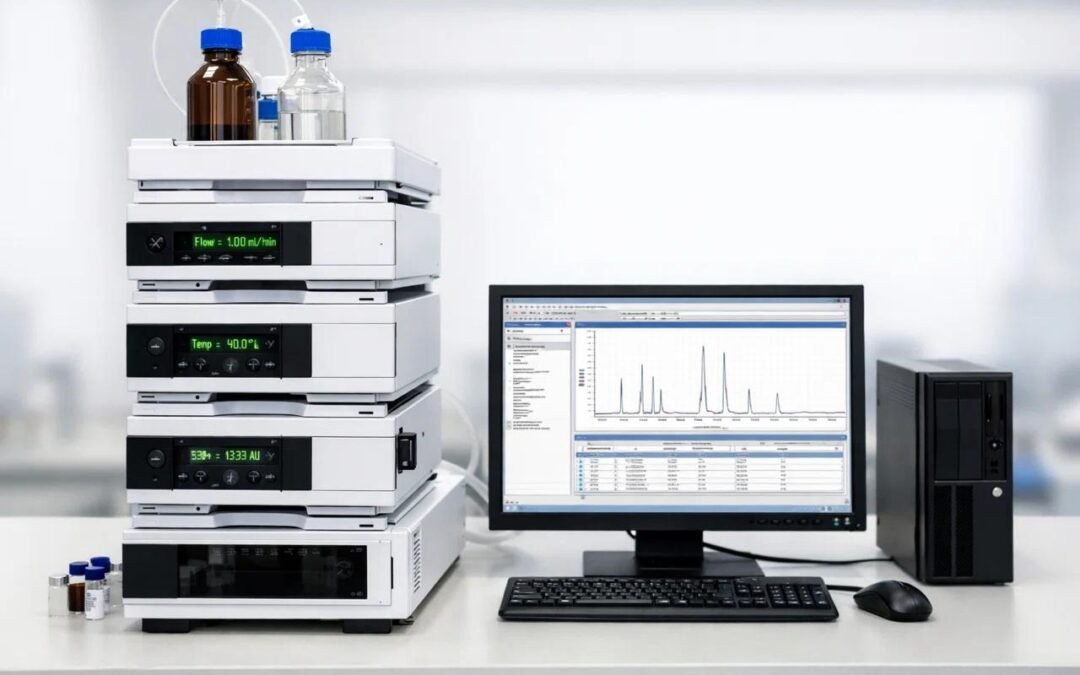
High-Performance Liquid Chromatography, commonly abbreviated as HPLC, is an analytical technique used to separate components within a sample.
HPLC is widely used in pharmaceutical analysis, biochemical research, and peptide characterisation.
In peptide purity testing, the sample passes through a chromatographic system containing a stationary phase and a flowing mobile phase.
Different components interact with the system in different ways, causing them to separate.
A detector then records signals as the components leave the column.
The resulting chromatogram displays peaks corresponding to detected components.
How HPLC Helps Evaluate Peptide Purity
An HPLC chromatogram can provide information about the number and relative abundance of detectable components in a peptide sample.
Researchers examine characteristics such as:
- Retention time
- Peak shape
- Peak area
- Resolution between peaks
- Baseline quality
- Method suitability
When the intended peptide produces a dominant chromatographic peak, the integrated peak area may be used to estimate chromatographic purity.
However, the reliability of the result depends on factors such as separation efficiency, detector response, method validation, and appropriate peak identification.
What Does an HPLC Chromatogram Show?
A chromatogram typically displays detector response against time.
The horizontal axis represents retention time, while the vertical axis represents the detector signal.
A major peak may represent the intended peptide, while smaller peaks may indicate other detectable components.
Nevertheless, a chromatographic peak alone does not prove molecular identity.
Two different compounds may sometimes have similar retention behaviour, and some impurities may overlap with the main peak.
This is why HPLC is frequently combined with other analytical methods.
What Is Mass Spectrometry in Peptide Testing?
Mass spectrometry is an analytical technique used to measure ions according to their mass-to-charge ratio.
In peptide research, it is commonly used to help determine whether a sample contains a molecule consistent with the expected peptide mass.
Mass spectrometry can provide valuable information about molecular identity and certain chemical modifications.
How Mass Spectrometry Supports Peptide Identification
A peptide has an expected molecular mass based on its amino acid sequence and chemical structure.
Scientists can compare the mass spectrometry results with this expected value.
Agreement between the observed and calculated molecular masses provides evidence supporting the peptide’s identity.
However, mass agreement alone may not distinguish every possible structural isomer or sequence variation.
Additional analytical techniques may be required for comprehensive structural confirmation.
HPLC vs Mass Spectrometry: What Is the Difference?
Although both methods are important, they answer different analytical questions.
| Analytical method | Primary purpose |
|---|---|
| HPLC | Separates detectable components and helps estimate chromatographic purity |
| Mass spectrometry | Measures mass-to-charge ratios and supports molecular identification |
| LC-MS | Combines chromatographic separation with mass spectrometric detection |
Using complementary analytical methods can provide a more complete understanding of peptide composition than relying on a single measurement.
What Is a Peptide Certificate of Analysis?
A Certificate of Analysis (COA) is a document reporting specified analytical test results for a particular material, sample, or batch.
A peptide COA may contain information such as:
- Product or compound name
- Batch or lot number
- Expected molecular formula
- Expected molecular mass
- Analytical methods used
- Reported chromatographic purity
- Molecular mass results
- Testing date
- Laboratory identification
The information included depends on the testing programme and the laboratory responsible.
A COA is most useful when its results can be traced to the actual batch being evaluated.
How to Read a Peptide Certificate of Analysis
When reviewing a peptide COA, researchers should consider several questions.
1. Does the COA identify the correct peptide?
The compound name, molecular formula, and other identifying information should be consistent with the intended material.
2. Is the batch number provided?
Batch identification helps connect the analytical document with a specific production lot.
3. Which analytical methods were used?
A reported purity percentage should identify the testing method used to generate the result.
4. Is molecular identity supported?
Mass spectrometry or other appropriate identity tests can help determine whether the sample is consistent with the expected compound.
5. Is the laboratory identifiable?
The laboratory name, testing date, and supporting documentation can help assess traceability and credibility.
6. Are the limitations clear?
A COA reports particular measurements. It should not be interpreted as proof of properties that were not tested.
Does 99% Peptide Purity Mean the Peptide Is Safe?
No.
This is an important distinction in peptide research.
A reported purity of 99% does not establish that a peptide is safe for human use.
Chemical purity, biological safety, sterility, endotoxin content, and clinical effectiveness are different considerations.
For example, a sample may have high chromatographic purity while still containing substances not adequately assessed by the analytical method.
A sample may also be chemically pure but possess biological properties that make it unsuitable or unsafe for particular applications.
Furthermore, analytical purity does not demonstrate that a compound has received regulatory approval.
Researchers should avoid interpreting purity percentages as medical safety guarantees.
Peptide Identity vs Peptide Purity
Peptide identity and peptide purity are closely related but scientifically distinct.
Peptide identity concerns whether a sample contains the intended molecule.
Peptide purity concerns the relative amount of the intended component compared with other measured components.
A sample may produce a chromatogram with one dominant peak but still require additional testing to confirm that the peak represents the intended peptide.
Conversely, a sample may contain the correct peptide while also containing detectable impurities.
Both identity and purity are therefore important components of analytical characterisation.
What Factors Can Affect Peptide Quality?
Several factors can influence the chemical characteristics of peptide samples.
Peptide Sequence and Structure
Longer or chemically complex peptide sequences may present additional synthesis and purification challenges.
Some amino acid sequences are also more susceptible to particular chemical reactions or degradation pathways.
Manufacturing and Purification Methods
Synthesis conditions and purification processes influence the types and amounts of impurities present in the final material.
Appropriate analytical testing helps evaluate the outcome of these processes.
Storage and Stability
Peptide stability depends on the specific molecular structure, formulation, environmental conditions, and packaging.
Some peptides may be sensitive to moisture, temperature, light, or oxidation.
Storage requirements should therefore be based on verified compound-specific documentation rather than general assumptions.
Analytical Method Limitations
Different testing methods detect different properties.
No single analytical result can fully characterise every aspect of peptide quality.
The appropriate testing programme depends on the intended scientific application.
Why Scientific Documentation Matters in Peptide Research
Reliable scientific research depends on accurate and reproducible experimental conditions.
When researchers use peptide samples, they need to understand what material is present and which characteristics have been measured.
Analytical documentation supports this process by recording sample identity, testing conditions, and relevant results.
Transparent documentation also makes it easier to compare findings across experiments and identify possible sources of variation.
For UK researchers, the same general scientific principles apply: product claims should be supported by suitable evidence, and regulatory requirements must be considered independently of analytical purity.
Frequently Asked Questions About Peptide Purity
What does 98% peptide purity mean?
It commonly refers to a chromatographic purity estimate, such as the percentage of integrated HPLC peak area attributed to the main component. The exact meaning depends on the analytical method.
Is HPLC enough to confirm peptide identity?
Not always. HPLC primarily separates components and evaluates chromatographic characteristics. Mass spectrometry or other appropriate techniques may be needed to support molecular identification.
What does a peptide COA prove?
A COA documents the results of specified tests for a sample or batch. It does not automatically prove sterility, clinical safety, regulatory approval, or suitability for human use.
Are peptide purity and peptide concentration the same?
No. Purity concerns sample composition, while concentration describes the amount of a substance within a defined volume or quantity of material.
Can a peptide degrade after testing?
Yes. Depending on the compound and storage conditions, chemical degradation may occur after the original analytical testing.
Conclusion
Understanding peptide purity requires more than comparing percentages on laboratory reports.
High-Performance Liquid Chromatography helps evaluate chromatographic composition, while mass spectrometry provides important evidence about molecular identity.
Certificates of Analysis bring these results together in a documented form, although their reliability depends on the methods used, the laboratory responsible, and batch traceability.
For scientific peptide research, the most useful approach is to evaluate purity, identity, stability, and analytical documentation together.
These principles help support more reliable experiments and more accurate interpretation of research findings.
Scientific disclaimer: This article is intended for educational and laboratory research information. Analytical purity does not establish that any peptide is safe, effective, sterile, or approved for human administration.