
Description
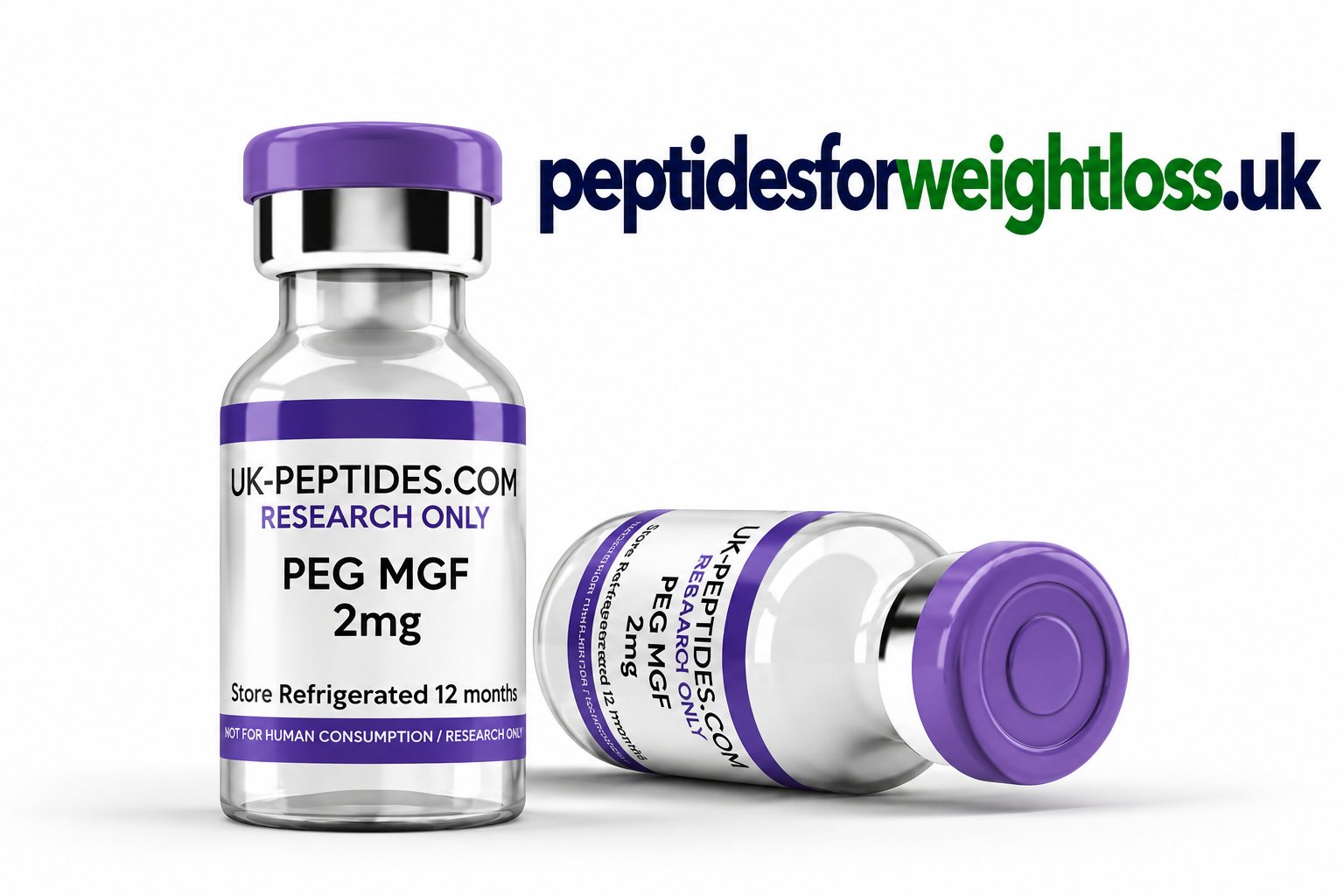
PEG-MGF 2mg – Pegylated Mechano Growth Factor Research Peptide
PEG-MGF 2mg refers to a polyethylene glycol-modified peptide associated with research into mechano growth factor (MGF), insulin-like growth factor-1 (IGF-1) gene expression and skeletal muscle cell biology.
PEG-MGF stands for Pegylated Mechano Growth Factor. The compound is marketed as a chemically modified version of an MGF-related peptide, with polyethylene glycol (PEG) attached to the peptide structure.
Scientific interest in MGF originates from investigations into how skeletal muscle responds to mechanical loading, tissue damage and cellular repair processes. However, research involving naturally expressed MGF or unmodified MGF peptides does not establish the biological effectiveness of PEG-MGF itself.
This PEG-MGF 2mg product description examines the compound’s identity, scientific background, research limitations and important laboratory quality considerations.
What Is PEG-MGF?
PEG-MGF is a term used for pegylated forms of mechano growth factor-related peptides.
Mechano growth factor is associated with an alternatively spliced form of the IGF-1 gene, commonly identified in humans as IGF-1Ec.
Researchers have investigated the relationship between this splice variant and the biological response of skeletal muscle to mechanical stress.
PEGylation involves attaching polyethylene glycol to a molecule. This modification can change its physicochemical properties, but its effects depend on the particular molecule, PEG structure and attachment chemistry.
PEG-MGF should not be assumed to have a proven longer duration of biological action without compound-specific experimental evidence.
PEG-MGF 2mg Product Specifications
- Product Name: PEG-MGF 2mg
- Full Name: Pegylated Mechano Growth Factor
- Alternative Name: PEGylated MGF
- Classification: PEG-modified research peptide
- Labelled Quantity: 2mg
- Related Biological Pathway: IGF-1 splice variant research
- Research Areas: Skeletal muscle biology, peptide modification and cellular signalling
- Exact Molecular Identity: Requires manufacturer confirmation
- PEG Molecular Weight: Requires manufacturer confirmation
- Analytical Purity: Refer to batch-specific documentation
- Storage Conditions: Follow verified manufacturer instructions
Understanding Mechano Growth Factor and IGF-1Ec
The IGF-1 gene can produce different transcript variants through alternative splicing. These variants are associated with different precursor structures and biological contexts.
One variant, commonly called IGF-1Ec in humans, has been investigated in skeletal muscle research following mechanical loading or injury.
The term mechano growth factor is used in this research area, although scientific publications and commercial suppliers do not always use the term to describe precisely the same molecular material.
It is important to distinguish endogenous IGF-1Ec expression, synthetic MGF-derived peptides and PEGylated MGF products.
Evidence obtained using one of these materials should not automatically be attributed to the others.
Scientific Research Associated With PEG-MGF
1. Skeletal Muscle Biology
Research into mechano growth factor has examined changes in IGF-1 gene expression following mechanical loading and muscle damage.
These investigations help scientists understand how muscle tissue responds to physical stress at the molecular level.
However, observing changes in endogenous IGF-1Ec expression does not demonstrate that externally supplied PEG-MGF improves muscle development or recovery.
2. Muscle Satellite Cell Research
Satellite cells are muscle-associated stem cells involved in skeletal muscle maintenance and regeneration.
Some laboratory studies involving MGF-related peptides have examined satellite cell activity, proliferation and differentiation.
The findings are mixed, and research has not established that PEG-MGF produces the same effects.
Additional studies using chemically characterised PEG-MGF would be needed to evaluate its specific biological activity.
3. PEGylation and Peptide Chemistry
PEGylation is a chemical modification used in pharmaceutical and biotechnology research.
Attaching polyethylene glycol to a peptide can influence properties such as molecular size, solubility, stability and interactions with biological systems.
However, these effects vary according to the peptide, PEG chain length, attachment site and resulting molecular structure.
For PEG-MGF, researchers should distinguish general PEGylation principles from experimentally verified properties of the specific product.
4. IGF-1 Signalling Research
IGF-1 participates in cellular growth, differentiation and metabolic regulation through established signalling pathways.
MGF-related research examines particular IGF-1 splice variants and their possible biological roles.
PEG-MGF is not equivalent to mature IGF-1, IGF-1 LR3 or an approved IGF-1 medicine.
Claims concerning the biological effects of other IGF-1 compounds cannot be transferred directly to PEG-MGF.
5. Cellular Repair and Regeneration Research
Investigations involving MGF-related biological pathways have explored cellular responses associated with tissue damage and regeneration.
These studies are relevant to understanding tissue biology and growth factor signalling.
Nevertheless, there is insufficient direct evidence demonstrating that PEG-MGF itself improves tissue repair, muscle recovery or regeneration in humans.
PEG-MGF vs MGF: What Is the Difference?
Although the names are closely related, PEG-MGF and unmodified MGF peptides are chemically different.
- MGF: A term associated with the IGF-1Ec splice variant and related synthetic E-domain peptides.
- PEG-MGF: A PEG-modified MGF-related peptide whose exact identity depends on its peptide sequence and PEG conjugation chemistry.
- IGF-1: A distinct growth factor with established physiological signalling functions.
PEGylation creates a modified molecular construct. It does not automatically preserve the biological properties of the unmodified peptide.
Does PEG-MGF Support Muscle Growth?
PEG-MGF is sometimes promoted in connection with muscle growth and recovery. However, these claims exceed the available direct evidence.
Some preclinical studies have examined MGF-related peptides and muscle-associated cellular responses, but these findings are not proof of PEG-MGF effectiveness.
Reliable controlled human clinical trials have not established that PEG-MGF increases muscle mass, improves strength or accelerates recovery.
PEG-MGF should therefore be described as an investigational research compound rather than a clinically validated muscle-building treatment.
Understanding the PEG-MGF 2mg Label
The 2mg designation refers to the labelled quantity of material.
It does not establish the exact molecular composition, peptide content independent of the attached PEG, chemical purity or suitability for human administration.
Because PEGylated peptides can differ in PEG chain length and conjugation chemistry, a product’s precise identity should be confirmed using appropriate analytical documentation.
Research Quality and Product Documentation
Important considerations when evaluating PEG-MGF research material include:
- Confirmation of the underlying peptide sequence
- Identification of the PEG conjugation site
- PEG molecular weight and distribution
- Batch-specific certificate of analysis
- Analytical identity and purity testing
- Verification of labelled material quantity
- Manufacturer and batch traceability
- Packaging and formulation information
- Product-specific stability and storage data
- Clearly stated intended-use restrictions
These details are particularly important for PEGylated materials because the modification can influence molecular composition and analytical characterisation.
Storage and Handling Considerations
PEG-MGF research material should be stored according to verified manufacturer instructions.
Appropriate storage conditions depend on the precise molecular structure, formulation, packaging and stability characteristics.
Generic peptide storage guidance should not replace product-specific technical information.
Safety and Research Limitations
PEG-MGF remains an investigational compound without established human clinical safety or therapeutic effectiveness.
Potential concerns associated with incompletely characterised PEGylated peptide products include immune reactions, peptide-related impurities and uncertainty about molecular composition.
PEG-MGF is not an established FDA-, EMA- or MHRA-approved medicine for muscle growth, injury recovery or weight management.
Mechano growth factors are also prohibited in sport under the World Anti-Doping Agency’s prohibited substances framework.
This product information is intended for scientific and educational purposes. It does not provide medical advice, human dosing recommendations or administration instructions.
Frequently Asked Questions About PEG-MGF 2mg
What is PEG-MGF 2mg?
PEG-MGF 2mg is a product listing for a PEG-modified mechano growth factor-related peptide, with a labelled material quantity of 2mg.
What does PEG-MGF stand for?
PEG-MGF stands for Pegylated Mechano Growth Factor.
What is PEGylation?
PEGylation is the chemical attachment of polyethylene glycol to another molecule, potentially changing its physical and chemical properties.
Is PEG-MGF the same as IGF-1?
No. PEG-MGF is a modified MGF-related peptide and should not be confused with mature IGF-1 or approved IGF-1 medicines.
What is PEG-MGF researched for?
PEG-MGF is associated with research into MGF-related biology, peptide modification, skeletal muscle signalling and growth factor pathways. Direct experimental evidence involving the PEGylated product is limited.
Does PEG-MGF increase muscle mass?
Reliable human clinical evidence has not established that PEG-MGF increases muscle mass or strength.
Does PEGylation make MGF longer lasting?
PEGylation can alter the behaviour of certain molecules, but a longer biological duration of action has not been adequately demonstrated for commercially marketed PEG-MGF.
Is PEG-MGF approved for human use?
PEG-MGF is not an established approved medicine for human therapeutic use.
Is PEG-MGF prohibited in professional sport?
Yes. Mechano growth factors are included in the World Anti-Doping Agency’s prohibited growth factor category.
What does PEG-MGF 2mg mean?
The 2mg label indicates the stated quantity of material. It does not represent a recommended human dose or establish pharmaceutical quality.
PEG-MGF 2mg – Product Summary
PEG-MGF 2mg is a PEG-modified peptide product associated with research into mechano growth factor, IGF-1 splice variants and skeletal muscle biology.
Its scientific context includes studies of muscle-related gene expression, cellular signalling and peptide modification.
However, research involving endogenous MGF or unmodified peptides should not be treated as direct evidence of PEG-MGF effectiveness.
Before selecting PEG-MGF for laboratory investigation, researchers should verify its molecular identity, PEG conjugation characteristics, purity, batch documentation and storage requirements.
Reviews
There are no reviews yet.