
Description
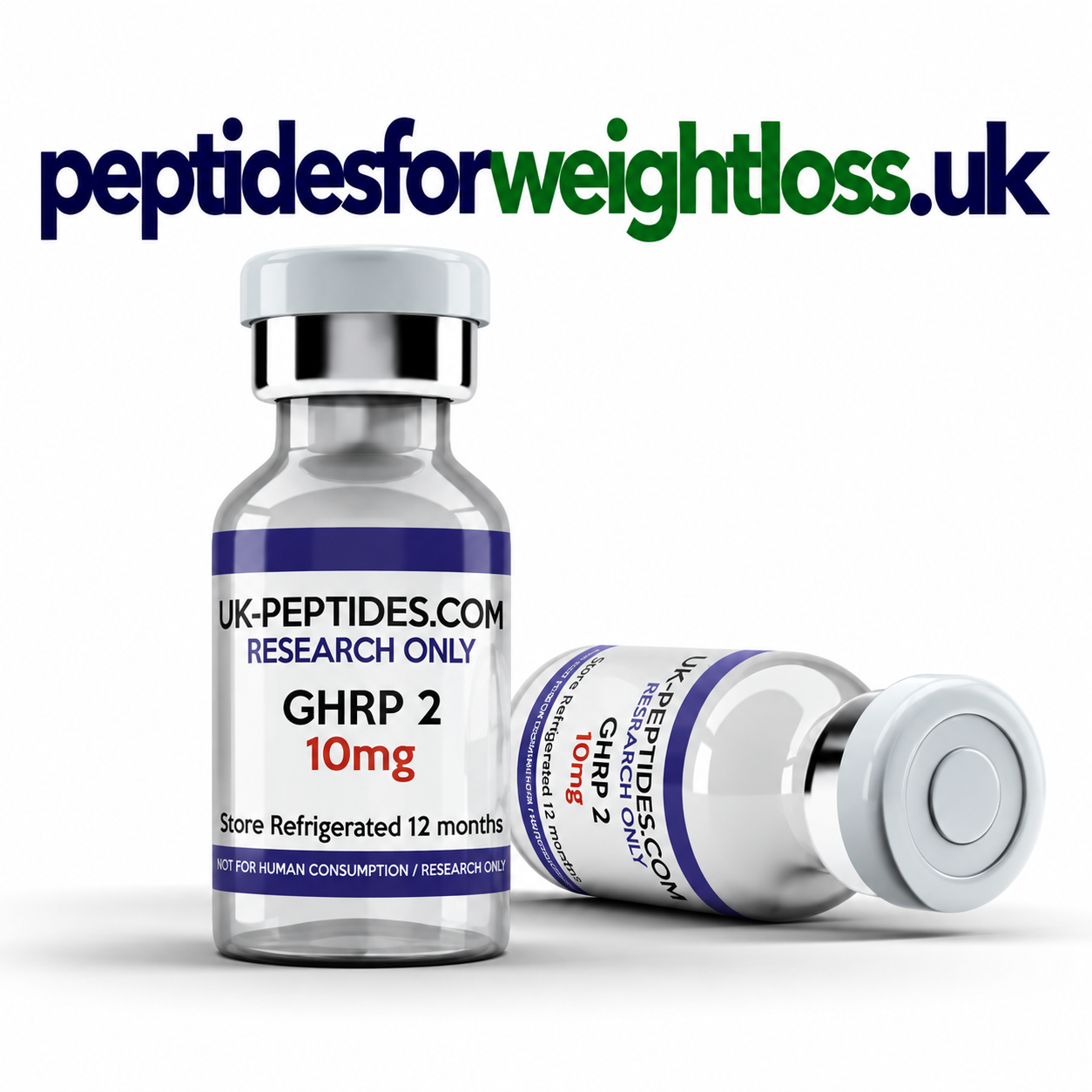
GHRP-2 10mg – Pralmorelin Growth Hormone Releasing Research Peptide
GHRP-2 10mg is a synthetic research hexapeptide associated with scientific investigations into growth hormone secretion, ghrelin receptor signalling and pituitary endocrine regulation. Also known as Pralmorelin or KP-102, GHRP-2 belongs to the growth hormone secretagogue family of peptides.
GHRP-2 has been investigated in laboratory and human experimental research because of its ability to stimulate growth hormone secretion through the growth hormone secretagogue receptor, commonly known as GHSR-1a.
Its scientific background includes studies of receptor pharmacology, pituitary hormone responses, hypothalamic regulation and interactions between different endocrine signalling systems.
Although GHRP-2 demonstrates measurable hormonal activity in controlled experiments, this does not establish that it improves muscle growth, fat loss, physical performance or long-term health outcomes in humans.
What Is GHRP-2 Peptide?
GHRP-2 stands for Growth Hormone Releasing Peptide-2. It is a synthetic hexapeptide designed to investigate the biological mechanisms controlling growth hormone secretion.
GHRP-2 is also known by its international nonproprietary name, Pralmorelin, and by the research designation KP-102.
Unlike naturally occurring growth hormone-releasing hormone (GHRH), GHRP-2 acts through the growth hormone secretagogue receptor pathway.
This receptor system is also associated with ghrelin, a naturally occurring hormone involved in endocrine and appetite-related signalling.
GHRP-2 is not the same molecule as ghrelin, human growth hormone or GHRH.
GHRP-2 10mg Product Specifications
- Product Name: GHRP-2 10mg
- Full Name: Growth Hormone Releasing Peptide-2
- Alternative Name: Pralmorelin
- Research Name: KP-102
- Peptide Classification: Synthetic hexapeptide
- Reference Sequence: D-Ala-D-2Nal-Ala-Trp-D-Phe-Lys-NH2
- Peptide Length: 6 amino acid residues
- Reference Molecular Formula: C45H55N9O6
- Approximate Molecular Weight: 818.0 g/mol (free base)
- CAS Number: 158861-67-7 (reference free base)
- Labelled Quantity: 10mg
- Primary Research Target: Growth Hormone Secretagogue Receptor 1a (GHSR-1a)
- Research Category: Endocrinology and receptor pharmacology
- Research Focus: Growth hormone secretion, pituitary signalling and ghrelin receptor biology
- Salt Form: Requires manufacturer verification
- Purity: Requires batch-specific analytical verification
- Physical Form: Confirm with manufacturer
- Storage: Follow verified manufacturer instructions
- Intended Use: Laboratory research
The reference molecular formula and molecular weight apply to Pralmorelin free base. Acetate, hydrochloride and other salt forms may have different molecular weights and analytical characteristics.
Understanding the Molecular Structure of GHRP-2
GHRP-2 contains six amino acid residues joined through peptide bonds.
Its reference sequence includes D-alanine, D-2-naphthylalanine, alanine, tryptophan, D-phenylalanine and lysine.
The peptide contains several structural features important to its molecular identity.
- D-Alanine: An amino acid with the D-stereochemical configuration.
- D-2-Naphthylalanine: A nonstandard aromatic amino acid residue.
- Alanine: A small amino acid with a nonpolar side chain.
- Tryptophan: An aromatic amino acid containing an indole group.
- D-Phenylalanine: An aromatic amino acid with D-stereochemistry.
- Lysine: A basic amino acid with a positively charged side chain under many physiological conditions.
GHRP-2 also has an amidated C-terminus, represented by NH2.
These stereochemical and structural features distinguish GHRP-2 from other growth hormone-releasing peptides.
Researchers should verify the complete sequence rather than relying only on the product name.
How Does GHRP-2 Work?
GHRP-2 is a synthetic growth hormone secretagogue associated with activation of the GHSR-1a receptor.
Activation of this receptor can stimulate intracellular signalling pathways involved in growth hormone secretion.
GHSR-1a is a G-protein-coupled receptor associated with ghrelin-related endocrine signalling.
Experimental research has investigated pathways involving phospholipase C, intracellular calcium mobilisation and protein kinase activity.
These signalling mechanisms differ from those primarily activated by growth hormone-releasing hormone.
GHRP-2 can therefore provide a useful experimental model for investigating interactions between distinct growth hormone regulatory pathways.
However, an increase in circulating growth hormone is not equivalent to demonstrated improvements in muscle development, fat reduction or clinical health outcomes.
Scientific Research Into GHRP-2
1. Growth Hormone Secretion Research
Growth hormone is produced by somatotroph cells located in the anterior pituitary gland.
Its secretion is regulated by multiple biological factors, including GHRH, somatostatin and ghrelin-associated receptor signalling.
GHRP-2 has been investigated for its ability to stimulate growth hormone release through the growth hormone secretagogue receptor pathway.
Controlled experimental studies have demonstrated measurable growth hormone responses following GHRP-2 exposure.
These findings establish acute hormonal activity but do not prove that GHRP-2 provides sustained therapeutic benefits.
2. Ghrelin Receptor Signalling Research
Ghrelin is a naturally occurring hormone involved in appetite regulation and endocrine signalling.
Its principal signalling receptor is GHSR-1a.
GHRP-2 is a synthetic agonist associated with the same receptor system.
Researchers investigate GHRP-2 to better understand how receptor activation influences pituitary hormone secretion and related physiological responses.
These studies contribute to the broader understanding of ghrelin receptor pharmacology.
However, GHRP-2 and ghrelin have different chemical structures and may produce different biological response profiles.
3. Pituitary Endocrine Research
The pituitary gland regulates several important endocrine systems.
GHRP-2 has been investigated in research measuring the secretion of growth hormone and other pituitary-associated hormones.
Some human investigations have reported changes in additional endocrine markers, including ACTH and cortisol, under specific experimental conditions.
These observations demonstrate that growth hormone secretagogue research may involve multiple hormonal pathways.
They also highlight the importance of evaluating endocrine selectivity rather than assuming that GHRP-2 affects growth hormone alone.
4. GHRP-2 and GHRH Research
Growth hormone-releasing hormone is a naturally occurring hypothalamic peptide involved in regulating pituitary growth hormone secretion.
GHRP-2 activates a different receptor-associated pathway.
Researchers have investigated interactions between growth hormone secretagogues and GHRH in experimental settings.
Some studies reported enhanced growth hormone responses when both signalling systems were stimulated under controlled conditions.
These findings are relevant to basic endocrinology and the study of hormone regulation.
They should not be interpreted as instructions or recommendations for combined administration.
5. Hypothalamic and Neuroendocrine Regulation
The hypothalamus helps coordinate endocrine activity through signals that influence pituitary function.
GHRP-2 research has contributed to investigations of the relationship between hypothalamic signalling and growth hormone secretion.
Experimental studies have examined how different regulatory systems influence the magnitude and timing of hormonal responses.
These interactions are complex and depend on physiological conditions, receptor activity and other endocrine signals.
Research findings should therefore be interpreted within the specific experimental setting.
6. Appetite and Energy Balance Research
GHRP-2 is associated with appetite research because its receptor target is involved in ghrelin signalling.
Ghrelin receptor activation can influence hunger-related neural pathways and endocrine responses.
Researchers have investigated appetite-related effects of growth hormone secretagogues in experimental studies.
However, GHRP-2 should not be described as a proven appetite suppressant or an approved weight-management treatment.
Its endocrine activity does not establish sustained changes in body weight or body composition.
7. Growth Hormone and IGF-1 Research
Growth hormone influences multiple physiological processes, including the regulation of insulin-like growth factor 1 (IGF-1).
Researchers studying GHRP-2 have examined its relationship with the broader growth hormone regulatory system.
Acute growth hormone responses are important experimental measurements but do not automatically predict sustained changes in IGF-1 concentrations.
Long-term endocrine outcomes depend on numerous factors, including feedback regulation and physiological context.
These complexities limit conclusions that can be drawn from short-term hormone measurements alone.
8. Endocrine Feedback Research
Hormonal systems operate through feedback mechanisms that help regulate secretion and receptor responses.
Growth hormone secretion is influenced by inhibitory and stimulatory signals.
Research involving GHRP-2 can help scientists investigate how these regulatory mechanisms interact.
Experimental outcomes may vary depending on the study population, physiological conditions and measurement methods.
Consequently, findings from isolated cells or short-term studies should not be assumed to represent long-term human effects.
GHRP-2 vs GHRP-6: What Is the Difference?
GHRP-2 and GHRP-6 are synthetic hexapeptides associated with growth hormone secretagogue research.
Although both have six amino acid residues, they differ in their molecular structures.
- GHRP-2: Also known as Pralmorelin, with the sequence D-Ala-D-2Nal-Ala-Trp-D-Phe-Lys-NH2.
- GHRP-6: A different hexapeptide with the sequence His-D-Trp-Ala-Trp-D-Phe-Lys-NH2.
- Research Target: Both are associated with GHSR-1a receptor signalling.
- Molecular Identity: Their distinct amino acid sequences produce different chemical structures.
- Experimental Responses: Their endocrine and appetite-related effects may vary under different study conditions.
Research results involving GHRP-6 should not automatically be applied to GHRP-2.
GHRP-2 vs Ipamorelin
GHRP-2 and ipamorelin are different synthetic growth hormone secretagogues.
Both have been investigated for their effects on growth hormone secretion.
However, their amino acid sequences, molecular structures and endocrine response profiles differ.
Some preclinical research involving ipamorelin has focused on growth hormone selectivity.
Findings involving ipamorelin cannot establish equivalent selectivity or safety for GHRP-2.
GHRP-2 and Muscle Growth Research
GHRP-2 is sometimes discussed in connection with muscle development because it stimulates growth hormone secretion in experimental settings.
However, short-term changes in hormone concentrations do not demonstrate sustained increases in skeletal muscle mass or strength.
There is insufficient reliable clinical evidence establishing that GHRP-2 improves muscle growth, exercise recovery or athletic performance.
Commercial claims describing GHRP-2 as a guaranteed muscle-building peptide are therefore unsupported.
GHRP-2 and Weight Management
GHRP-2 is not an established weight-loss treatment.
Its interaction with the ghrelin receptor makes it relevant to investigations of appetite and metabolic signalling.
However, there is insufficient clinical evidence that GHRP-2 produces sustained fat loss or meaningful reductions in body weight.
Its relationship with appetite-associated pathways is particularly important when evaluating unsupported fat-burning claims.
Understanding the GHRP-2 10mg Label
The 10mg designation refers to the labelled quantity of peptide material.
It does not represent a recommended human dose or independently establish purity, sterility, molecular identity or suitability for administration.
Researchers should verify the actual peptide content, salt form and batch-specific analytical specifications using manufacturer documentation.
GHRP-2 10mg Research Quality and Product Documentation
Important considerations when evaluating GHRP-2 research material include:
- Confirmation of the six-residue peptide sequence
- Verification of the D-amino-acid configurations
- Confirmation of the D-2-naphthylalanine residue
- Verification of C-terminal amidation
- Identification of the free-base or salt form
- Batch-specific certificate of analysis
- Appropriate analytical purity testing
- Mass spectrometry or another suitable identity test
- Accurate labelled peptide quantity
- Manufacturer and batch traceability
- Documentation of counterions and formulation components
- Verified packaging specifications
- Product-specific storage and stability information
- Clearly stated research-use classification
These records help distinguish verified research materials from unsupported commercial purity or quality claims.
Storage and Handling of GHRP-2 Peptide
GHRP-2 research material should be stored according to verified manufacturer instructions.
Storage requirements depend on the peptide’s salt form, physical state, formulation and packaging.
Researchers should not assume that all GHRP-2 products have identical storage requirements or shelf-life characteristics.
Laboratory handling should follow relevant safety documentation and institutional procedures.
GHRP-2 Safety and Scientific Limitations
GHRP-2 is a biologically active synthetic growth hormone secretagogue.
Its acute effects on hormone secretion have been investigated, but comprehensive long-term human safety data remain limited.
Potential concerns include endocrine disturbances, effects on glucose regulation, peptide-related impurities, immune reactions and uncertainty about different formulations.
Research-grade GHRP-2 should not be assumed suitable for human administration.
Regulatory status may vary by jurisdiction and specific medicinal product. Research-grade GHRP-2 is not an established approved treatment for muscle growth or weight management in the United Kingdom.
This information is intended for scientific and educational purposes only and does not provide medical advice, human dosing recommendations or administration instructions.
Frequently Asked Questions About GHRP-2 10mg
What is GHRP-2 10mg?
GHRP-2 10mg is a product listing for a synthetic six-residue growth hormone secretagogue with a labelled quantity of 10mg.
What does GHRP-2 stand for?
GHRP-2 stands for Growth Hormone Releasing Peptide-2.
What is another name for GHRP-2?
GHRP-2 is also known as Pralmorelin or KP-102.
What is the GHRP-2 peptide sequence?
The reference sequence is D-Ala-D-2Nal-Ala-Trp-D-Phe-Lys-NH2.
How many amino acids are in GHRP-2?
GHRP-2 contains six amino acid residues.
What is the molecular weight of GHRP-2?
The reference free-base peptide has an approximate molecular weight of 818.0 g/mol.
What receptor does GHRP-2 interact with?
GHRP-2 is associated with the growth hormone secretagogue receptor, GHSR-1a.
Is GHRP-2 the same as GHRP-6?
No. GHRP-2 and GHRP-6 are different peptides with distinct molecular structures.
Does GHRP-2 increase muscle mass?
There is insufficient reliable clinical evidence establishing that GHRP-2 produces sustained muscle growth in humans.
Is GHRP-2 a weight-loss peptide?
No. GHRP-2 is not an established weight-loss treatment.
What does GHRP-2 10mg mean?
The 10mg designation refers to the labelled quantity of peptide material, not a recommended human dose.
GHRP-2 10mg – Product Summary
GHRP-2 10mg is a synthetic hexapeptide associated with scientific investigations into growth hormone secretion, ghrelin receptor activity and endocrine regulation.
Also known as Pralmorelin, GHRP-2 has a defined molecular structure that includes D-amino-acid residues, a nonstandard naphthylalanine residue and C-terminal amidation.
Although controlled experimental research demonstrates acute growth hormone secretagogue activity, GHRP-2 has not been established as a clinically effective treatment for muscle development, fat loss or athletic performance.
Researchers should verify the exact molecular identity, stereochemistry, salt form, purity, batch documentation and storage requirements before selecting GHRP-2 10mg for laboratory investigation.

Reviews
There are no reviews yet.