
Description
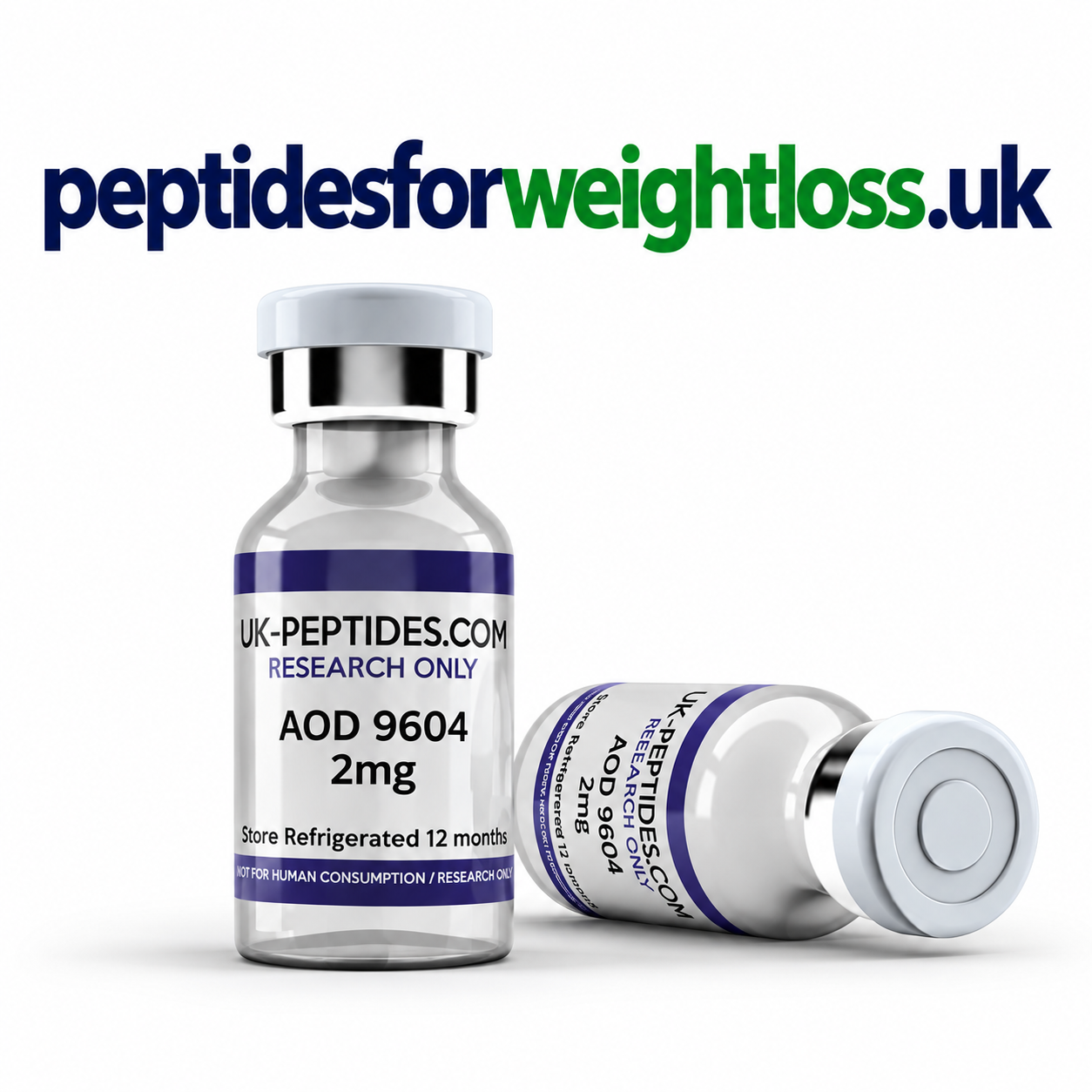
AOD-9604 2mg – Human Growth Hormone Fragment Research Peptide
AOD-9604 2mg is a synthetic research peptide associated with scientific investigations into lipid metabolism, fat-cell signalling and the biological activity of human growth hormone fragments. Also known as Anti-Obesity Drug 9604, AOD-9604 is a 16-amino-acid peptide developed from the C-terminal region of human growth hormone (HGH).
AOD-9604 attracted research interest because early experimental studies investigated whether a selected growth hormone fragment could influence fat metabolism without reproducing the broader growth-promoting effects of the complete HGH molecule.
Although laboratory and animal studies reported changes in selected lipid metabolism measurements, subsequent human obesity research did not establish clinically meaningful weight-loss effectiveness. AOD-9604 remains an investigational compound and is not an approved weight-management treatment.
This AOD-9604 2mg product description provides an overview of the peptide’s molecular structure, proposed mechanisms, experimental applications, human clinical evidence, safety limitations and research quality considerations.
What Is AOD-9604 Peptide?
AOD-9604 is a synthetic hexadecapeptide consisting of 16 amino acid residues.
Its structure is based on the C-terminal portion of human growth hormone, specifically residues 177-191, with an additional tyrosine residue at the N-terminus.
It is frequently described as a modified HGH fragment 176-191, although this terminology should not be confused with the precise numbering of residues in the original growth hormone sequence.
AOD-9604 was developed as an experimental compound for investigating lipid metabolism and obesity-related biological processes.
The peptide has been studied in animal models and human clinical trials, but it has not demonstrated sufficient clinical effectiveness to become an approved weight-loss medicine.
AOD-9604 2mg Product Specifications
- Product Name: AOD-9604 2mg
- Full Research Name: Anti-Obesity Drug 9604
- Alternative Name: Tyr-hGH (177-191)
- Additional Research Name: LAT8881
- Peptide Classification: Synthetic growth hormone-derived hexadecapeptide
- Peptide Length: 16 amino acids
- Reference Sequence: Tyr-Leu-Arg-Ile-Val-Gln-Cys-Arg-Ser-Val-Glu-Gly-Ser-Cys-Gly-Phe
- One-Letter Sequence: YLRIVQCRSVEGSCGF
- Reference Molecular Formula: C78H123N23O23S2 (oxidised free peptide with disulfide bond)
- Approximate Molecular Weight: 1,815.1 g/mol
- CAS Number: 221231-10-3
- Labelled Quantity: 2mg
- Research Category: Peptide metabolism and growth hormone fragment research
- Research Focus: Lipolysis, fat oxidation and experimental metabolic signalling
- Purity: Requires batch-specific analytical verification
- Salt Form: Confirm with manufacturer
- Physical Form: Confirm with manufacturer
- Storage: Follow verified manufacturer instructions
- Intended Use: Laboratory research
The molecular formula and molecular weight above refer to the oxidised free-peptide reference structure. Product-specific counterions, salt forms and modifications may affect analytical specifications.
Understanding the Molecular Structure of AOD-9604
AOD-9604 contains 16 amino acid residues linked through peptide bonds.
The peptide was designed using the C-terminal region of human growth hormone, with an additional tyrosine residue incorporated into its structure.
Two cysteine residues within the sequence can form an intramolecular disulfide bond. This bond is an important structural feature of the commonly documented AOD-9604 reference molecule.
Because disulfide bond formation changes the molecular formula and chemical properties of a peptide, researchers should verify the exact molecular form supplied.
The molecular structure of AOD-9604 is central to its investigation as a growth hormone-derived research compound.
How Does AOD-9604 Work?
AOD-9604 was developed to investigate whether selected metabolic activities associated with human growth hormone could be studied separately from its conventional growth-promoting effects.
Early animal research examined changes in lipolysis, the breakdown of stored triglycerides into fatty acids and glycerol.
Other experimental investigations measured fat oxidation and changes in body-weight gain in rodent models.
Researchers have explored possible relationships between AOD-9604 and adrenergic signalling, including pathways associated with beta-3 adrenergic receptors.
However, the precise mechanism responsible for its experimental metabolic effects remains incompletely understood, and a clinically validated mechanism producing meaningful human weight loss has not been established.
Scientific Research Into AOD-9604
1. Lipolysis and Fat Metabolism Research
Lipolysis is the biochemical process through which stored triglycerides are broken down into fatty acids and glycerol.
This process contributes to the mobilisation of stored energy and is regulated by several hormonal and cellular signalling systems.
AOD-9604 has been investigated in experimental models designed to examine lipolysis and fat metabolism.
Some preclinical studies reported changes in fat-related metabolic measurements following exposure to the peptide.
These findings helped motivate the development of AOD-9604 as an experimental obesity compound.
However, changes in lipolysis observed in animals or isolated cells do not demonstrate that AOD-9604 produces sustained fat loss in humans.
2. Animal Obesity Models
Researchers have investigated AOD-9604 in rodent models of obesity and metabolic regulation.
Some studies reported reductions in body-weight gain and changes in fat oxidation under specific experimental conditions.
These investigations suggested that selected growth hormone fragments might influence metabolic pathways differently from full-length human growth hormone.
Animal models are valuable for generating biological hypotheses, but they cannot establish clinical effectiveness in humans.
The later human obesity development programme did not confirm the weight-loss benefits suggested by the early experimental research.
3. Human Obesity Clinical Trials
AOD-9604 progressed beyond animal research into human clinical development as a potential obesity treatment.
Clinical investigations evaluated its safety, tolerability and effects on body-weight-related outcomes.
Although some earlier studies suggested possible metabolic activity, the larger phase IIb obesity trial did not demonstrate a statistically significant weight-loss advantage over placebo.
The original obesity development programme was subsequently discontinued.
These findings are particularly important when evaluating commercial claims about AOD-9604, because the human clinical evidence does not establish reliable weight-loss effectiveness.
4. Growth Hormone and IGF-1 Research
Human growth hormone participates in growth, metabolism and other physiological processes.
Many effects of full-length growth hormone involve insulin-like growth factor 1 (IGF-1) signalling.
AOD-9604 was developed to investigate whether selected metabolic effects could be separated from the broader hormonal actions of the complete growth hormone molecule.
Published research has examined endocrine and metabolic safety measurements in participants exposed to AOD-9604 during controlled studies.
However, the absence of certain short-term hormonal changes does not establish long-term safety or clinical benefit.
5. Beta-3 Adrenergic Signalling Research
Beta-3 adrenergic receptors are involved in metabolic regulation, including certain processes related to fat tissue biology.
Experimental research has explored whether beta-3 adrenergic signalling contributes to the metabolic effects observed with AOD-9604.
Some animal investigations examined responses in models with altered adrenergic receptor activity.
The results suggest that the relationship between AOD-9604 and adrenergic signalling may be more complex than a single-receptor explanation.
AOD-9604 should therefore not be described as a clinically validated beta-3 receptor agonist.
6. Fat Oxidation Research
Fat oxidation refers to the metabolic use of fatty acids to produce energy.
Preclinical AOD-9604 studies have examined changes in fat oxidation and other indicators of lipid metabolism.
These measurements can help researchers investigate how experimental compounds influence energy-related biological pathways.
However, increased fat oxidation in an experimental model does not necessarily produce clinically meaningful changes in body composition.
Human clinical evidence has not established AOD-9604 as an effective treatment for reducing body fat.
7. Cartilage and Joint Research
Research involving AOD-9604 and its later development name LAT8881 has extended beyond obesity-related investigations.
Preclinical studies have examined selected outcomes involving cartilage and joint biology.
Later clinical research programmes also investigated pain-related indications.
These investigations should be evaluated separately from the historical obesity research programme.
Neither the preclinical joint findings nor the available clinical development record establishes AOD-9604 as an approved treatment for cartilage damage, osteoarthritis or chronic pain.
AOD-9604 vs Human Growth Hormone: What Is the Difference?
AOD-9604 and human growth hormone are related through molecular design but are not the same compound.
- AOD-9604: A synthetic 16-amino-acid peptide derived from the C-terminal region of human growth hormone.
- Human Growth Hormone: A naturally occurring protein hormone consisting of 191 amino acids in its principal circulating form.
- Molecular Structure: AOD-9604 represents a small modified fragment rather than the complete HGH molecule.
- Research Focus: AOD-9604 was investigated for potential metabolic effects, while full-length HGH has broader physiological functions.
- Clinical Status: AOD-9604 has not been established as an approved weight-loss treatment.
Research findings involving full-length HGH cannot automatically be attributed to AOD-9604.
AOD-9604 and Weight Loss: What Does the Evidence Show?
AOD-9604 was developed as a potential anti-obesity compound, but its clinical development history does not support claims of proven weight-loss effectiveness.
Early experimental studies suggested that the peptide might influence fat metabolism in animals.
However, the larger human obesity trial did not establish a statistically significant benefit over placebo.
Therefore, statements describing AOD-9604 as a proven fat burner, guaranteed weight-loss peptide or clinically validated treatment for obesity are not supported by the available evidence.
Its scientific relevance lies primarily in the investigation of growth hormone fragments and experimental metabolic signalling.
AOD-9604 and Body Composition Research
Body composition research examines the relative proportions of fat mass, lean tissue and other components of body weight.
Experimental studies of AOD-9604 have considered changes in lipid metabolism and body-weight-related outcomes.
However, no reliable clinical evidence establishes that AOD-9604 consistently reduces body fat while preserving or increasing muscle mass in humans.
Its proposed body-composition effects should remain clearly distinguished from clinically demonstrated results.
Understanding the AOD-9604 2mg Label
The 2mg designation identifies the labelled quantity of peptide material.
It does not represent a recommended human dose or independently establish purity, sterility, chemical identity or suitability for administration.
Researchers should verify the exact molecular form, salt form and batch-specific analytical specifications using manufacturer documentation.
AOD-9604 2mg Research Quality and Product Documentation
Important considerations when evaluating AOD-9604 research material include:
- Verification of the 16-amino-acid sequence
- Confirmation of the N-terminal tyrosine residue
- Verification of the intramolecular disulfide bond
- Identification of the free peptide or salt form
- Batch-specific certificate of analysis
- Appropriate analytical purity testing
- Mass spectrometry or another suitable identity method
- Accurate labelled peptide quantity
- Manufacturer and batch traceability
- Information about counterions and formulation components
- Verified packaging specifications
- Product-specific storage and stability documentation
- Clearly stated research-use classification
These details are essential for distinguishing verified research material from unsupported claims about product quality.
Storage and Handling of AOD-9604 Peptide
AOD-9604 research material should be stored according to verified manufacturer instructions.
Storage conditions depend on the peptide’s molecular form, physical state, formulation, packaging and available stability data.
Researchers should not assume that all AOD-9604 products have identical storage requirements or shelf-life characteristics.
Laboratory handling should follow relevant safety documentation and institutional procedures.
AOD-9604 Safety and Scientific Limitations
AOD-9604 remains an investigational peptide with important limitations in the available clinical evidence.
Human studies have evaluated selected short-term safety outcomes, but these findings do not establish long-term safety or the safety of independently supplied research formulations.
Potential concerns include immune reactions, peptide aggregation, product-related impurities and uncertainty about the effects of different formulations or administration routes.
Regulatory reviews have identified insufficient information to establish the safety of AOD-9604 free base and acetate in proposed compounded preparations.
AOD-9604 is not an established FDA-, EMA- or MHRA-approved medicine for weight management or other medical conditions.
Research-grade material must not be assumed suitable for injection, ingestion or other human administration.
This information is intended for scientific and educational purposes only and does not provide medical advice, human dosing recommendations or administration instructions.
Frequently Asked Questions About AOD-9604 2mg
What is AOD-9604 2mg?
AOD-9604 2mg is a product listing for a synthetic 16-amino-acid growth hormone-derived research peptide with a labelled quantity of 2mg.
What does AOD-9604 stand for?
AOD-9604 stands for Anti-Obesity Drug 9604, reflecting its original research development programme.
What is the AOD-9604 peptide sequence?
The reference sequence is YLRIVQCRSVEGSCGF.
How many amino acids are in AOD-9604?
AOD-9604 contains 16 amino acid residues.
What is the molecular weight of AOD-9604?
The oxidised free peptide has an approximate molecular weight of 1,815.1 g/mol.
Is AOD-9604 the same as HGH?
No. AOD-9604 is a small modified fragment derived from human growth hormone, not the complete HGH protein.
Does AOD-9604 cause weight loss?
The larger human obesity trial did not establish a statistically significant weight-loss benefit over placebo.
What is AOD-9604 researched for?
AOD-9604 has been investigated in research involving lipid metabolism, obesity-related outcomes, growth hormone fragments and selected pain and joint-related models.
Is AOD-9604 an approved weight-loss medicine?
No. AOD-9604 is not an established approved medicine for obesity treatment.
What does AOD-9604 2mg mean?
The 2mg designation refers to the labelled quantity of peptide material, not a recommended human dose.
Is AOD-9604 safe for human use?
Available clinical studies do not establish comprehensive long-term safety, and research-grade products should not be assumed suitable for human administration.
AOD-9604 2mg – Product Summary
AOD-9604 2mg is a synthetic growth hormone-derived hexadecapeptide associated with scientific investigations into fat metabolism, lipolysis and experimental metabolic signalling.
Its 16-amino-acid structure and historical obesity development programme make it relevant to research into growth hormone fragments.
Although early animal studies reported metabolic effects, human clinical trials did not establish reliable weight-loss effectiveness.
Researchers should verify the peptide’s exact molecular identity, disulfide bond, salt form, purity, batch documentation and storage requirements before selecting AOD-9604 2mg for laboratory investigation.
Reviews
There are no reviews yet.