
Description
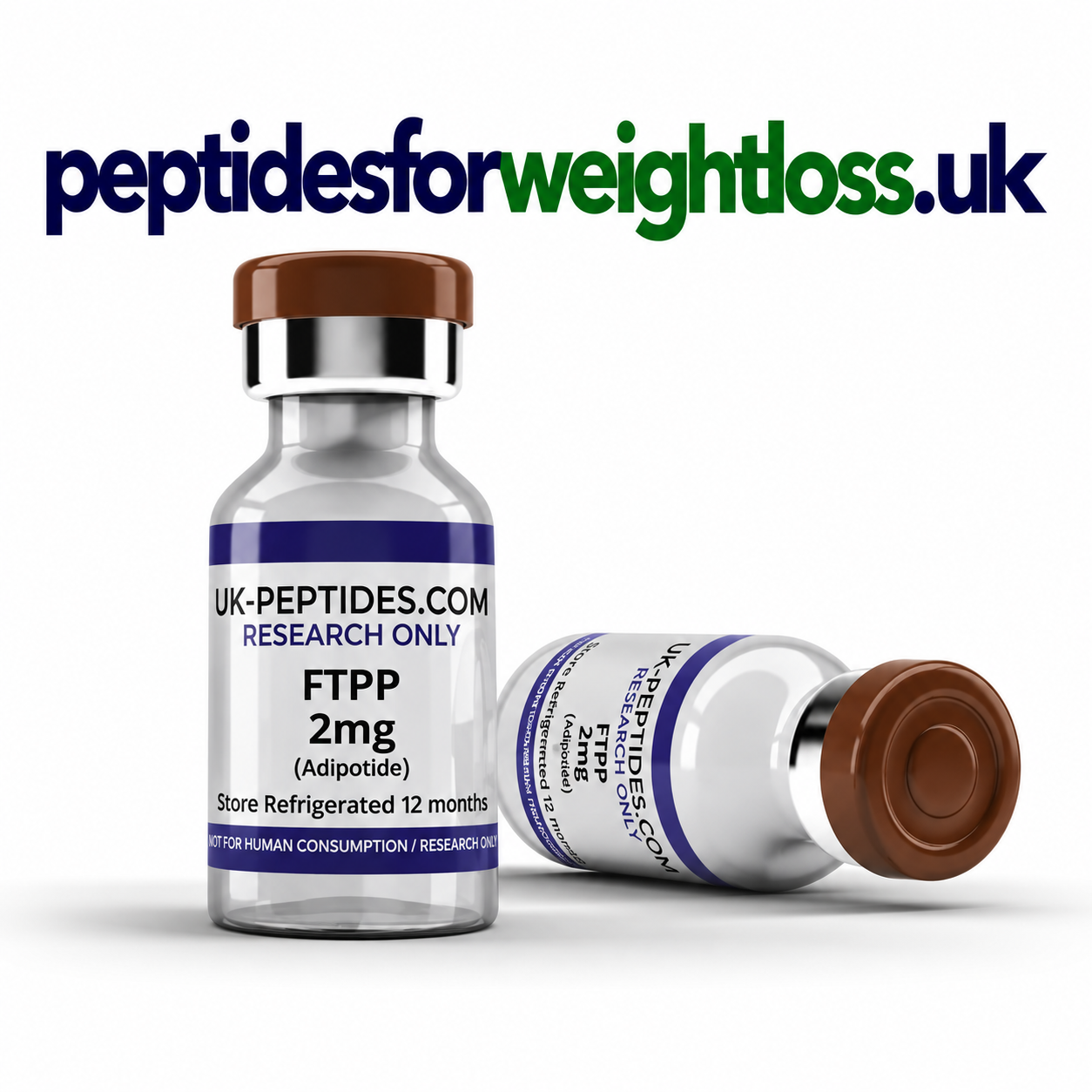
FTPP Adipotide 2mg – Fat-Targeted Proapoptotic Research Peptide
FTPP Adipotide 2mg is a synthetic research peptidomimetic investigated in experimental studies of white adipose tissue, vascular targeting, programmed cell death and obesity-related biology. Also known as Adipotide, FTPP or prohibitin-targeting peptide, the compound was developed to investigate whether selective disruption of blood vessels supplying white adipose tissue could alter fat accumulation in animal models.
FTPP Adipotide 2mg is associated with research into ligand-directed targeting, mitochondrial membrane disruption and apoptosis in adipose tissue-associated vascular cells. Unlike compounds that primarily influence appetite or metabolic hormone receptors, Adipotide was designed to target the vascular support system of white adipose tissue.
Published preclinical studies reported reductions in body weight and white adipose tissue in selected animal models. However, primate experiments also identified dose-related kidney toxicity, including renal tubular injury and changes in kidney function measurements.
FTPP Adipotide 2mg remains an investigational research material. There is no established evidence that Adipotide is a safe or effective human weight-loss treatment, and its potential toxicity is a major limitation.
What Is FTPP Adipotide 2mg?
FTPP Adipotide 2mg refers to a product labelled as containing 2mg of Adipotide, a synthetic peptide-based compound investigated for its ability to target blood vessels associated with white adipose tissue.
Adipotide is commonly described as a fat-targeted proapoptotic peptide. Its molecular design combines a targeting sequence with a second sequence intended to induce cell death after cellular uptake.
The compound was developed through investigations into proteins expressed on the surface of blood vessels supplying adipose tissue.
Its research history includes laboratory experiments, rodent studies and investigations involving obese nonhuman primates.
Researchers evaluating FTPP Adipotide 2mg should distinguish these preclinical observations from established clinical outcomes.
Adipotide has not been validated as an approved treatment for obesity or metabolic disease in humans.
FTPP Adipotide 2mg Product Specifications
- Product Name: FTPP Adipotide 2mg
- Alternative Names: Adipotide, FTPP, Prohibitin-Targeting Peptide-1
- Compound Classification: Synthetic targeted proapoptotic peptidomimetic
- Reference Sequence: CKGGRAKDC-GG-D(KLAKLAK)2
- Targeting Motif: CKGGRAKDC
- Linker: Gly-Gly
- Proapoptotic Domain: D(KLAKLAK)2
- Peptide Length: 25 amino acid residues
- Reference Molecular Formula: C111H206N36O28S2
- Reference Molecular Weight: Approximately 2557.2 g/mol
- Commonly Listed CAS Number: 859216-15-2
- Labelled Quantity: 2mg
- Research Category: Adipose tissue and vascular biology
- Research Focus: Prohibitin-associated targeting, apoptosis and experimental obesity models
- Purity: Requires batch-specific verification
- Salt Form: Confirm with manufacturer
- Physical Form: Confirm with manufacturer
- Storage: Follow verified manufacturer instructions
- Intended Use: Laboratory research only
These reference specifications describe a commonly documented form of Adipotide. Commercial materials may differ in counterions, terminal chemistry or other analytical characteristics. Batch-specific testing is necessary to verify the identity of FTPP Adipotide 2mg.
Understanding the Molecular Structure of Adipotide
Adipotide is a chimeric peptide-based molecule containing two functional domains joined by a short linker.
The reference sequence is:
CKGGRAKDC-GG-D(KLAKLAK)2
The first domain, CKGGRAKDC, was investigated as a targeting motif associated with proteins expressed on white adipose tissue vasculature.
The glycine-glycine linker connects the targeting motif to the second functional domain.
The second domain, D(KLAKLAK)2, contains D-amino acid residues and was designed to disrupt mitochondrial membranes following cellular internalisation.
The distinction between D- and L-amino acids is important because stereochemistry can influence peptide stability and biological activity.
Researchers should also verify the cysteine oxidation state and any disulfide bonding within the targeting region.
How Does FTPP Adipotide Work?
FTPP Adipotide was developed to investigate targeted apoptosis in blood vessels supplying white adipose tissue.
The proposed mechanism involves recognition of selected vascular surface proteins, cellular internalisation and disruption of mitochondrial membranes.
Early studies identified prohibitin as a protein associated with the targeting motif.
Subsequent research also investigated the role of annexin A2 in adipose vascular targeting.
After cellular uptake, the proapoptotic component can disrupt mitochondrial membranes in experimental systems.
This process may activate pathways associated with programmed cell death.
In animal studies, damage to the vascular support of adipose tissue was associated with reductions in white adipose tissue mass.
However, the same experimental programme identified important off-target toxicity, particularly involving the kidneys.
Scientific Research Into FTPP Adipotide 2mg
1. FTPP Adipotide 2mg and White Adipose Tissue Research
White adipose tissue is an energy-storing tissue composed of adipocytes, vascular cells, immune cells and supporting structures.
Blood vessels supply adipose tissue with oxygen and nutrients.
Adipotide research investigated whether selectively disrupting these vessels could influence adipose tissue survival.
Animal studies reported reductions in white adipose tissue following exposure to the compound.
However, these results were obtained in controlled preclinical experiments and cannot establish safe human weight loss.
2. FTPP Adipotide and Prohibitin Research
Prohibitin is a protein associated with several cellular functions, including mitochondrial biology.
Research also identified prohibitin-associated targets on the surface of selected vascular endothelial cells.
The CKGGRAKDC motif was investigated for its ability to recognise these targets.
This targeting concept contributed to the development of Adipotide.
However, prohibitin is not exclusively associated with fat tissue, and tissue-selective targeting does not guarantee an absence of effects elsewhere in the body.
3. FTPP Adipotide 2mg and Vascular Targeting
Vascular targeting involves directing a molecule towards selected cells associated with blood vessels.
Adipotide was designed to recognise targets associated with white adipose tissue vasculature.
Its development illustrates the concept of combining a targeting ligand with a biologically active payload.
In preclinical studies, this approach was associated with disruption of selected adipose vascular structures.
However, the degree of targeting selectivity and potential effects on other tissues require careful evaluation.
4. Adipotide and Apoptosis Research
Apoptosis is a regulated form of programmed cell death.
It involves several signalling pathways and can include mitochondrial membrane changes.
Adipotide incorporates a domain designed to induce apoptosis after entering target cells.
Researchers have examined this process in experimental vascular and adipose tissue models.
However, deliberately inducing cell death carries substantial biological risks.
Experimental apoptotic activity should not be interpreted as evidence of therapeutic safety.
5. FTPP Adipotide 2mg and Mitochondrial Membrane Research
Mitochondria participate in cellular energy metabolism and regulated cell-death pathways.
The D(KLAKLAK)2 component of Adipotide was designed to disrupt mitochondrial membranes.
This activity is relevant to the compound’s experimental proapoptotic mechanism.
Researchers studying FTPP Adipotide 2mg should distinguish its destructive cellular activity from compounds intended to improve mitochondrial function.
Adipotide is not established as a mitochondrial health supplement or metabolic enhancer.
6. FTPP Adipotide and Obesity Research
Obesity is a complex chronic condition involving genetic, environmental, behavioural and metabolic factors.
Adipotide was investigated as an experimental approach that differed from conventional appetite-regulating or metabolic treatments.
In a 2011 study involving obese rhesus monkeys, researchers reported reductions in body weight and adipose tissue measurements.
The same study identified changes in renal function and kidney tissue.
These safety findings limit the interpretation of the observed weight-loss effects.
FTPP Adipotide 2mg is not an established or approved treatment for obesity.
7. FTPP Adipotide 2mg and Nonhuman Primate Research
Nonhuman primate models are sometimes used to investigate biological responses that may differ between rodents and humans.
A published study examined Adipotide in obese rhesus monkeys and included additional investigations involving other Old World monkey species.
The researchers reported changes in body weight, adipose tissue and insulin-resistance measurements.
However, the experiments also identified dose-related renal toxicity.
Animal findings cannot establish a safe human therapeutic dose or long-term safety profile.
8. FTPP Adipotide and Insulin Resistance Research
Insulin resistance occurs when cells respond less effectively to insulin signalling.
It is associated with several metabolic conditions, including obesity and type 2 diabetes.
The 2011 primate study reported improvements in selected insulin-resistance measurements following Adipotide exposure.
These changes occurred alongside reductions in body weight and adipose tissue.
However, the study did not establish that Adipotide safely treats insulin resistance in humans.
9. FTPP Adipotide 2mg and Visceral Fat Research
Visceral fat is adipose tissue located around internal abdominal organs.
It is associated with metabolic risk when present in excess.
The published primate study used imaging methods, including magnetic resonance imaging and dual-energy X-ray absorptiometry, to investigate changes in adipose tissue.
The investigators reported reductions in white adipose tissue, including visceral fat.
However, these results should not be interpreted as evidence that FTPP Adipotide 2mg safely reduces visceral fat in humans.
10. FTPP Adipotide and Kidney Toxicity Research
Kidney toxicity is one of the most important safety findings associated with Adipotide.
In nonhuman primate experiments, researchers observed changes in serum creatinine, urinary glucose, urinary protein and renal tubular function.
Histological examination identified renal tubular degeneration and other tissue changes.
Some abnormalities improved after treatment ended, but this does not establish that the compound is safe.
The findings demonstrate that Adipotide can affect tissues outside its intended adipose vascular target.
Any scientifically accurate description of FTPP Adipotide 2mg should clearly acknowledge these risks.
11. FTPP Adipotide 2mg and Renal Tubular Biology
Renal tubules participate in the filtration and reabsorption processes necessary for maintaining fluid and electrolyte balance.
Damage to tubular cells can impair kidney function.
Adipotide studies identified dose-related changes involving renal proximal tubules.
These observations are important for understanding the compound’s preclinical toxicology.
They also demonstrate why weight-loss findings cannot be evaluated independently of safety outcomes.
12. FTPP Adipotide and Peptide Stereochemistry
Stereochemistry describes the three-dimensional arrangement of atoms within molecules.
Most naturally occurring protein amino acids have the L-configuration.
Adipotide incorporates a proapoptotic sequence containing D-amino acid residues.
This modification is relevant to the compound’s stability and biological properties.
Researchers should confirm stereochemistry when evaluating the identity of FTPP Adipotide 2mg.
13. FTPP Adipotide 2mg and Targeted Drug Delivery Research
Targeted delivery research investigates how biological or chemical recognition mechanisms can direct compounds towards selected tissues.
Adipotide combines a targeting motif with a proapoptotic component.
This molecular design is relevant to the broader study of ligand-directed delivery systems.
However, successful targeting in one experimental model does not guarantee tissue selectivity or safety in humans.
14. FTPP Adipotide and Angiogenesis Research
Angiogenesis is the process through which new blood vessels form from existing vessels.
Adipose tissue expansion involves changes in vascular structure and blood supply.
Adipotide research explored a vascular-targeting approach to modifying adipose tissue.
However, Adipotide should not be described as a conventional or broadly selective angiogenesis inhibitor.
Its proposed mechanism involves targeted endothelial cell apoptosis rather than general suppression of new blood vessel formation.
15. FTPP Adipotide 2mg and Metabolic Research
Metabolic research examines how tissues store, release and utilise energy.
Adipotide has been investigated in animal studies involving adipose tissue mass and insulin-resistance measurements.
However, these studies do not establish that FTPP Adipotide 2mg safely increases metabolic rate or improves metabolic health in humans.
Its experimental effects should be interpreted together with the documented kidney toxicity.
FTPP Adipotide 2mg vs AOD-9604
FTPP Adipotide and AOD-9604 are different research compounds.
- FTPP Adipotide: A targeted proapoptotic peptidomimetic investigated for its effects on white adipose tissue vasculature.
- AOD-9604: A synthetic fragment of human growth hormone investigated in metabolic and obesity-related research.
- Research Mechanism: Adipotide was designed to disrupt selected vascular cells, while AOD-9604 was investigated through a different metabolic research approach.
- Clinical Evidence: Neither compound should be assumed to provide established, safe human weight-loss benefits.
FTPP Adipotide 2mg vs GLP-1 Research Compounds
GLP-1 receptor agonists and Adipotide act through fundamentally different biological mechanisms.
GLP-1 receptor agonists influence hormone-related pathways involved in glucose regulation and appetite.
Adipotide was designed to target vascular cells associated with white adipose tissue.
These mechanisms are not interchangeable.
Results involving approved GLP-1 medicines do not establish the safety or effectiveness of Adipotide.
FTPP Adipotide 2mg and Human Weight Loss Claims
FTPP Adipotide 2mg is sometimes discussed online as a fat-loss research peptide.
However, there is insufficient reliable human clinical evidence demonstrating safe and effective weight reduction.
The compound’s reported animal effects were accompanied by significant renal safety concerns.
FTPP Adipotide 2mg should not be marketed as a clinically proven fat-burning product, obesity medicine or weight-management treatment.
Understanding the FTPP Adipotide 2mg Label
The 2mg designation refers to the labelled quantity of research material.
It does not represent a recommended human dose or independently establish purity, identity, sterility or biological activity.
Researchers should verify the supplied peptide’s exact molecular form and batch-specific analytical documentation.
FTPP Adipotide 2mg Research Quality and Documentation
Important considerations when evaluating FTPP Adipotide 2mg research material include:
- Verification of the complete reference sequence
- Confirmation of the CKGGRAKDC targeting motif
- Verification of the D-amino acid proapoptotic domain
- Confirmation of the glycine-glycine linker
- Identification of the cysteine oxidation state
- Verification of the expected molecular mass
- Confirmation of the supplied salt form
- Batch-specific certificate of analysis
- Appropriate analytical purity testing
- Mass spectrometry or another suitable identity method
- Confirmation of the labelled 2mg quantity
- Assessment of synthesis-related impurities
- Manufacturer and batch traceability
- Verified packaging specifications
- Product-specific storage and stability information
- Clearly stated research-use classification
Storage and Handling of FTPP Adipotide 2mg
FTPP Adipotide 2mg should be stored according to verified manufacturer instructions.
Storage requirements depend on the peptide’s salt form, physical presentation, formulation and packaging.
Researchers should not assume that all Adipotide preparations have identical stability or shelf-life characteristics.
Laboratory handling should follow appropriate safety documentation and institutional procedures.
FTPP Adipotide 2mg Safety and Scientific Limitations
FTPP Adipotide 2mg is an investigational research material without an established human clinical safety profile.
Published primate research documented renal tubular injury and altered kidney function measurements.
Although some abnormalities improved after exposure ended, the findings do not establish that Adipotide is safe.
Additional uncertainties include long-term toxicity, effects on other vascular tissues, immune responses and potential consequences of targeted cell death.
Adipotide is not an established approved medicine for obesity, fat loss, diabetes or metabolic disease.
Research-grade material should not be assumed suitable for human administration.
This information is intended for scientific and educational purposes only and does not provide human dosing recommendations or administration instructions.
Frequently Asked Questions About FTPP Adipotide 2mg
What is FTPP Adipotide 2mg?
FTPP Adipotide 2mg is a product listing for a targeted proapoptotic research peptidomimetic with a labelled quantity of 2mg.
What does FTPP stand for?
FTPP is commonly used to mean fat-targeted proapoptotic peptide.
What is the Adipotide peptide sequence?
The reference sequence is CKGGRAKDC-GG-D(KLAKLAK)2.
How many amino acids does Adipotide contain?
The reference compound contains 25 amino acid residues.
What is the molecular weight of Adipotide?
A commonly documented reference molecular weight is approximately 2557.2 g/mol, although exact values depend on chemical form and analytical representation.
What is the CAS number for Adipotide?
A commonly listed CAS number is 859216-15-2. Researchers should verify the identifier against the exact supplied molecular form.
What is prohibitin-targeting peptide?
It is a term used for peptide-based compounds designed to recognise prohibitin-associated targets in experimental systems.
Does Adipotide target fat cells?
Adipotide was designed primarily to target blood vessel cells associated with white adipose tissue rather than directly targeting all fat cells.
Does FTPP Adipotide cause weight loss?
Animal studies reported weight reduction, but there is insufficient evidence establishing safe and effective human weight loss.
Does Adipotide damage the kidneys?
Published nonhuman primate research documented renal tubular injury and altered kidney function measurements following Adipotide exposure.
Is FTPP Adipotide approved for human use?
Adipotide is not an established approved human medicine for obesity or weight management.
Is Adipotide the same as AOD-9604?
No. These are chemically different research compounds investigated through different biological mechanisms.
What does FTPP Adipotide 2mg mean?
The designation refers to a labelled quantity of 2mg of research material, not a recommended human dose.
FTPP Adipotide 2mg – Scientific Product Summary
FTPP Adipotide 2mg is a synthetic fat-targeted proapoptotic research peptidomimetic associated with investigations into white adipose tissue vasculature, prohibitin-related targeting and programmed cell death.
The compound combines a targeting sequence with a D-amino acid proapoptotic domain.
Although preclinical studies reported reductions in adipose tissue and changes in metabolic measurements, important kidney toxicity findings limit its therapeutic interpretation.
Researchers evaluating FTPP Adipotide 2mg should verify the complete molecular identity, peptide stereochemistry, purity, labelled quantity and batch-specific documentation.
Reviews
There are no reviews yet.