
Description
“`html
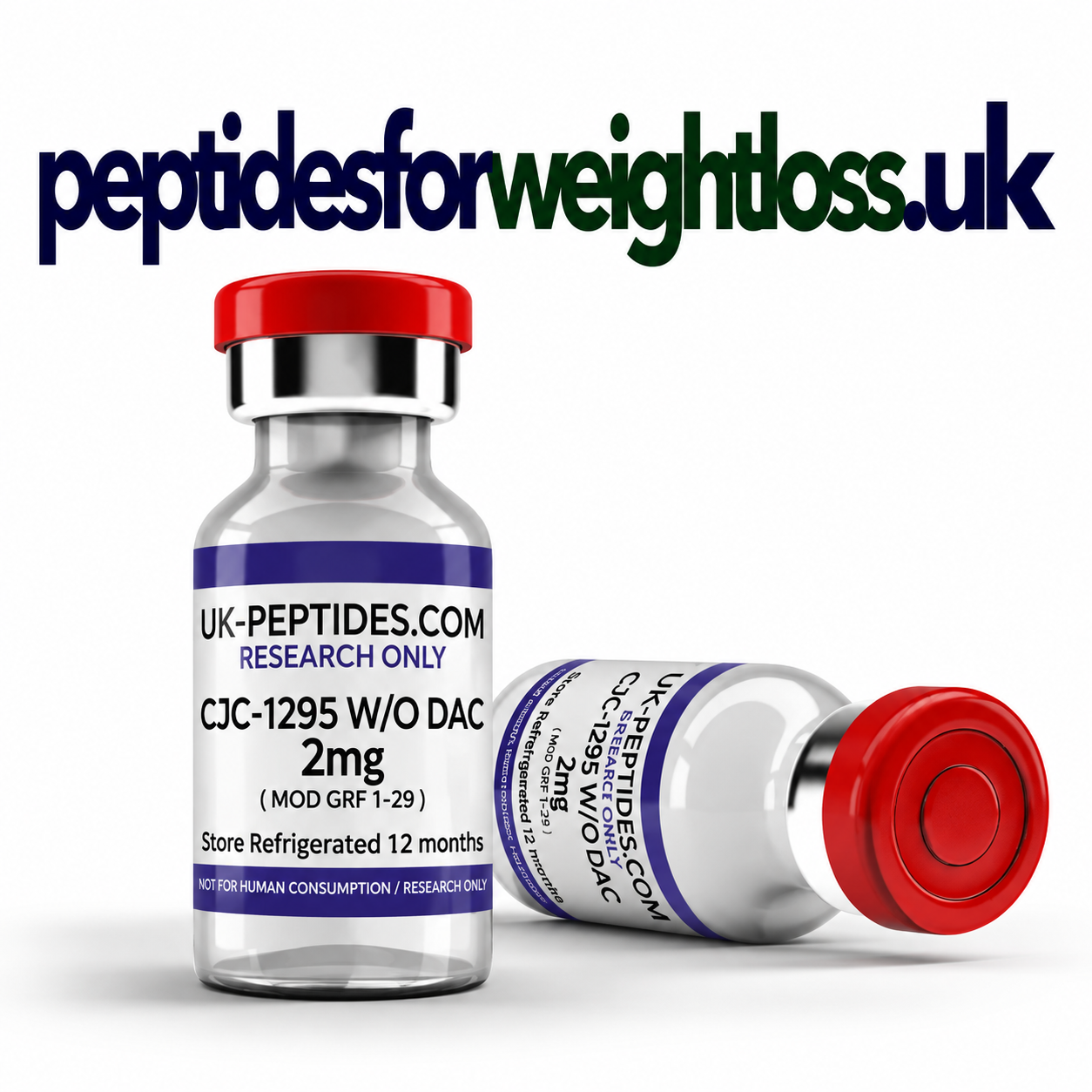
CJC-1295 Without DAC 2mg – Modified GRF 1-29 Research Peptide
CJC-1295 Without DAC 2mg, commonly referred to as Modified GRF (1-29) or Mod GRF 1-29, is a synthetic peptide analogue derived from the first 29 amino acids of growth hormone-releasing hormone (GHRH).
The peptide has been discussed in research involving growth hormone signalling, GHRH receptor biology and the structural modification of peptide hormones.
Unlike CJC-1295 with DAC, Modified GRF (1-29) does not contain the drug affinity complex designed to promote binding to circulating albumin.
Although these compounds share related peptide structures, they should not be treated as interchangeable substances.
CJC-1295 Without DAC 2mg Product Specifications
| Product Name | CJC-1295 Without DAC 2mg |
|---|---|
| Scientific Name | Modified GRF (1-29) |
| Alternative Names | Mod GRF 1-29, CJC-1295 No DAC |
| Labelled Quantity | 2mg |
| Peptide Length | 29 amino acids |
| Peptide Category | GHRH analogue |
| DAC Modification | Absent |
| Research Focus | Growth hormone signalling and receptor biology |
| Clinical Approval | Not approved for human therapeutic use |
These specifications describe the intended peptide identity and labelled quantity. Actual vial content, identity and purity must be established through appropriate batch-specific analytical testing.
What Is CJC-1295 Without DAC?
CJC-1295 Without DAC is a commonly used commercial name for Modified GRF (1-29), a modified analogue of the biologically active N-terminal region of human GHRH.
Natural GHRH is involved in the regulation of growth hormone secretion through signalling at receptors in the anterior pituitary gland.
Modified GRF (1-29) contains four amino-acid substitutions relative to the corresponding native GHRH sequence. These modifications are intended to alter molecular stability and susceptibility to enzymatic degradation.
Its precise pharmacological behaviour, safety and clinical effectiveness in humans remain insufficiently established.
Understanding Modified GRF 1-29
Modified GRF 1-29 is a 29-residue peptide related to the GHRH signalling pathway.
The compound differs from unmodified GRF (1-29) through substitutions at amino-acid positions 2, 8, 15 and 27.
These structural differences are relevant to research investigating peptide stability, receptor interactions and molecular degradation.
Modified GRF (1-29) is also chemically distinct from the original DAC-containing CJC-1295 molecule.
CJC-1295 Without DAC vs CJC-1295 With DAC
The difference between these two research compounds is important when interpreting scientific studies.
| Characteristic | Without DAC | With DAC |
|---|---|---|
| Common Name | Modified GRF (1-29) | CJC-1295 DAC |
| DAC Modification | Absent | Present |
| Albumin-Binding Design | No DAC-mediated binding | Designed for albumin binding |
| Published Human Evidence | Very limited | Human pharmacology studies available |
| Clinical Approval | Not approved | Not approved |
The DAC modification changes the molecular structure and pharmacokinetic characteristics of the peptide.
Published findings involving CJC-1295 DAC should not automatically be interpreted as evidence of the effectiveness or safety of Modified GRF (1-29).
CJC-1295 No DAC and Growth Hormone Research
The GHRH signalling pathway plays an important role in the physiological regulation of growth hormone.
Research into GHRH analogues examines how peptide structure influences receptor recognition, downstream signalling and hormone regulation.
Modified GRF (1-29) is relevant to this research area because of its relationship to the biologically active region of GHRH.
However, a proposed biological mechanism does not establish a proven therapeutic benefit. Direct human clinical evidence for the no-DAC peptide remains limited.
Modified GRF 1-29 Research Applications
Scientific interest in Modified GRF (1-29) includes several areas of peptide and endocrine research:
- GHRH receptor biology: Investigation of peptide-receptor interactions.
- Peptide structure: Examination of amino-acid substitutions and molecular properties.
- Peptide stability: Research into structural factors affecting degradation.
- Growth hormone signalling: Investigation of signalling pathways associated with GHRH.
- Analytical chemistry: Identification, characterisation and assessment of synthetic peptides.
These are research topics, not established clinical indications or evidence of effectiveness for weight management, muscle development or other health outcomes.
Is CJC-1295 Without DAC a Weight-Loss Peptide?
Although CJC-1295 Without DAC is sometimes discussed in connection with body composition and weight management, there is insufficient reliable human clinical evidence establishing that Modified GRF (1-29) produces meaningful or safe weight-loss outcomes.
Research involving growth hormone signalling should not be confused with clinical evidence supporting weight-loss treatment.
Modified GRF (1-29) is not an approved weight-loss medicine.
CJC-1295 Without DAC 2mg and Peptide Identity
The designation 2mg refers to the stated quantity of peptide in the vial.
It does not indicate a recommended dose, establish the amount of biologically active material or confirm product purity.
For research purposes, reliable analytical documentation is important for establishing:
- Peptide identity
- Actual peptide content
- Purity
- Relevant impurities
- Batch traceability
- Analytical methods
Peptide Purity and Certificate of Analysis
Peptide identity and purity should be assessed using appropriate analytical techniques and documented through batch-specific records.
Depending on the testing programme, analytical methods may include high-performance liquid chromatography (HPLC) and mass spectrometry.
A Certificate of Analysis (COA) should identify the applicable batch and provide relevant analytical results.
A purity percentage should not be advertised unless supported by actual documentation for the specific batch.
CJC-1295 Without DAC Storage Information
Storage requirements depend on the formulation, physical state, packaging and stability information supplied for the individual batch.
Research materials should be handled according to documented supplier specifications and institutional laboratory procedures.
Temperature limits, shelf life and stability claims should not be assumed without supporting product-specific evidence.
CJC-1295 Without DAC Safety and Research Limitations
Modified GRF (1-29) is not approved for human therapeutic use, and adequate clinical evidence has not established its safety or effectiveness for treating medical conditions.
Potential concerns with unapproved peptide preparations include uncertainty about identity, impurities, formulation quality and biological effects.
This material should not be represented as a treatment for obesity, growth hormone deficiency, ageing or any other medical condition.
Frequently Asked Questions About CJC-1295 Without DAC 2mg
What is CJC-1295 Without DAC 2mg?
It is a product labelled as containing 2mg of Modified GRF (1-29), a synthetic 29-amino-acid GHRH analogue.
Is CJC-1295 Without DAC the same as Modified GRF 1-29?
The terms are commonly used interchangeably in commercial peptide descriptions. The exact molecular identity should nevertheless be verified through analytical documentation.
What does DAC mean?
DAC stands for Drug Affinity Complex, a structural modification associated with albumin binding in the DAC-containing CJC-1295 molecule.
Does Modified GRF 1-29 contain DAC?
No. The peptide commonly identified as Modified GRF (1-29) does not contain the DAC modification.
Is CJC-1295 Without DAC approved for weight loss?
No. Modified GRF (1-29) is not an approved weight-loss treatment, and adequate human clinical evidence supporting such use is lacking.
Is CJC-1295 Without DAC approved for human use?
No. It is not an approved human therapeutic medicine.
What does 2mg mean?
It identifies the labelled peptide quantity. It is not a recommended administration amount or proof of actual vial content.
What is the difference between CJC-1295 DAC and No DAC?
The DAC-containing form has an additional structural modification designed to enable albumin binding. Modified GRF (1-29) lacks this modification and has a different evidence base.
Does CJC-1295 Without DAC increase growth hormone?
The peptide is structurally related to GHRH and is discussed in growth hormone signalling research. However, direct clinical evidence for the exact no-DAC compound is insufficient to establish reliable effects in humans.
Can research findings from CJC-1295 DAC be applied to Modified GRF 1-29?
No. The two compounds are chemically distinct, and findings involving the DAC form should not automatically be applied to the no-DAC form.
How is peptide purity verified?
Appropriate analytical methods, including HPLC and mass spectrometry, may be used to assess peptide identity and purity. Results should correspond to the actual production batch.
CJC-1295 Without DAC 2mg Summary
CJC-1295 Without DAC 2mg, also known as Modified GRF (1-29), is a synthetic GHRH analogue relevant to research involving peptide structure, receptor biology and growth hormone signalling.
The no-DAC form is chemically distinct from CJC-1295 DAC, and the available human evidence for the DAC-containing compound cannot establish the safety or effectiveness of Modified GRF (1-29).
Accurate identification, batch-specific analytical documentation and clear communication of research limitations are essential when describing this peptide.
Research-use information: Not approved for human or veterinary therapeutic administration.

Reviews
There are no reviews yet.