
Description
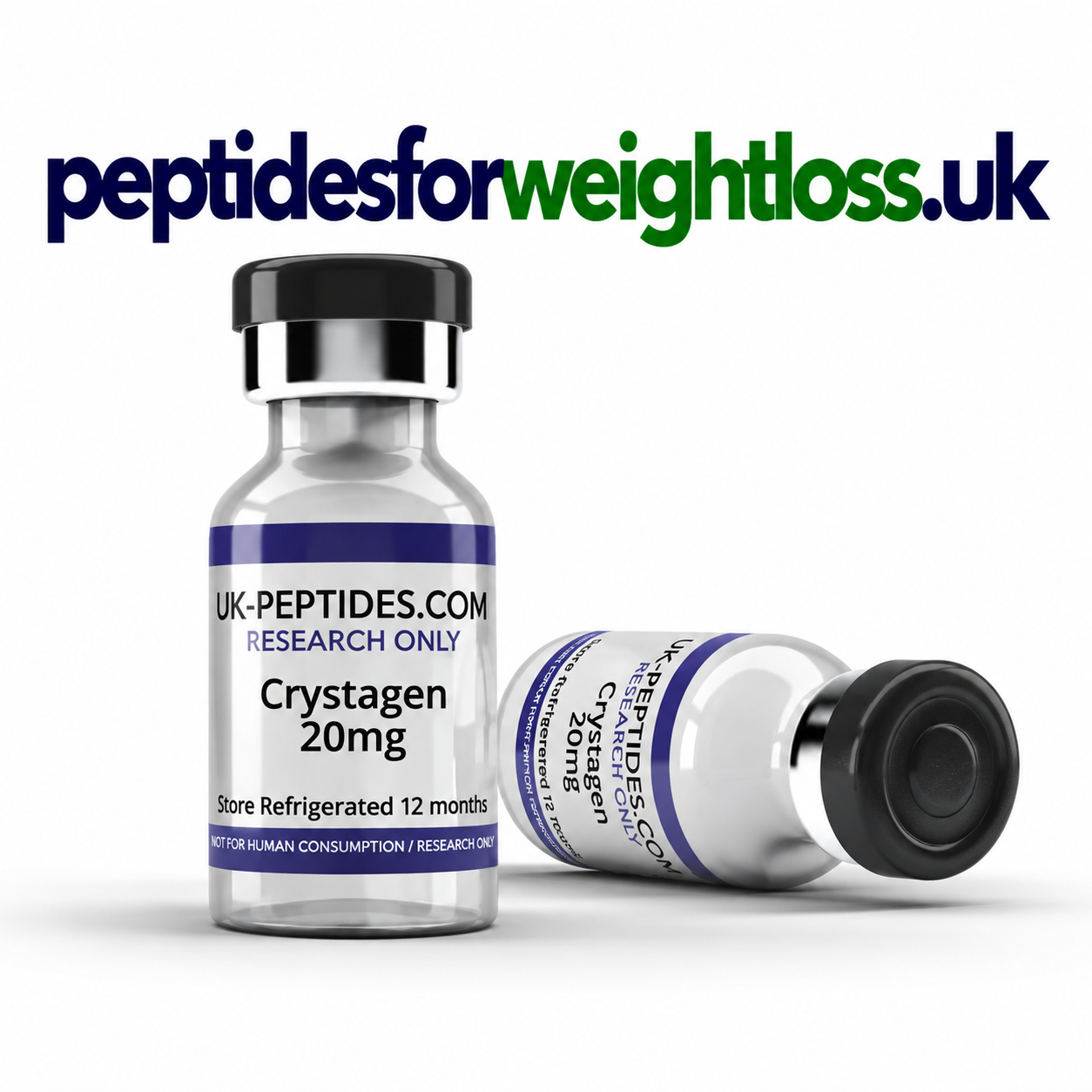
Crystagen 20mg – EDP Tripeptide Bioregulator for Laboratory Research
Crystagen 20mg is a synthetic tripeptide associated with scientific investigations into immune-system biology, spleen tissue responses, cellular ageing and short-peptide bioregulation. Also known as Kristagen or the EDP peptide, Crystagen contains three amino acids: glutamic acid, aspartic acid and proline.
Crystagen belongs to the family of short synthetic peptides associated with the research programme of Vladimir Khavinson and colleagues. This programme investigated how selected amino acid sequences may influence cellular activity in laboratory and preclinical models.
The peptide has been studied in experimental research involving immune-cell populations and ageing-related changes in lymphoid tissues. Its research history is particularly associated with the spleen, B-cell-related responses and broader thymic peptide biochemistry.
Although Crystagen is sometimes marketed as an immune-support or anti-ageing bioregulator, its published evidence remains limited. Laboratory observations do not establish that Crystagen strengthens immunity, prevents infection or reverses biological ageing in humans.
Crystagen 20mg is therefore relevant to laboratory research involving short-peptide chemistry, immune-cell biology, experimental immunosenescence and peptide structure-activity relationships.
What Is Crystagen Peptide?
Crystagen is commonly identified as a synthetic peptide containing three amino acid residues.
Its reference sequence is Glu-Asp-Pro, abbreviated EDP using the standard one-letter amino acid code.
The peptide is associated with the Khavinson short-peptide bioregulator family, which includes compounds investigated for tissue-associated cellular effects.
Crystagen has also been discussed in relation to thymic peptide research, particularly the broader study of small peptides associated with thymus-derived preparations.
However, Crystagen is a chemically defined synthetic tripeptide, not the same material as a complex animal-derived thymic extract.
Researchers should verify the exact sequence and chemical identity of the supplied material because commercial descriptions of peptide bioregulators are not always consistent.
Crystagen 20mg Product Specifications
- Product Name: Crystagen 20mg
- Alternative Names: Crystagen, Kristagen, EDP peptide
- Peptide Classification: Synthetic short-peptide bioregulator
- Peptide Type: Tripeptide
- Reference Sequence: Glu-Asp-Pro
- One-Letter Sequence: EDP
- Peptide Length: 3 amino acid residues
- Reference Structure: H-Glu-Asp-Pro-OH
- Reference Molecular Formula: C14H21N3O8
- Approximate Molecular Weight: 359.33 g/mol
- CAS Number: Not reliably verified
- Labelled Quantity: 20mg
- Research Category: Immune-system and short-peptide bioregulator research
- Research Focus: Spleen biology, immune-cell responses and cellular ageing
- Purity: Requires batch-specific verification
- Salt Form: Confirm with manufacturer
- Physical Form: Confirm with manufacturer
- Storage: Follow verified manufacturer instructions
- Intended Use: Laboratory research only
The reference molecular formula and molecular weight describe the unmodified free-acid EDP tripeptide. Commercial preparations containing counterions, water or other formulation components may have different analytical characteristics.
Understanding the Molecular Structure of Crystagen
Crystagen contains three amino acid residues connected through peptide bonds.
Its reference sequence consists of:
- Glutamic Acid (Glu): An acidic amino acid with a carboxyl-containing side chain.
- Aspartic Acid (Asp): An acidic amino acid containing a shorter carboxyl-bearing side chain.
- Proline (Pro): A cyclic amino acid that can influence peptide backbone conformation.
The peptide has free amino and carboxyl termini in its reference structure.
Its small molecular size makes it relevant to research into short-peptide chemistry and molecular interactions.
Researchers should distinguish Crystagen from other peptides that contain overlapping amino acid sequences.
For example, Cortagen contains the sequence Ala-Glu-Asp-Pro, while Crystagen contains only Glu-Asp-Pro.
The addition of an amino acid changes molecular identity and may influence chemical and biological properties.
How Does Crystagen Work?
Crystagen has been investigated as part of a broader research programme examining the effects of short synthetic peptides on cellular processes.
Experimental studies have explored its relationship with immune-cell activity and ageing-associated changes in lymphoid tissues.
A published study involving spleen ageing reported effects on B-cell-associated immune activity.
However, the researchers did not observe stimulation of cell renewal in ageing spleen tissue.
These findings suggest that the peptide may influence selected experimental immune-cell responses without broadly restoring tissue renewal.
A specific, independently validated molecular receptor or complete mechanism of action for Crystagen has not been established.
Its proposed biological effects should therefore be interpreted as preliminary experimental observations rather than proven clinical outcomes.
Scientific Research Into Crystagen
1. Spleen Tissue Research
The spleen is an important secondary lymphoid organ involved in filtering blood and coordinating immune responses.
It contains specialised immune-cell populations, including B lymphocytes, T lymphocytes and antigen-presenting cells.
Crystagen has been investigated in experimental research examining ageing-related changes in spleen tissue.
A 2014 study compared the effects of several short peptides on immune-related processes in the ageing spleen.
The researchers reported that Crystagen influenced the B-cell component of the immune system.
However, the study did not demonstrate stimulation of cellular renewal in ageing spleen tissue.
These findings provide a specific preclinical research basis for Crystagen but do not establish human therapeutic effectiveness.
2. B-Lymphocyte Research
B lymphocytes are immune cells involved in antibody production and adaptive immune responses.
Their development and activity depend on interactions with other immune cells and signalling molecules.
Research involving Crystagen has examined selected B-cell-associated responses in experimental ageing models.
The published spleen study reported activity associated with the B-cell component of immunity.
However, the study does not establish that Crystagen increases antibody production, improves vaccine responses or prevents infections in humans.
3. Immune-System Ageing Research
Immunosenescence refers to age-associated changes in immune-system function.
These changes may involve alterations in immune-cell populations, tissue organisation and responses to biological challenges.
Short peptide bioregulators have been investigated as experimental tools for studying selected ageing-related cellular processes.
Crystagen is relevant to this field because of its inclusion in research involving ageing spleen tissue.
However, experimental immune-cell changes do not establish reversal of immunosenescence in humans.
4. Thymic Peptide Research
The thymus is a primary lymphoid organ involved in T-cell development and maturation.
Thymic peptide research has examined both complex tissue-derived preparations and defined synthetic peptide sequences.
Crystagen is associated with the broader Khavinson programme of short peptides investigated in immune-related models.
Its EDP sequence has been discussed in relation to the chemical characterisation of thymus-associated peptide preparations.
However, the biological effects of a complex thymic extract cannot automatically be attributed to a single synthetic tripeptide.
5. Cellular Renewal Research
Cellular renewal involves the replacement and maintenance of cells within tissues.
It depends on processes such as proliferation, differentiation and programmed cell death.
Ageing can alter these processes in lymphoid tissues.
The 2014 Crystagen spleen study specifically examined ageing-related immune-cell processes.
Although effects on B-cell-associated activity were reported, the investigators did not find evidence that Crystagen stimulated cell renewal in ageing spleen tissue.
This limitation is important when evaluating claims that Crystagen regenerates immune organs.
6. Lymphoid Tissue Biology
Lymphoid tissues provide specialised environments for immune-cell development and communication.
The thymus, spleen and lymph nodes perform different roles within the immune system.
Crystagen has been studied in relation to experimental lymphoid tissue responses.
These investigations are relevant to basic immunology because they examine how small peptide molecules may influence selected cellular populations.
However, there is insufficient evidence that Crystagen restores normal lymphoid tissue function in humans.
7. Short-Peptide Bioregulator Research
The peptide bioregulator concept involves investigating small amino acid sequences for potential effects on cellular regulation.
Crystagen belongs to a family of compounds associated with this research approach.
Other examples include Vilon, Thymogen, Cortagen and Epitalon.
These compounds differ in amino acid sequence and molecular structure.
Published findings involving one peptide should not automatically be attributed to another.
Researchers should evaluate compound-specific evidence whenever possible.
8. Gene Expression and Chromatin Research
Gene expression involves the conversion of genetic information into functional cellular products.
Chromatin organisation can influence which regions of DNA are accessible to transcriptional machinery.
Some studies involving the wider Khavinson peptide family have investigated relationships between short peptides and chromatin-associated processes.
Crystagen is relevant to this broader research area because of its classification as a short-peptide bioregulator.
However, direct evidence establishing a specific chromatin-binding mechanism for Crystagen remains limited.
Mechanistic findings involving other peptide sequences should not be presented as demonstrated effects of Crystagen.
9. Peptide Structure-Activity Research
Structure-activity relationship research examines how molecular features influence chemical and biological behaviour.
Crystagen provides a defined three-amino-acid sequence for studying short-peptide properties.
Its Glu-Asp-Pro structure can be compared with other synthetic peptides containing acidic amino acids or a terminal proline residue.
These comparisons may help researchers investigate sequence-dependent molecular interactions.
However, shared amino acid residues do not establish identical biological activity.
Crystagen vs Thymalin
Crystagen and Thymalin are different research materials.
- Crystagen: A synthetic tripeptide commonly identified as Glu-Asp-Pro.
- Thymalin: A complex peptide preparation historically derived from animal thymus tissue.
- Molecular Identity: Crystagen has a defined three-residue sequence, while Thymalin contains multiple peptide components.
- Research Interpretation: Findings involving Thymalin cannot automatically establish the effects of isolated Crystagen.
Researchers should verify the exact molecular identity of the material being studied.
Crystagen vs Thymogen
Thymogen is another synthetic peptide associated with immune-system research.
Thymogen contains the sequence Glu-Trp, abbreviated EW.
Crystagen contains Glu-Asp-Pro, abbreviated EDP.
Thymogen is a dipeptide, while Crystagen is a tripeptide.
Their molecular structures and research evidence differ.
Results involving Thymogen should not be attributed to Crystagen without direct supporting evidence.
Crystagen vs Vilon
Vilon is a synthetic dipeptide with the sequence Lys-Glu, abbreviated KE.
Crystagen is the EDP tripeptide.
Both compounds appear in research associated with short-peptide bioregulators.
The 2014 spleen study investigated both peptides but reported differences in their experimental immune-cell effects.
These differences demonstrate the importance of evaluating each peptide separately.
Crystagen vs Cortagen
Cortagen is a synthetic tetrapeptide containing the sequence Ala-Glu-Asp-Pro.
Crystagen contains Glu-Asp-Pro.
Although the peptides share three consecutive amino acid residues, Cortagen includes an additional N-terminal alanine.
This structural difference changes molecular identity.
Cortagen is historically associated with nervous-system research, while Crystagen has been investigated in immune-related experimental models.
Crystagen and Immune Function Research
Crystagen is sometimes described as an immune bioregulator because of its experimental association with lymphoid tissues.
However, the term does not establish a clinically proven immune-enhancing effect.
The available compound-specific research is limited and does not demonstrate improved resistance to infections, better vaccine responses or prevention of immune-related disease in humans.
Claims that Crystagen reliably strengthens the immune system are not supported by robust clinical evidence.
Crystagen and Anti-Ageing Research
Crystagen has been investigated in ageing-related immune tissue models.
However, findings involving selected immune-cell responses do not establish reversal of biological ageing.
There is insufficient reliable clinical evidence that Crystagen extends human lifespan, rejuvenates the thymus or restores youthful immune function.
Its long-term safety and therapeutic effectiveness remain unestablished.
Crystagen and Weight Management
Crystagen is not an established weight-loss peptide.
Its principal research associations involve immune-cell biology and short-peptide bioregulation.
There is insufficient reliable clinical evidence that Crystagen reduces body fat, suppresses appetite or treats obesity.
It should not be described as a proven fat-burning or weight-management compound.
Understanding the Crystagen 20mg Label
The 20mg designation refers to the labelled quantity of research material.
It does not represent a recommended human dose or independently establish purity, identity or biological activity.
Researchers should verify whether the stated quantity refers to the free peptide or includes counterions and other formulation components.
Batch-specific analytical documentation is necessary to establish the actual characteristics of the supplied material.
Crystagen 20mg Research Quality and Documentation
Important considerations when evaluating Crystagen research material include:
- Verification of the complete Glu-Asp-Pro sequence
- Confirmation that the peptide contains three amino acid residues
- Verification of the expected molecular mass
- Confirmation of peptide stereochemistry
- Distinction from Cortagen and other related peptides
- Identification of the supplied salt form
- Batch-specific certificate of analysis
- Appropriate analytical purity testing
- Mass spectrometry or another suitable identity method
- Confirmation of the labelled 20mg quantity
- Assessment of synthesis-related impurities
- Manufacturer and batch traceability
- Documentation of counterions and formulation components
- Verified packaging specifications
- Product-specific storage and stability information
- Clearly stated research-use classification
These records help distinguish accurately characterised Crystagen from products identified only by commercial naming conventions.
Storage and Handling of Crystagen
Crystagen research material should be stored according to verified manufacturer instructions.
Storage requirements depend on the peptide’s salt form, physical presentation, formulation and packaging.
Researchers should not assume that all Crystagen products have identical stability or shelf-life characteristics.
Laboratory handling should follow relevant safety documentation and institutional procedures.
Crystagen Safety and Scientific Limitations
Crystagen is an investigational peptide without an established human clinical safety profile.
Published compound-specific research is limited, and independent clinical confirmation is lacking.
Potential concerns include peptide-related impurities, formulation-dependent reactions, unknown biological effects and insufficient long-term safety information.
Crystagen is not an established approved medicine for immune deficiency, infection prevention, anti-ageing or weight management.
Research-grade material should not be assumed suitable for human administration.
This information is intended for scientific and educational purposes only and does not provide medical advice, human dosing recommendations or administration instructions.
Frequently Asked Questions About Crystagen 20mg
What is Crystagen 20mg?
Crystagen 20mg is a product listing for the synthetic EDP tripeptide with a labelled quantity of 20mg.
What is the Crystagen peptide sequence?
The reference sequence is Glu-Asp-Pro, abbreviated EDP.
How many amino acids are in Crystagen?
Crystagen contains three amino acid residues.
What is the molecular weight of Crystagen?
The reference free-acid peptide has an approximate molecular weight of 359.33 g/mol.
What is the molecular formula of Crystagen?
The reference molecular formula is C14H21N3O8.
Is Crystagen the same as Thymalin?
No. Crystagen is a defined synthetic tripeptide, while Thymalin is a complex thymus-derived peptide preparation.
Is Crystagen the same as Thymogen?
No. Crystagen has the sequence EDP, while Thymogen has the sequence EW.
Is Crystagen the same as Cortagen?
No. Crystagen is the EDP tripeptide, while Cortagen is the AEDP tetrapeptide.
What is Crystagen researched for?
Crystagen has been investigated in experimental spleen ageing and immune-cell biology research.
Does Crystagen strengthen the immune system?
There is insufficient reliable clinical evidence establishing improved immune function in humans.
Does Crystagen reverse immune ageing?
No reliable clinical evidence establishes reversal of human immunosenescence.
Is Crystagen a weight-loss peptide?
No. Crystagen is not an established treatment for obesity or weight management.
What does the 20mg designation mean?
It refers to the labelled quantity of research material, not a recommended human dose.
Crystagen 20mg – Product Summary
Crystagen 20mg is a synthetic tripeptide containing the amino acid sequence Glu-Asp-Pro.
Also known as Kristagen or EDP, it belongs to the Khavinson short-peptide bioregulator research family and has been investigated in experimental studies involving spleen ageing and immune-cell biology.
Although a published study reported effects on B-cell-associated immune activity, the available evidence does not establish clinically meaningful immune rejuvenation or therapeutic benefits in humans.
Researchers should verify the complete peptide sequence, molecular identity, purity, salt form, labelled quantity and batch-specific documentation before selecting Crystagen 20mg for laboratory investigation.
Reviews
There are no reviews yet.