
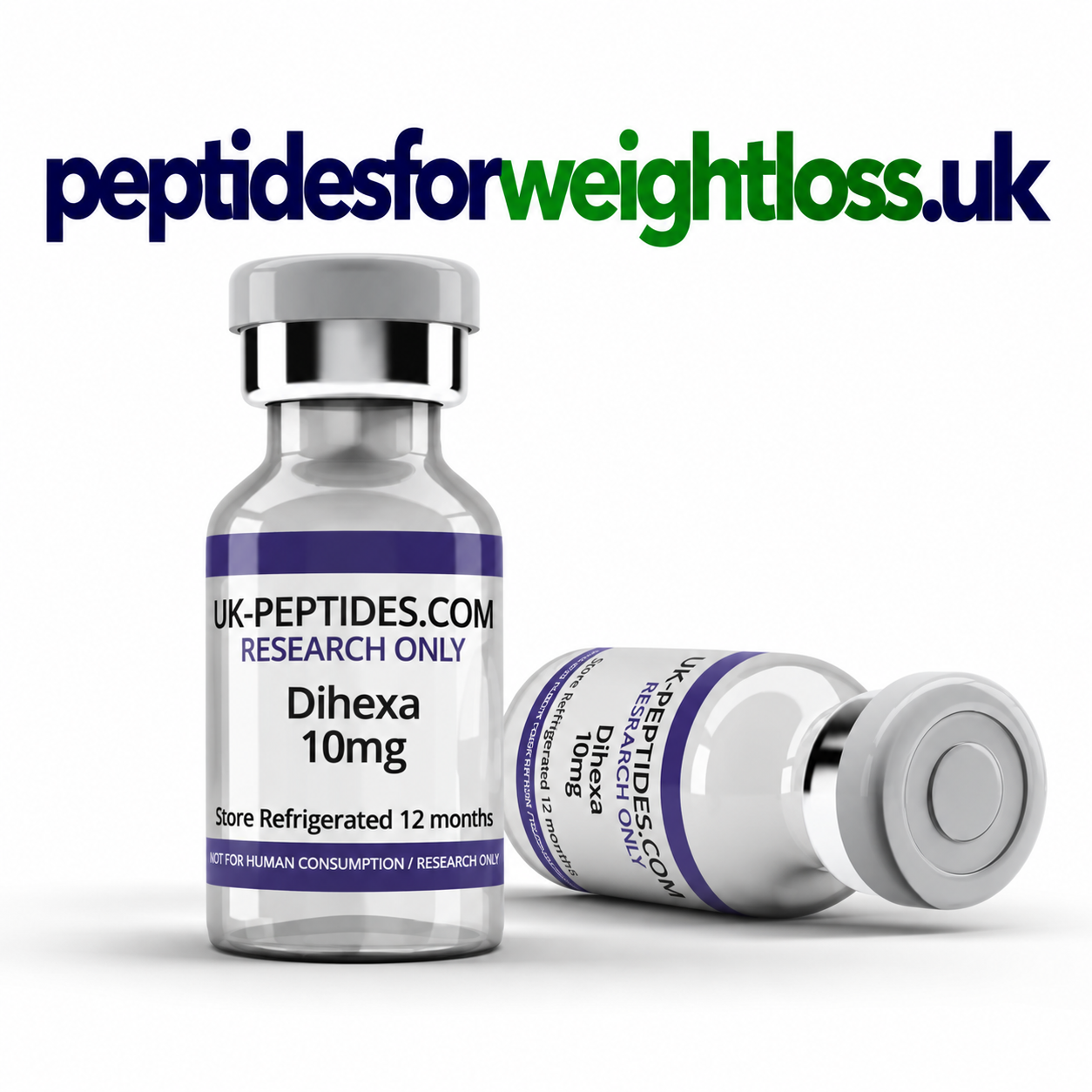
Description
Dihexa 10mg – PNB-0408 Peptidomimetic for Neuroscience Research
Dihexa 10mg is a research product associated with investigations into neuronal signalling, synaptic plasticity and experimental cognitive function. Dihexa, also known as PNB-0408, is a synthetic angiotensin IV-derived peptidomimetic rather than a conventional unmodified peptide.
Dihexa 10mg has attracted scientific interest because early preclinical studies reported effects on learning-related behaviour and neuronal structures in laboratory models. Its proposed interaction with hepatocyte growth factor (HGF) and the c-Met receptor became a major focus of the research literature.
However, the foundational paper reporting the direct HGF/c-Met mechanism was retracted in 2025, and another important Dihexa publication remains subject to an expression of concern. These developments substantially limit confidence in widely repeated claims about Dihexa.
Dihexa 10mg remains an investigational research material. There are no established human therapeutic indications, validated human dosing regimens or adequate human safety data.
For laboratory research, Dihexa 10mg is relevant to investigations involving peptidomimetic chemistry, angiotensin IV analogues, experimental neuronal signalling and the reproducibility of preclinical findings.
What Is Dihexa 10mg?
Dihexa 10mg refers to a product labelled as containing 10mg of Dihexa, a synthetic compound also identified as PNB-0408.
Dihexa was developed through research into angiotensin IV analogues and their possible effects on learning-related biological processes.
Its chemical structure contains a tyrosine-isoleucine dipeptide core modified with an N-terminal hexanoyl group and a C-terminal 6-aminohexanoic amide component.
Because of these modifications, Dihexa is more precisely classified as a peptidomimetic than as an ordinary amino-acid peptide.
Dihexa has been investigated in laboratory and animal studies involving neuronal structure, experimental memory tasks and neurodegenerative disease models.
However, Dihexa 10mg has not been established as a safe or effective treatment for Alzheimer’s disease, cognitive impairment or any other medical condition.
Dihexa 10mg Product Specifications
- Product Name: Dihexa 10mg
- Alternative Names: Dihexa, PNB-0408
- Compound Classification: Synthetic angiotensin IV-derived peptidomimetic
- Reference Chemical Structure: N-hexanoyl-Tyr-Ile-Ahx-NH2
- Reference Molecular Formula: C27H44N4O5
- Reference Molecular Weight: Approximately 504.66 g/mol
- CAS Number: 1401708-83-5
- PubChem CID: 129010512
- Labelled Quantity: 10mg
- Research Category: Neuroscience and peptidomimetic chemistry
- Research Focus: Neuronal signalling, synaptic plasticity and experimental cognition
- Proposed Biological Pathway: HGF/c-Met signalling; direct mechanistic evidence retracted
- Human Clinical Evidence: No established clinical trial evidence
- Purity: Requires batch-specific verification
- Physical Form: Confirm with manufacturer
- Salt Form: Confirm with manufacturer
- Storage: Follow verified manufacturer instructions
- Intended Use: Laboratory research only
The reference chemical specifications identify the Dihexa molecule itself. They do not independently establish the purity, formulation, identity or analytical quality of a commercial Dihexa 10mg preparation.
Understanding the Molecular Structure of Dihexa
Dihexa is a chemically modified compound derived from research involving angiotensin IV analogues.
Its shorthand chemical structure is:
N-hexanoyl-Tyr-Ile-Ahx-NH2
This structure contains a tyrosine-isoleucine peptide core together with chemically modified terminal components.
The N-terminal hexanoyl group is a fatty-acid-derived chemical modification.
The C-terminal component is derived from 6-aminohexanoic acid and terminates in an amide.
These features distinguish Dihexa from conventional peptides composed exclusively of amino acid residues.
Dihexa 10mg should therefore be evaluated using analytical methods appropriate for its specific chemical structure.
How Does Dihexa Work?
Early Dihexa research proposed that the compound influenced neuronal signalling through the hepatocyte growth factor and c-Met receptor pathway.
HGF is a signalling protein involved in cellular growth, migration and tissue responses.
c-Met is a receptor tyrosine kinase that responds to HGF.
These signalling pathways are involved in several biological processes, including neuronal development and cellular proliferation.
However, the 2014 study that reported direct mechanistic evidence for Dihexa’s HGF/c-Met activity was retracted in April 2025.
As a result, the specific mechanism of action of Dihexa remains uncertain.
It is scientifically inappropriate to present Dihexa as a confirmed HGF activator or to claim that it reliably produces new synapses in humans.
Scientific Research Into Dihexa 10mg
1. Dihexa 10mg and Angiotensin IV Analogue Research
Angiotensin IV is a peptide fragment associated with the renin-angiotensin system.
Researchers have investigated angiotensin IV and chemically modified analogues in experimental neuroscience.
Dihexa was developed as part of this broader research into compounds with altered chemical stability and biological properties.
Its modified structure distinguishes it from naturally occurring angiotensin IV.
However, results involving angiotensin IV itself should not automatically be attributed to Dihexa.
2. Dihexa and Experimental Cognitive Research
Preclinical research involving Dihexa has examined learning-related behaviour in rodents.
Some early studies reported changes in performance on selected experimental memory tasks.
However, a key 2013 Dihexa publication remains subject to an expression of concern.
This means its findings require additional scrutiny and independent confirmation.
Experimental changes in rodent behaviour do not establish improved human memory or cognitive performance.
3. Dihexa 10mg and Synaptic Plasticity Research
Synaptic plasticity refers to changes in the strength, organisation or function of connections between neurons.
These processes are relevant to learning, memory and nervous-system adaptation.
Early Dihexa research reported effects on dendritic spines and synapse-related measurements in experimental systems.
However, important mechanistic publications supporting these claims were later retracted.
The available evidence is insufficient to establish that Dihexa 10mg reliably increases synapse formation in humans.
4. Dihexa and Dendritic Spine Research
Dendritic spines are small neuronal structures associated with many excitatory synapses.
Changes in spine number and morphology are investigated in studies of neuronal connectivity.
Dihexa has been associated with research examining dendritic spine formation in laboratory models.
However, the integrity concerns affecting foundational publications mean these findings must be interpreted cautiously.
Additional independent research is necessary to establish reproducible effects.
5. Dihexa 10mg and HGF/c-Met Research
HGF/c-Met signalling participates in cellular growth, development and responses to injury.
The pathway has been investigated in both neuroscience and cancer biology.
Early Dihexa research proposed that the compound potentiated HGF-related signalling.
However, the key 2014 mechanistic study was retracted in 2025.
Consequently, the extent and reliability of direct HGF/c-Met activation by Dihexa remain unresolved.
This uncertainty is central to any accurate scientific description of Dihexa 10mg.
6. Dihexa and Alzheimer’s Disease Research
Alzheimer’s disease involves complex pathological processes associated with progressive cognitive decline.
Experimental disease models are used to investigate possible relationships between neuronal signalling and cognitive function.
Dihexa has been examined in selected animal models relevant to Alzheimer’s disease research.
Some preclinical studies reported changes in behavioural and molecular measurements.
However, these findings do not demonstrate that Dihexa prevents, reverses or treats Alzheimer’s disease in humans.
No established human clinical trial evidence supports Dihexa as an Alzheimer’s treatment.
7. Dihexa 10mg and Neurodegeneration Research
Neurodegeneration involves progressive damage to or loss of neurons.
Researchers investigate numerous biological processes that may contribute to neuronal vulnerability.
Dihexa has been studied in selected experimental models of neurological injury and degeneration.
However, results have not been uniformly positive across disease models.
An independent rat study involving a Huntington’s disease-related toxin model did not demonstrate a protective effect.
These mixed findings reinforce the need for independent replication and careful evaluation.
8. Dihexa and Neuronal Signalling Research
Neuronal signalling depends on interactions among receptors, enzymes, neurotransmitters and intracellular pathways.
Dihexa has attracted attention as an experimental compound potentially influencing selected neuronal processes.
However, its complete molecular mechanism has not been independently established.
Researchers should distinguish proposed mechanisms from experimentally confirmed findings.
This distinction is particularly important when interpreting older Dihexa publications.
9. Dihexa 10mg and Peptidomimetic Chemistry
Peptidomimetics are synthetic molecules designed to reproduce selected structural or functional characteristics of peptides.
They may incorporate chemical modifications intended to alter molecular stability, solubility or interactions.
Dihexa is an example of a modified angiotensin IV-derived research compound.
Its chemical structure provides a useful subject for investigations into structure-activity relationships.
However, theoretical advantages associated with chemical modifications do not establish human pharmacological benefits.
10. Dihexa and Blood-Brain Barrier Research
The blood-brain barrier regulates the movement of many substances between circulating blood and the central nervous system.
Dihexa was designed with chemical modifications intended to influence properties relevant to biological distribution.
Some preclinical research has discussed potential central nervous system activity.
However, reliable human pharmacokinetic and brain-distribution data are unavailable.
It is therefore inappropriate to claim that Dihexa 10mg has proven blood-brain barrier penetration or predictable central nervous system exposure in humans.
11. Dihexa 10mg and Experimental Memory Models
Rodent memory models can help researchers investigate selected learning-related processes.
These tests are screening tools rather than direct measures of human cognition.
Early Dihexa studies reported improvements in selected rodent behavioural tasks.
However, research-integrity concerns affect the interpretation of important publications.
Further independent studies are required before drawing reliable conclusions about cognitive effects.
12. Dihexa and Research Reproducibility
Scientific reproducibility refers to the ability of independent researchers to obtain comparable results under appropriately controlled conditions.
Reproducibility is especially important when experimental findings suggest a novel biological mechanism.
Several influential publications from the original Dihexa research programme received formal integrity notices.
Three related papers were retracted in April 2025.
These developments highlight the importance of independent replication, transparent reporting and cautious interpretation of preclinical claims.
Dihexa 10mg vs Angiotensin IV
Dihexa and angiotensin IV are related but chemically different research compounds.
- Dihexa: A synthetic peptidomimetic derived from angiotensin IV analogue research.
- Angiotensin IV: A naturally occurring peptide fragment.
- Chemical Structure: Dihexa contains modified terminal groups and a shorter peptide core.
- Research Interpretation: Results involving angiotensin IV cannot automatically establish the properties of Dihexa.
Dihexa 10mg vs GDNF Research Peptides
Dihexa and GDNF-related research peptides belong to different molecular research categories.
Dihexa is an angiotensin IV-derived peptidomimetic.
GDNF-related peptides are investigated in connection with glial cell line-derived neurotrophic factor biology.
Although both research areas involve neuronal signalling, their molecular structures and proposed mechanisms differ.
Findings involving GDNF-related peptides should not be attributed to Dihexa.
Dihexa 10mg and Cognitive Enhancement Claims
Dihexa 10mg is sometimes described online as a nootropic or memory-enhancing compound.
However, there is no established human clinical evidence that Dihexa improves memory, concentration, learning or cognitive performance.
Several foundational research publications have been retracted or formally questioned.
Therefore, claims of proven cognitive enhancement are not scientifically justified.
Dihexa 10mg and Weight Management
Dihexa 10mg is not an established weight-loss treatment.
Its research history primarily concerns experimental neuronal signalling and cognition-related models.
There is insufficient reliable evidence that Dihexa suppresses appetite, reduces body fat or treats obesity.
It should not be described as a proven metabolic or fat-burning compound.
Dihexa 10mg and Cancer-Related Safety Questions
The HGF/c-Met pathway is involved in normal cellular signalling but is also relevant to cancer biology.
Abnormal activation of c-Met is associated with the development and progression of several cancers.
Because early Dihexa research proposed enhancement of this pathway, researchers have raised theoretical concerns about possible effects on abnormal cell growth.
However, Dihexa has not been shown to cause cancer in humans.
Its potential carcinogenicity has also not been adequately investigated.
The retraction of key mechanistic research makes the extent of Dihexa’s actual interaction with this pathway uncertain.
These unresolved questions are important limitations when evaluating Dihexa 10mg.
Understanding the Dihexa 10mg Label
The 10mg designation refers to the labelled quantity of research material.
It does not represent a recommended human dose or independently establish the identity, purity or biological activity of the material.
Researchers should verify the supplied chemical form and batch-specific analytical documentation.
Dihexa 10mg Research Quality and Documentation
Important considerations when evaluating Dihexa 10mg research material include:
- Verification of the complete chemical identity
- Confirmation of the N-hexanoyl-Tyr-Ile-Ahx-NH2 structure
- Verification of the expected molecular mass
- Confirmation of relevant stereochemistry
- Identification of the supplied chemical form
- Batch-specific certificate of analysis
- Appropriate analytical purity testing
- Mass spectrometry or another suitable identity method
- Confirmation of the labelled 10mg quantity
- Assessment of synthesis-related impurities
- Manufacturer and batch traceability
- Verified packaging specifications
- Product-specific storage and stability information
- Clearly stated research-use classification
Storage and Handling of Dihexa 10mg
Dihexa 10mg research material should be stored according to verified manufacturer instructions.
Storage requirements depend on the chemical form, physical presentation, formulation and packaging.
Researchers should not assume that all Dihexa preparations have identical stability or shelf-life characteristics.
Laboratory handling should follow relevant safety documentation and institutional procedures.
Dihexa 10mg Safety and Scientific Limitations
Dihexa 10mg is an investigational research material without an established human clinical safety profile.
There are no published human clinical trials demonstrating its safety or effectiveness.
Important unanswered questions include long-term toxicity, human pharmacokinetics, potential interactions with cellular growth pathways and possible effects on abnormal cell proliferation.
The foundational 2014 HGF/c-Met mechanism study was retracted in 2025, and other publications from the original research programme have received formal integrity notices.
Dihexa is not an established approved medicine for Alzheimer’s disease, cognitive impairment, neurological injury or weight management.
Research-grade material should not be assumed suitable for human administration.
This information is intended for scientific and educational purposes only and does not provide human dosing recommendations or administration instructions.
Frequently Asked Questions About Dihexa 10mg
What is Dihexa 10mg?
Dihexa 10mg is a product listing for a synthetic angiotensin IV-derived peptidomimetic with a labelled quantity of 10mg.
Is Dihexa a peptide?
Dihexa is more precisely classified as a peptidomimetic because it contains chemically modified components rather than an ordinary unmodified peptide sequence.
What is the molecular formula of Dihexa?
The reference molecular formula is C27H44N4O5.
What is the molecular weight of Dihexa?
The reference molecular weight is approximately 504.66 g/mol.
What is the CAS number for Dihexa?
The commonly listed CAS number is 1401708-83-5.
What is PNB-0408?
PNB-0408 is a developmental identifier associated with Dihexa.
Does Dihexa activate HGF/c-Met?
Early research proposed this mechanism, but the foundational mechanistic paper was retracted in 2025. The direct mechanism remains uncertain.
Does Dihexa improve memory?
There is no established human clinical evidence that Dihexa improves memory or cognitive performance.
Does Dihexa promote synapse formation?
Early laboratory research reported synapse-related effects, but important supporting publications have been retracted or questioned.
Can Dihexa treat Alzheimer’s disease?
No reliable human clinical evidence establishes Dihexa as an effective treatment for Alzheimer’s disease.
Does Dihexa cause cancer?
Dihexa has not been demonstrated to cause cancer in humans, but its long-term carcinogenicity has not been adequately studied. The proposed HGF/c-Met mechanism raises unresolved theoretical concerns.
Is Dihexa a weight-loss compound?
No. Dihexa is not an established treatment for obesity or weight management.
What does Dihexa 10mg mean?
The designation refers to a labelled quantity of 10mg of research material, not a recommended human dose.
Dihexa 10mg – Scientific Summary
Dihexa 10mg is a synthetic angiotensin IV-derived peptidomimetic associated with research into neuronal signalling, synaptic plasticity and experimental cognitive function.
The compound has the reference formula C27H44N4O5 and molecular weight of approximately 504.66 g/mol.
Although early preclinical studies reported potentially interesting neurological effects, major research-integrity concerns affect the foundational evidence, and human safety and effectiveness remain unestablished.
Researchers evaluating Dihexa 10mg should verify the complete chemical identity, purity, labelled quantity, physical form and batch-specific analytical documentation.

Reviews
There are no reviews yet.