
Description
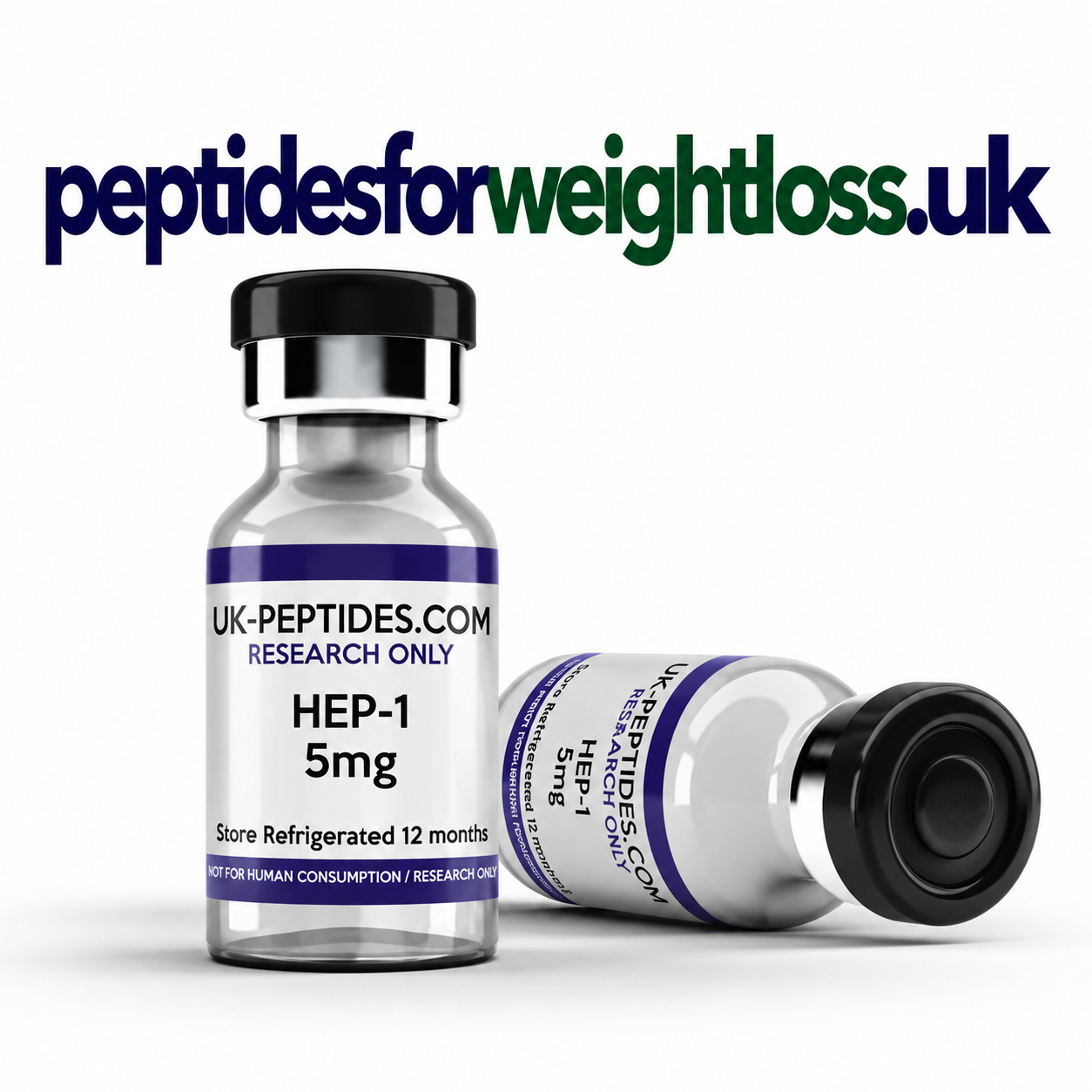
HEP-1 5mg (Gepon) – Human Ezrin Peptide for Immunology Research
HEP-1 5mg (Gepon) is a synthetic 14-amino-acid research peptide investigated in studies involving immune regulation, inflammatory cytokine signalling and host responses to infectious agents. Also known as Human Ezrin Peptide One, HEP1 or Hepon, the compound corresponds to a short amino acid sequence derived from the human ezrin protein.
HEP-1 5mg contains the reference peptide sequence Thr-Glu-Lys-Lys-Arg-Arg-Glu-Thr-Val-Glu-Arg-Glu-Lys-Glu, abbreviated TEKKRRETVEREKE. The peptide has attracted research interest because early experimental and clinical reports described changes in selected immune and inflammatory markers.
Gepon has a history of medical registration and use in Russia. However, this does not establish approval in the United Kingdom or demonstrate effectiveness under modern standards of clinical evidence. The internationally indexed human literature is limited, and much of the published research originates from the compound’s developers.
HEP-1 5mg is relevant to investigations involving peptide biochemistry, ezrin-derived sequences, cytokine regulation, immune-cell signalling and experimental host-defence mechanisms.
Although researchers have proposed immunomodulatory properties, HEP-1 5mg should not be described as a proven treatment for viral infections, bacterial infections, immune deficiency or inflammatory disease.
What Is HEP-1 5mg (Gepon)?
HEP-1 5mg refers to a product labelled as containing 5mg of Human Ezrin Peptide One.
HEP-1 is a chemically defined synthetic peptide composed of 14 amino acid residues.
The peptide sequence is derived from a region of ezrin, a human protein involved in linking the cell membrane to the underlying actin cytoskeleton.
Ezrin participates in processes involving cell shape, membrane organisation, signalling and cellular movement.
However, HEP-1 is only a short fragment of the much larger ezrin protein. It should not be assumed to reproduce all functions of full-length ezrin.
HEP-1 has been investigated in experimental studies of immune signalling and inflammatory responses.
The compound has also been marketed under the name Gepon in Russia, where it has a separate regulatory history.
For UK laboratory research, HEP-1 5mg should be evaluated according to its molecular identity, batch-specific analytical characteristics and the limitations of the available scientific evidence.
HEP-1 5mg Product Specifications
- Product Name: HEP-1 5mg (Gepon)
- Alternative Names: Gepon, Hepon, HEP1, Human Ezrin Peptide One
- Peptide Classification: Synthetic ezrin-derived research peptide
- Peptide Type: Tetradecapeptide
- Reference Sequence: Thr-Glu-Lys-Lys-Arg-Arg-Glu-Thr-Val-Glu-Arg-Glu-Lys-Glu
- One-Letter Sequence: TEKKRRETVEREKE
- Peptide Length: 14 amino acid residues
- Reference Molecular Formula: C74H132N26O27
- Reference Molecular Weight: Approximately 1818.03 g/mol
- CAS Number: 174641-44-2
- PubChem CID: 25078222
- Labelled Quantity: 5mg
- Research Category: Immunology and peptide biochemistry
- Research Focus: Immune signalling, cytokine responses and ezrin-derived peptides
- Purity: Requires batch-specific verification
- Salt Form: Confirm with manufacturer
- Physical Form: Confirm with manufacturer
- Storage: Follow verified manufacturer instructions
- Intended Use: Laboratory research only
These molecular specifications describe the reference HEP-1 peptide. They do not independently verify the purity, physical presentation or other characteristics of a particular HEP-1 5mg batch.
Understanding the Molecular Structure of HEP-1
HEP-1 is a short synthetic peptide containing 14 amino acid residues.
Its reference sequence is:
TEKKRRETVEREKE
The sequence contains threonine, glutamic acid, lysine, arginine and valine residues.
Several of these amino acids have electrically charged side chains under common physiological conditions.
This gives HEP-1 a relatively polar molecular character.
The peptide’s amino acid composition is relevant to research involving electrostatic interactions, peptide solubility and protein-binding behaviour.
However, the presence of charged residues does not establish a specific biological receptor or therapeutic mechanism.
HEP-1 5mg should be characterised using analytical methods capable of confirming the complete sequence and expected molecular mass.
How Does HEP-1 (Gepon) Work?
HEP-1 has been investigated as a possible immunomodulatory peptide.
Early research proposed that the peptide could influence inflammatory cytokine production and selected immune-cell responses.
These proposed effects include changes in cytokine expression and markers associated with adaptive immunity.
However, the precise molecular mechanism remains incompletely established.
No independently validated, specific HEP-1 cell-surface receptor has been conclusively identified.
Consequently, HEP-1 should not be presented as a proven receptor agonist or antagonist.
Researchers should distinguish experimentally observed immune markers from proposed explanations of how the peptide produces those changes.
Scientific Research Into HEP-1 5mg
1. HEP-1 5mg and Immune System Research
The immune system includes innate and adaptive mechanisms that respond to pathogens and other biological challenges.
HEP-1 has been investigated in research examining selected immune responses.
Early publications described changes in immune-related markers following exposure to Gepon.
However, the available clinical evidence is limited and does not establish broad immune enhancement in healthy humans.
Further independently replicated studies are necessary to determine the reproducibility and clinical relevance of these observations.
2. HEP-1 and Ezrin-Derived Peptide Research
Ezrin belongs to the ezrin-radixin-moesin family of proteins.
These proteins connect components of the cell membrane to the actin cytoskeleton.
They are involved in cellular organisation and signalling.
HEP-1 contains a short sequence corresponding to a region of human ezrin.
Researchers have investigated whether this fragment possesses biological properties distinct from the full-length protein.
However, the functions of full-length ezrin cannot automatically be assigned to the isolated HEP-1 peptide.
3. HEP-1 5mg and Cytokine Regulation Research
Cytokines are signalling proteins that help coordinate immune and inflammatory responses.
They include interleukins, interferons and tumour necrosis factor-related molecules.
HEP-1 research has examined possible changes in cytokine production.
Published reports have discussed inflammatory mediators including interleukin-6, interleukin-8 and tumour necrosis factor-alpha.
However, the direction and magnitude of cytokine responses can depend on the experimental system.
HEP-1 5mg should not be described as a universally effective anti-inflammatory compound.
4. HEP-1 and Interleukin Research
Interleukins are a diverse group of cytokines involved in communication between immune cells.
Interleukin-6 participates in inflammatory and other physiological signalling processes.
Interleukin-8 is associated with the recruitment and activity of selected immune cells.
Early HEP-1 research investigated changes in interleukin-associated responses.
However, these findings have not established that HEP-1 reliably reduces harmful inflammation in humans.
5. HEP-1 5mg and Interferon Research
Interferons are signalling proteins involved in host responses to viral infections and other biological stimuli.
Researchers have proposed that Gepon may influence interferon-related pathways.
These proposals are part of the compound’s historical immunology research.
However, the available evidence is insufficient to establish a consistent interferon response across different experimental conditions.
HEP-1 is not an established replacement for approved antiviral medicines.
6. HEP-1 and T-Cell Research
T lymphocytes are important components of adaptive immunity.
They participate in recognising antigens and coordinating immune responses.
HEP-1 has been discussed in relation to adaptive immune regulation.
However, there is insufficient independent evidence to establish that HEP-1 consistently improves T-cell function or prevents infection.
Research findings involving immune markers should be interpreted within their original experimental context.
7. HEP-1 5mg and B-Cell Research
B lymphocytes are involved in antibody production and other adaptive immune functions.
Early Gepon research discussed possible effects on antibody-associated responses.
These findings contributed to the peptide’s proposed immunomodulatory profile.
However, the available evidence does not establish that HEP-1 5mg reliably improves vaccine responses or antibody-mediated protection.
8. HEP-1 and Macrophage Research
Macrophages are immune cells involved in detecting, processing and responding to biological material.
They also produce cytokines and participate in tissue responses.
Some historical Gepon reports proposed effects involving macrophage activity.
However, a precise molecular mechanism and consistent biological response have not been independently established.
These claims require further controlled laboratory investigation.
9. HEP-1 5mg and Antiviral Research
Antiviral research investigates the interactions between viruses, host cells and immune responses.
HEP-1 has been examined in preliminary studies involving viral infections.
A small 2007 clinical report investigated the peptide in patients with hepatitis C and HIV coinfection.
However, the study was limited and has not established reproducible antiviral effectiveness.
HEP-1 5mg should not be described as a clinically proven treatment for hepatitis C, HIV or other viral infections.
10. HEP-1 and Hepatitis C Research
Hepatitis C is a viral infection affecting the liver.
A 2007 publication examined HEP-1 in a small group of patients with hepatitis C and HIV coinfection.
The researchers reported selected changes in laboratory and clinical measurements.
However, the study design and sample size limit the strength of its conclusions.
There is insufficient independent clinical evidence that HEP-1 provides an effective treatment for hepatitis C.
11. HEP-1 5mg and HIV-Related Research
HIV affects immune-system function and can increase susceptibility to certain infections.
HEP-1 has been investigated in preliminary studies involving people living with HIV.
These studies explored possible immunological and infection-related outcomes.
However, HEP-1 has not been established as an effective treatment for HIV infection.
It should not be described as a substitute for established antiretroviral therapy.
12. HEP-1 and Respiratory Infection Research
Respiratory infections can trigger complex immune and inflammatory responses.
Gepon has been discussed in clinical reports involving respiratory viral illnesses.
A 2021 narrative review described preliminary observations involving children with acute respiratory viral infections.
However, the evidence has important methodological limitations and requires independent replication.
These reports do not establish HEP-1 as an approved UK treatment for respiratory infections.
13. HEP-1 5mg and COVID-19 Research
HEP-1 was also proposed for investigation during the COVID-19 pandemic.
A small phase 1 study was registered to investigate the compound.
However, publicly available registry information does not establish completed clinical results demonstrating effectiveness.
HEP-1 5mg should not be described as a proven treatment or preventive intervention for COVID-19.
14. HEP-1 and Inflammatory Signalling Research
Inflammatory signalling involves interactions among immune cells, cytokines and tissue-specific regulatory pathways.
HEP-1 has been investigated for possible effects on selected inflammatory responses.
However, inflammatory processes are context-dependent, and a change in one laboratory marker does not automatically represent a beneficial clinical effect.
Additional controlled studies are needed to establish the biological significance of HEP-1-associated observations.
15. HEP-1 5mg and Peptide Structure-Activity Research
Structure-activity relationship research examines how molecular structure influences biological properties.
HEP-1 contains a defined sequence of 14 amino acid residues.
Its charged and polar amino acid composition makes it relevant to studies of peptide chemistry and molecular interactions.
Researchers may compare HEP-1 with other ezrin-derived sequences to investigate sequence-dependent behaviour.
However, structural similarity does not establish identical biological activity.
HEP-1 5mg vs Full-Length Ezrin
HEP-1 and full-length ezrin are different molecular entities.
- HEP-1: A synthetic peptide containing 14 amino acid residues.
- Full-Length Ezrin: A much larger human protein containing hundreds of amino acid residues.
- Structure: HEP-1 represents a short fragment of the ezrin sequence.
- Research Interpretation: The biological functions of full-length ezrin cannot automatically be attributed to HEP-1.
HEP-1 5mg vs Thymogen
HEP-1 and Thymogen are different synthetic peptides.
HEP-1 contains the 14-residue sequence TEKKRRETVEREKE.
Thymogen is a dipeptide commonly identified by the sequence Glu-Trp.
Although both compounds have appeared in immunology-related research, they are not chemically interchangeable.
Researchers should verify the exact identity of each compound before comparing results.
HEP-1 5mg vs Thymosin Alpha-1
HEP-1 and Thymosin Alpha-1 are different research peptides.
HEP-1 is a 14-amino-acid ezrin-derived peptide.
Thymosin Alpha-1 is a 28-amino-acid peptide investigated in immunology and clinical research.
These compounds have different molecular structures and research histories.
Findings involving Thymosin Alpha-1 should not automatically be attributed to HEP-1.
HEP-1 5mg and Immune Enhancement Claims
HEP-1 5mg is sometimes described online as an immune-enhancing peptide.
However, the immune system is complex, and increasing the activity of selected immune markers is not universally beneficial.
The published HEP-1 literature is limited, with relatively little independent replication.
There is insufficient reliable clinical evidence that HEP-1 consistently improves immune protection in healthy humans.
HEP-1 5mg and Weight Management
HEP-1 5mg is not an established weight-loss peptide.
Its principal research associations involve immune and inflammatory signalling rather than appetite regulation or obesity treatment.
There is insufficient clinical evidence that HEP-1 reduces body fat, suppresses appetite or treats obesity.
It should not be marketed as a proven fat-burning or weight-management compound.
Understanding the HEP-1 5mg Label
The 5mg designation refers to the labelled quantity of research material.
It does not represent a recommended human dose or independently establish purity, identity, sterility or biological activity.
Researchers should verify whether the stated mass refers to the free peptide or includes counterions and other formulation components.
HEP-1 5mg Research Quality and Documentation
Important considerations when evaluating HEP-1 5mg research material include:
- Verification of the complete TEKKRRETVEREKE sequence
- Confirmation of the 14-amino-acid structure
- Verification of the expected molecular mass
- Confirmation of relevant amino acid stereochemistry
- Identification of the supplied salt form
- Batch-specific certificate of analysis
- Appropriate analytical purity testing
- Mass spectrometry or another suitable identity method
- Confirmation of the labelled 5mg quantity
- Assessment of synthesis-related impurities
- Manufacturer and batch traceability
- Documentation of counterions and formulation components
- Verified packaging specifications
- Product-specific storage and stability information
- Clearly stated research-use classification
Storage and Handling of HEP-1 5mg
HEP-1 5mg research material should be stored according to verified manufacturer instructions.
Storage requirements depend on the peptide’s salt form, physical presentation, formulation and packaging.
Researchers should not assume that all HEP-1 preparations have identical stability or shelf-life characteristics.
Laboratory handling should follow relevant safety documentation and institutional procedures.
HEP-1 5mg Safety and Scientific Limitations
HEP-1 has been used in a different regulatory context under the Gepon name, but this does not establish approval or effectiveness in the United Kingdom.
The internationally indexed clinical evidence is limited, and much of the published research originates from the compound’s developers.
Important uncertainties include long-term safety, reproducibility of reported immune effects, human pharmacokinetics and potential interactions with inflammatory pathways.
HEP-1 5mg is not an established approved UK medicine for immune deficiency, viral infections, bacterial infections, inflammatory disease or weight management.
Research-grade material should not be assumed suitable for human administration.
This information is intended for scientific and educational purposes only and does not provide human dosing recommendations or administration instructions.
Frequently Asked Questions About HEP-1 5mg
What is HEP-1 5mg?
HEP-1 5mg is a product listing for a synthetic 14-amino-acid ezrin-derived research peptide with a labelled quantity of 5mg.
What is another name for HEP-1?
HEP-1 is also known as Gepon, Hepon or Human Ezrin Peptide One.
What is the HEP-1 peptide sequence?
The reference sequence is TEKKRRETVEREKE.
How many amino acids does HEP-1 contain?
HEP-1 contains 14 amino acid residues.
What is the molecular formula of HEP-1?
The reference molecular formula is C74H132N26O27.
What is the molecular weight of HEP-1?
The reference molecular weight is approximately 1818.03 g/mol.
What is the CAS number for Gepon?
A commonly listed CAS number is 174641-44-2.
Is HEP-1 derived from ezrin?
Yes. The HEP-1 sequence corresponds to a short region of the human ezrin protein.
Does HEP-1 regulate immune responses?
Preliminary research has investigated possible immunomodulatory effects, but the precise mechanism and clinical significance remain uncertain.
Does HEP-1 reduce inflammation?
Selected studies reported changes in inflammatory markers, but there is insufficient reliable clinical evidence that HEP-1 consistently reduces harmful inflammation in humans.
Does HEP-1 treat viral infections?
HEP-1 has been investigated in limited clinical reports, but it is not an established approved UK antiviral treatment.
Is HEP-1 the same as Thymogen?
No. HEP-1 is a 14-amino-acid peptide, while Thymogen is a chemically different dipeptide.
Is HEP-1 a weight-loss peptide?
No. HEP-1 is not an established treatment for obesity or weight management.
What does HEP-1 5mg mean?
The designation refers to a labelled quantity of 5mg of research material, not a recommended human dose.
HEP-1 5mg – Scientific Product Summary
HEP-1 5mg (Gepon) is a synthetic 14-amino-acid research peptide containing the sequence TEKKRRETVEREKE.
Also known as Human Ezrin Peptide One, HEP-1 has been investigated in preliminary research involving immune signalling, inflammatory cytokines and host responses to infectious agents.
Although the compound has a history of registration and use in Russia, the internationally indexed clinical evidence remains limited and does not establish UK therapeutic approval.
Researchers evaluating HEP-1 5mg should verify the complete peptide sequence, molecular identity, purity, salt form, labelled quantity and batch-specific analytical documentation.
Reviews
There are no reviews yet.