
Description
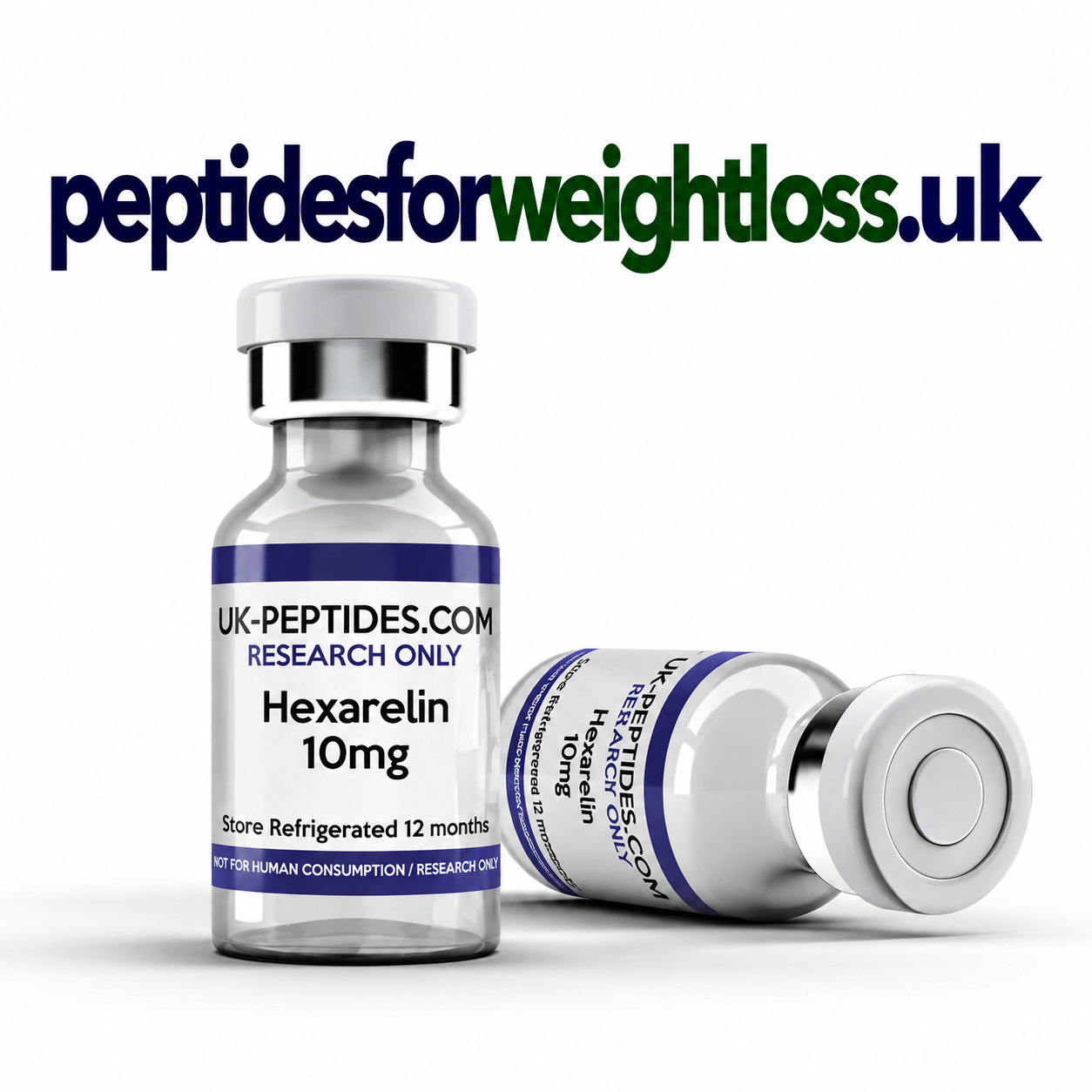
Hexarelin 10mg – Examorelin Growth Hormone Secretagogue Research Peptide
Hexarelin 10mg is a synthetic growth hormone secretagogue research peptide investigated in studies of pituitary hormone secretion, ghrelin receptor signalling, growth hormone regulation and neuroendocrine physiology. Also known as Examorelin, Hexarelin is a modified six-amino-acid peptide developed from the growth hormone-releasing peptide family.
Hexarelin 10mg is associated with research into the growth hormone secretagogue receptor, commonly called GHS-R1a. This receptor is involved in the regulation of growth hormone secretion and responds to ghrelin, an endogenous hormone associated with appetite and energy regulation.
Published human endocrine studies have demonstrated that Hexarelin can stimulate growth hormone release under controlled experimental conditions. Researchers have also investigated its effects on prolactin, adrenocorticotropic hormone (ACTH), cortisol and the interaction between growth hormone secretagogues and growth hormone-releasing hormone (GHRH).
However, Hexarelin 10mg remains an investigational research material. Demonstrating a temporary increase in circulating growth hormone does not establish clinically meaningful muscle growth, fat loss, improved athletic performance or anti-ageing benefits.
Hexarelin 10mg is relevant to laboratory investigations involving peptide chemistry, receptor pharmacology, endocrine signalling, pituitary responsiveness and the regulation of growth hormone secretion.
What Is Hexarelin 10mg?
Hexarelin 10mg refers to a product labelled as containing 10mg of the synthetic peptide Hexarelin, also known as Examorelin.
Hexarelin belongs to the growth hormone-releasing peptide family and is structurally related to GHRP-6.
The compound contains six amino acid residues, including modified amino acids that distinguish it from naturally occurring peptide sequences.
Its reference sequence is His-D-2-methyl-Trp-Ala-Trp-D-Phe-Lys-NH2.
Researchers developed Hexarelin to investigate synthetic compounds capable of stimulating growth hormone secretion through mechanisms distinct from direct GHRH receptor activation.
Human studies published during the 1990s and early 2000s examined Hexarelin responses in healthy volunteers and selected endocrine patient populations.
These investigations established measurable endocrine activity but did not demonstrate that Hexarelin 10mg is an approved treatment for obesity, muscle loss or hormone deficiency.
Hexarelin 10mg Product Specifications
- Product Name: Hexarelin 10mg
- Alternative Name: Examorelin
- Peptide Classification: Synthetic growth hormone secretagogue
- Peptide Family: Growth hormone-releasing peptides (GHRPs)
- Peptide Type: Modified hexapeptide
- Reference Sequence: His-D-2-methyl-Trp-Ala-Trp-D-Phe-Lys-NH2
- Peptide Length: 6 amino acid residues
- Reference Molecular Formula: C47H58N12O6
- Reference Molecular Weight: Approximately 887.04 g/mol
- Commonly Listed CAS Number: 140703-51-1
- Primary Research Target: Growth hormone secretagogue receptor (GHS-R1a)
- Labelled Quantity: 10mg
- Research Category: Endocrinology and peptide receptor pharmacology
- Research Focus: Growth hormone, prolactin, ACTH and cortisol regulation
- Purity: Requires batch-specific verification
- Salt Form: Confirm with manufacturer
- Physical Form: Confirm with manufacturer
- Storage: Follow verified manufacturer instructions
- Intended Use: Laboratory research only
The molecular specifications describe the commonly referenced Hexarelin structure. The exact purity, salt form and analytical characteristics of a commercial Hexarelin 10mg preparation require batch-specific verification.
Understanding the Molecular Structure of Hexarelin
Hexarelin is a modified synthetic hexapeptide containing six amino acid residues.
The reference sequence is:
His-D-2-methyl-Trp-Ala-Trp-D-Phe-Lys-NH2
The sequence includes histidine, a modified D-tryptophan residue, alanine, tryptophan, D-phenylalanine and lysine.
The D-amino acid residues and methyl modification distinguish Hexarelin from a conventional unmodified peptide sequence.
Its C-terminal lysine residue is amidated.
These structural characteristics are important for establishing chemical identity and investigating receptor interactions.
Hexarelin 10mg should be characterised using analytical methods capable of confirming molecular mass, peptide sequence and relevant stereochemistry.
How Does Hexarelin Work?
Hexarelin is a growth hormone secretagogue that stimulates growth hormone release through receptors associated with ghrelin signalling.
The growth hormone secretagogue receptor GHS-R1a is expressed in tissues involved in neuroendocrine regulation.
Activation of this receptor can influence growth hormone secretion through hypothalamic and pituitary mechanisms.
Hexarelin has been investigated as a synthetic agonist of this receptor system.
Unlike growth hormone itself, Hexarelin does not directly replace circulating growth hormone.
Instead, it stimulates endogenous hormone secretion under experimental conditions.
However, growth hormone secretion is regulated by multiple feedback systems, and acute hormonal responses do not establish long-term clinical benefits.
Scientific Research Into Hexarelin 10mg
1. Hexarelin 10mg and Growth Hormone Secretion Research
Growth hormone is produced by the anterior pituitary gland and participates in growth, metabolism and tissue regulation.
Hexarelin has been investigated for its ability to stimulate growth hormone release in humans.
A 1996 clinical study examined dose-related endocrine responses in healthy adult men.
The researchers reported increases in circulating growth hormone following Hexarelin exposure.
The study demonstrated that Hexarelin possesses measurable growth hormone secretagogue activity.
However, the findings did not establish that Hexarelin 10mg improves body composition or treats growth hormone deficiency.
2. Hexarelin and GHS-R1a Receptor Research
The growth hormone secretagogue receptor GHS-R1a is a G protein-coupled receptor associated with ghrelin signalling.
It participates in neuroendocrine pathways involved in growth hormone regulation.
Hexarelin is a synthetic agonist investigated in relation to this receptor system.
Researchers use growth hormone secretagogues to examine how receptor activation influences pituitary hormone secretion.
However, receptor activity alone does not establish clinical safety or therapeutic effectiveness.
3. Hexarelin 10mg and Ghrelin Research
Ghrelin is an endogenous peptide hormone produced primarily in the gastrointestinal system.
It interacts with the growth hormone secretagogue receptor and participates in appetite and metabolic regulation.
Hexarelin is not identical to ghrelin.
Instead, it is a synthetic compound that activates related receptor pathways.
Researchers investigating Hexarelin 10mg should distinguish ghrelin receptor activity from the complete physiological effects of endogenous ghrelin.
4. Hexarelin and Pituitary Function Research
The pituitary gland regulates several important endocrine systems.
Its anterior region produces growth hormone, prolactin, ACTH and other hormones.
Human Hexarelin studies have examined how the peptide influences selected pituitary hormone responses.
These investigations help researchers understand relationships between synthetic secretagogues and endogenous hormone regulation.
However, endocrine stimulation does not automatically translate into improved health or physical performance.
5. Hexarelin 10mg and Prolactin Research
Prolactin is a pituitary hormone involved in reproductive and other physiological processes.
Some human studies reported increased prolactin concentrations following acute Hexarelin exposure.
The magnitude of the response varied according to experimental conditions and the populations examined.
These findings demonstrate that Hexarelin activity is not always restricted to growth hormone secretion.
Potential effects on prolactin are relevant when interpreting the compound’s endocrine profile.
6. Hexarelin and Cortisol Research
Cortisol is a steroid hormone produced by the adrenal glands.
It participates in metabolism, stress responses and immune regulation.
Published human studies reported increases in cortisol following selected acute Hexarelin challenges.
However, results from longer observation periods have not always shown the same pattern.
Researchers should distinguish short-term endocrine responses from sustained changes in cortisol secretion.
7. Hexarelin 10mg and ACTH Research
Adrenocorticotropic hormone, abbreviated ACTH, is released by the anterior pituitary gland.
ACTH helps regulate cortisol production through the hypothalamic-pituitary-adrenal axis.
Hexarelin has been investigated for its ability to influence ACTH release in humans.
Selected acute studies reported increased ACTH concentrations.
However, these findings depend on the experimental protocol and should not be generalised to every exposure pattern.
8. Hexarelin and Growth Hormone-Releasing Hormone Research
Growth hormone-releasing hormone, commonly abbreviated GHRH, is produced in the hypothalamus.
It stimulates growth hormone secretion through a receptor pathway distinct from the primary ghrelin receptor pathway.
Researchers have investigated combinations of Hexarelin and GHRH to examine interactions between these signalling systems.
A 1996 study reported a strong growth hormone response when the two compounds were examined together.
These findings support investigation into neuroendocrine pathway interactions.
They do not establish the safety or clinical effectiveness of combining experimental secretagogues.
9. Hexarelin 10mg and Pulsatile Hormone Secretion
Growth hormone is normally secreted in pulses rather than at a constant rate.
Researchers use repeated blood sampling to examine hormone pulse frequency, amplitude and total secretion.
A 2002 study investigated the effects of Hexarelin on 24-hour growth hormone patterns in healthy volunteers.
The researchers reported increased growth hormone secretion associated with changes in secretory burst mass.
These findings demonstrate that Hexarelin can influence hormone secretion patterns under controlled conditions.
10. Hexarelin and IGF-1 Research
Insulin-like growth factor 1, commonly abbreviated IGF-1, is involved in growth hormone-related signalling.
Many growth hormone effects are mediated partly through IGF-1.
However, increases in circulating growth hormone do not always produce immediate or proportional changes in IGF-1.
A 2002 human study found that one-day Hexarelin exposure increased growth hormone secretion without significantly changing IGF-1 levels.
Researchers should therefore avoid assuming that Hexarelin 10mg reliably increases IGF-1 in every experimental setting.
11. Hexarelin 10mg and Endocrine Feedback Research
Endocrine feedback systems help regulate hormone secretion.
Growth hormone production is influenced by GHRH, somatostatin, ghrelin-related signalling and circulating metabolic factors.
Hexarelin research has examined how synthetic secretagogue exposure interacts with these regulatory mechanisms.
Repeated stimulation may produce different endocrine responses from a single experimental challenge.
These differences are relevant to understanding receptor responsiveness and hormonal feedback.
12. Hexarelin and Receptor Desensitisation Research
Receptor desensitisation occurs when cellular responses to repeated stimulation change over time.
Researchers have investigated whether repeated Hexarelin exposure alters subsequent growth hormone responses.
A 2002 study observed a blunted growth hormone response to a later Hexarelin challenge after prior exposure.
These findings suggest that response patterns can change under repeated experimental conditions.
However, they do not establish a predictable human dosing schedule or long-term safety profile.
13. Hexarelin 10mg and Age-Related Endocrine Research
Growth hormone secretion changes with age.
Researchers have examined Hexarelin responses across different age groups.
A 1997 study investigated growth hormone, prolactin, ACTH and cortisol responses in children, younger adults and older adults.
The findings demonstrated that endocrine responses can vary with age.
However, these results do not establish Hexarelin as an anti-ageing treatment.
14. Hexarelin and Cardiovascular Research
Growth hormone secretagogues have also been investigated in experimental cardiovascular research.
Some studies involving Hexarelin examined cardiac tissue responses and potential interactions with receptor systems outside the pituitary gland.
These investigations are relevant to understanding the broader biological activity of the compound.
However, cardiovascular findings from cell or animal models do not establish that Hexarelin 10mg treats heart disease in humans.
15. Hexarelin 10mg and Peptide Structure-Activity Research
Structure-activity relationship research investigates how molecular modifications influence biological activity.
Hexarelin contains a modified D-tryptophan residue and other structural features that distinguish it from GHRP-6.
These differences are relevant to research involving receptor interactions and peptide pharmacology.
However, structural modifications do not automatically establish improved safety or clinical effectiveness.
Hexarelin 10mg vs GHRP-6
Hexarelin and GHRP-6 are structurally related growth hormone secretagogues.
- Hexarelin: A modified synthetic hexapeptide containing a D-2-methyltryptophan residue.
- GHRP-6: A synthetic growth hormone-releasing peptide with a different amino acid structure.
- Research Target: Both are investigated in relation to growth hormone secretagogue receptor signalling.
- Research Interpretation: Findings involving GHRP-6 cannot automatically establish the endocrine effects of Hexarelin.
Hexarelin 10mg vs GHRP-2
Hexarelin and GHRP-2 are different synthetic growth hormone secretagogues.
Both have been investigated in human studies examining growth hormone secretion.
A 1997 study compared endocrine responses to Hexarelin and GHRP-2 in healthy volunteers.
The researchers reported broadly comparable growth hormone responses under the selected experimental conditions.
However, their molecular structures and detailed pharmacological profiles differ.
Hexarelin 10mg vs Ipamorelin
Hexarelin and Ipamorelin are synthetic growth hormone secretagogues associated with ghrelin receptor research.
Both compounds have been investigated for their effects on growth hormone secretion.
However, their amino acid sequences and endocrine selectivity profiles differ.
Hexarelin has demonstrated prolactin and cortisol responses in selected human studies.
Results involving Ipamorelin should not automatically be attributed to Hexarelin.
Hexarelin 10mg vs CJC-1295
Hexarelin and CJC-1295 are investigated through different growth hormone-related signalling pathways.
Hexarelin is a growth hormone secretagogue associated with ghrelin receptor activation.
CJC-1295 is a modified growth hormone-releasing hormone analogue.
Although both compounds are associated with growth hormone research, they are not chemically or pharmacologically interchangeable.
Findings involving CJC-1295 cannot establish the safety or effectiveness of Hexarelin 10mg.
Hexarelin 10mg and Muscle Growth Research
Hexarelin 10mg is sometimes discussed in connection with muscle growth because of its growth hormone secretagogue activity.
However, acute increases in circulating growth hormone do not establish clinically meaningful increases in muscle mass or strength.
There is insufficient reliable evidence that a commercial Hexarelin 10mg preparation safely increases muscle size or improves athletic performance.
It should not be described as a clinically proven muscle-building compound.
Hexarelin 10mg and Weight Management
Hexarelin 10mg is not an established treatment for obesity or weight loss.
Although growth hormone participates in metabolic regulation, experimentally increasing growth hormone secretion does not automatically result in meaningful fat reduction.
There is insufficient clinical evidence that Hexarelin safely reduces body fat, suppresses appetite or treats obesity.
Hexarelin should not be marketed as a proven fat-burning or weight-management treatment.
Hexarelin 10mg and Anti-Ageing Claims
Growth hormone secretion changes during ageing, which has led to interest in growth hormone secretagogues.
However, age-related changes in hormone concentrations do not establish that artificially increasing hormone secretion reverses ageing.
There is insufficient reliable clinical evidence that Hexarelin 10mg improves longevity, reverses biological ageing or prevents age-related disease.
Understanding the Hexarelin 10mg Label
The 10mg designation refers to the labelled quantity of research material.
It does not represent a recommended human dose or independently establish the peptide’s purity, identity, sterility or biological activity.
Researchers should verify whether the stated mass refers to the peptide itself or includes counterions and other formulation components.
Hexarelin 10mg Research Quality and Documentation
Important considerations when evaluating Hexarelin 10mg research material include:
- Verification of the complete six-residue sequence
- Confirmation of the D-2-methyltryptophan residue
- Verification of the D-phenylalanine residue
- Confirmation of C-terminal amidation
- Verification of the expected molecular mass
- Identification of the supplied salt form
- Batch-specific certificate of analysis
- Appropriate analytical purity testing
- Mass spectrometry or another suitable identity method
- Confirmation of the labelled 10mg quantity
- Assessment of synthesis-related impurities
- Manufacturer and batch traceability
- Documentation of counterions and formulation components
- Verified packaging specifications
- Product-specific storage and stability information
- Clearly stated research-use classification
Storage and Handling of Hexarelin 10mg
Hexarelin 10mg research material should be stored according to verified manufacturer instructions.
Storage requirements depend on the peptide’s salt form, physical presentation, formulation and packaging.
Researchers should not assume that all Hexarelin preparations have identical stability or shelf-life characteristics.
Laboratory handling should follow relevant safety documentation and institutional procedures.
Hexarelin 10mg Safety and Scientific Limitations
Hexarelin has demonstrated measurable endocrine activity in human research.
Selected studies reported increases in growth hormone, prolactin, ACTH and cortisol.
These effects demonstrate that the compound can influence multiple hormonal pathways.
Potential concerns include unintended endocrine changes, altered glucose regulation, fluid retention and unknown long-term effects.
Short-term clinical research does not establish the safety of prolonged or unsupervised exposure.
Hexarelin 10mg is not an established approved medicine for obesity, bodybuilding, athletic performance or anti-ageing in the United Kingdom.
Research-grade material should not be assumed suitable for human administration.
This information is intended for scientific and educational purposes only and does not provide human dosing recommendations or administration instructions.
Frequently Asked Questions About Hexarelin 10mg
What is Hexarelin 10mg?
Hexarelin 10mg is a product listing for a synthetic growth hormone secretagogue peptide with a labelled quantity of 10mg.
What is another name for Hexarelin?
Hexarelin is also known as Examorelin.
What is the Hexarelin peptide sequence?
The reference sequence is His-D-2-methyl-Trp-Ala-Trp-D-Phe-Lys-NH2.
How many amino acids does Hexarelin contain?
Hexarelin contains six amino acid residues.
What is the molecular formula of Hexarelin?
The reference molecular formula is C47H58N12O6.
What is the molecular weight of Hexarelin?
The reference molecular weight is approximately 887.04 g/mol.
What is the CAS number for Hexarelin?
A commonly listed CAS number is 140703-51-1.
Does Hexarelin stimulate growth hormone?
Yes. Controlled human endocrine studies have demonstrated increased growth hormone secretion following Hexarelin exposure.
Does Hexarelin increase prolactin?
Selected acute human studies reported increased prolactin concentrations following Hexarelin exposure.
Does Hexarelin affect cortisol?
Some acute studies reported increased cortisol, although responses differ across experimental protocols.
Does Hexarelin increase IGF-1?
Not consistently in short-term studies. One human study found increased growth hormone secretion without a significant change in IGF-1 over one day.
Is Hexarelin the same as GHRP-6?
No. Hexarelin is a structurally modified analogue related to GHRP-6.
Does Hexarelin build muscle?
There is insufficient reliable clinical evidence that Hexarelin safely increases muscle mass or strength in humans.
Is Hexarelin a weight-loss peptide?
No. Hexarelin is not an established treatment for obesity or weight management.
What does Hexarelin 10mg mean?
The designation refers to a labelled quantity of 10mg of research material, not a recommended human dose.
Hexarelin 10mg – Scientific Product Summary
Hexarelin 10mg is a synthetic six-amino-acid growth hormone secretagogue research peptide also known as Examorelin.
Its modified amino acid sequence and interaction with growth hormone secretagogue receptor pathways have made it relevant to investigations involving pituitary hormone secretion and neuroendocrine regulation.
Published human studies demonstrate acute growth hormone responses and, under some conditions, changes in prolactin, ACTH and cortisol.
However, human therapeutic effectiveness and long-term safety remain insufficiently established.
Researchers evaluating Hexarelin 10mg should verify the complete peptide sequence, molecular identity, purity, salt form, labelled quantity and batch-specific analytical documentation.

Reviews
There are no reviews yet.