
Description
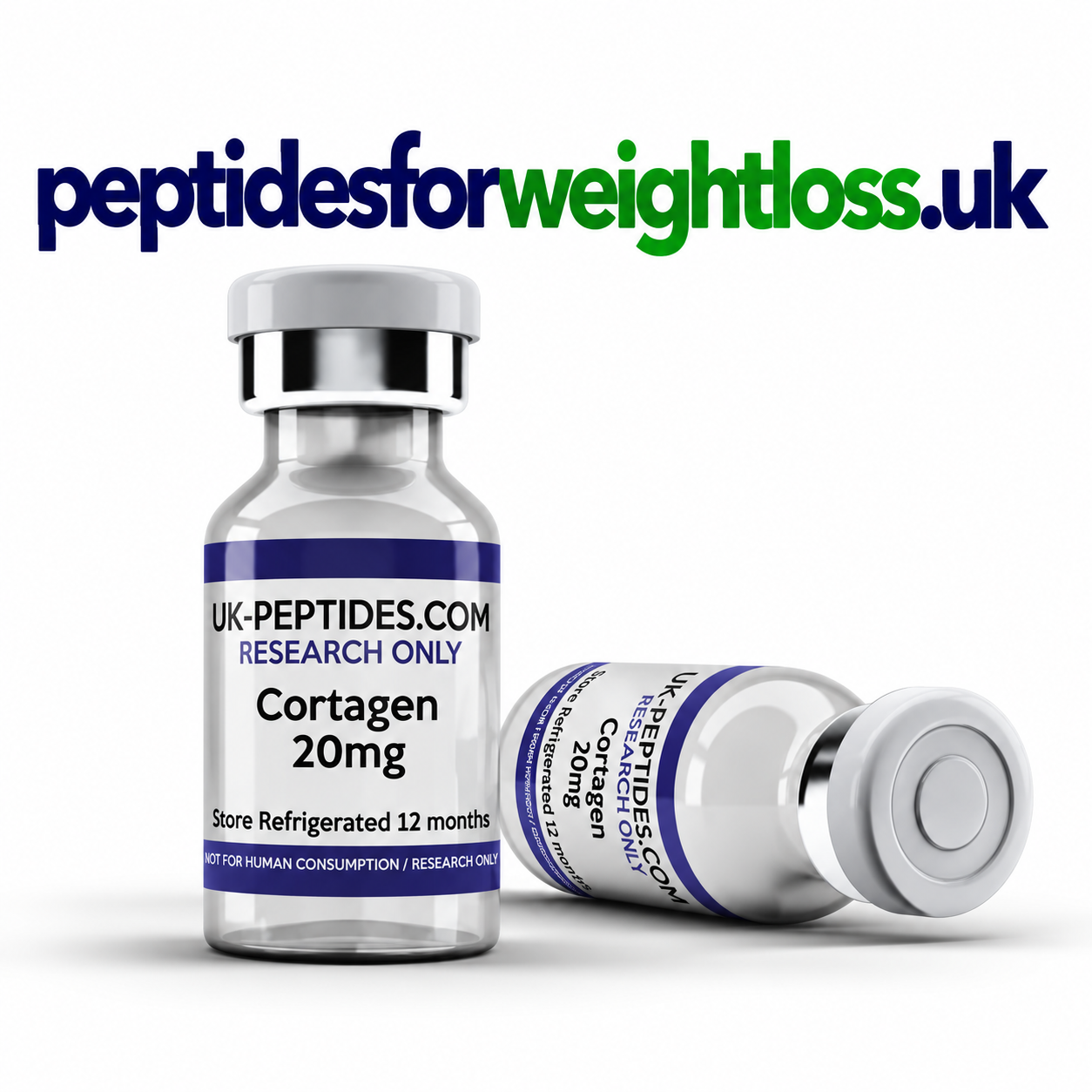
Cortagen 20mg – AEDP Tetrapeptide Bioregulator for Laboratory Research
Cortagen 20mg is a synthetic tetrapeptide associated with scientific research into nervous-system biology, peripheral nerve regeneration, cellular gene expression and short-peptide bioregulation. Also known as the AEDP peptide, Cortagen contains four amino acids: alanine, glutamic acid, aspartic acid and proline.
Cortagen belongs to the family of short synthetic peptides associated with the research of Vladimir Khavinson and colleagues. It was developed through directed peptide synthesis informed by the amino acid composition of Cortexin, a polypeptide preparation obtained from cerebral cortex tissue.
Unlike Cortexin, which is a complex mixture of peptides, Cortagen is a chemically defined four-amino-acid molecule. Its short sequence makes it relevant to investigations involving peptide structure, gene regulation and experimental tissue responses.
Published research has explored Cortagen in animal models of peripheral nerve injury and in investigations of gene expression in mouse heart tissue. However, the available evidence is limited, and Cortagen has not been established as an effective treatment for neurological disorders, nerve damage, cognitive impairment or other medical conditions in humans.
The Cortagen 20mg product is intended for laboratory research involving peptide biochemistry and experimental cellular biology.
What Is Cortagen Peptide?
Cortagen is a synthetic peptide consisting of four amino acid residues connected by peptide bonds.
Its reference sequence is Ala-Glu-Asp-Pro, abbreviated AEDP using the standard one-letter amino acid code.
The peptide is associated with the Khavinson short-peptide bioregulator research programme, which investigated how small amino acid sequences may influence biological processes in experimental models.
Cortagen is commonly described as a cerebral cortex-associated peptide bioregulator because of its historical relationship to research involving Cortexin.
However, this classification does not establish that Cortagen specifically targets the human cerebral cortex or provides proven neuroprotective benefits.
Cortagen 20mg Product Specifications
- Product Name: Cortagen 20mg
- Alternative Names: Cortagen peptide, AEDP peptide, Cortagene
- Peptide Classification: Synthetic short-peptide bioregulator
- Peptide Type: Tetrapeptide
- Reference Sequence: Ala-Glu-Asp-Pro
- One-Letter Sequence: AEDP
- Peptide Length: 4 amino acid residues
- Reference Structure: H-Ala-Glu-Asp-Pro-OH
- Reference Molecular Formula: C17H26N4O9
- Approximate Molecular Weight: 430.41 g/mol
- Reference CAS Number: 335591-03-2
- PubChem Compound ID: 18439621
- Labelled Quantity: 20mg
- Research Category: Peptide bioregulator and nervous-system research
- Research Focus: Peripheral nerve biology, gene expression and peptide structure
- Purity: Requires batch-specific verification
- Salt Form: Confirm with manufacturer
- Physical Form: Confirm with manufacturer
- Storage: Follow verified manufacturer instructions
- Intended Use: Laboratory research only
The reference molecular formula and molecular weight describe the free-acid AEDP tetrapeptide. Commercial preparations containing counterions, water or other components may have different analytical characteristics.
Understanding the Molecular Structure of Cortagen
Cortagen contains four amino acid residues arranged in the sequence Ala-Glu-Asp-Pro.
The reference molecule consists of:
- Alanine (Ala): A small amino acid with a methyl-containing side chain.
- Glutamic Acid (Glu): An acidic amino acid containing a carboxyl-bearing side chain.
- Aspartic Acid (Asp): An acidic amino acid with a shorter carboxyl-bearing side chain.
- Proline (Pro): A cyclic amino acid that can influence peptide backbone conformation.
The sequence contains free amino and carboxyl termini in the reference molecular structure.
The presence of proline at the fourth position distinguishes Cortagen from related tetrapeptides such as Epitalon and Cardiogen.
Researchers should confirm the complete sequence and stereochemistry using appropriate analytical documentation.
How Does Cortagen Work?
Cortagen has been investigated as part of a broader research programme examining the biological effects of short synthetic peptides.
Experimental studies have reported changes in selected tissue responses and gene-expression patterns following exposure to the AEDP peptide.
Researchers have proposed that some short peptide bioregulators may influence cellular regulatory processes, including mechanisms associated with chromatin organisation and gene activity.
However, a specific, independently validated molecular receptor or complete mechanism of action for Cortagen has not been established.
Its biological activity should therefore be described in relation to individual experimental findings rather than as a proven therapeutic mechanism.
Scientific Research Into Cortagen
1. Peripheral Nerve Regeneration Research
Peripheral nerves connect the central nervous system with muscles, sensory receptors and other tissues.
Following injury, peripheral nerve recovery involves multiple biological processes, including axonal regrowth, Schwann cell activity and restoration of nerve conduction.
Cortagen has been investigated in animal models involving injury to the sciatic nerve.
A published rat study reported improvements in selected measurements of regenerating nerve fibres following experimental exposure to Cortagen.
These findings are relevant to understanding experimental peripheral nerve recovery.
However, results obtained in rats cannot establish equivalent nerve regeneration or functional recovery in humans.
2. Sciatic Nerve Function Research
The sciatic nerve is a major peripheral nerve involved in motor and sensory function.
Experimental sciatic nerve injury models are used to investigate the biological processes involved in nerve damage and recovery.
Researchers have studied Cortagen in relation to changes in nerve conduction and regeneration following experimentally induced nerve injury.
Additional preclinical research has examined the timing of functional recovery.
These findings remain limited to experimental models and do not establish Cortagen as a treatment for sciatica, neuropathy or peripheral nerve injuries in humans.
3. Cerebral Cortex Research
The cerebral cortex is involved in sensory processing, voluntary movement, language and higher cognitive functions.
Cortagen was developed from research associated with a peptide preparation derived from cerebral cortex tissue.
This historical relationship explains its classification as a cortex-associated peptide bioregulator.
However, the chemical identity of Cortagen is different from the complex mixture of peptides found in Cortexin.
There is insufficient reliable clinical evidence that Cortagen improves memory, attention, learning or other cognitive functions in humans.
4. Gene Expression Research
Gene expression is the process through which genetic information contributes to the production of RNA and proteins.
Researchers investigate gene-expression patterns to understand how cells respond to biological signals and experimental compounds.
A published study examined the effects of Cortagen on gene expression in mouse heart tissue using microarray technology.
The investigation identified changes in selected transcripts following experimental exposure to the peptide.
These findings suggest that Cortagen may influence certain cellular responses under specific experimental conditions.
However, changes in gene expression do not establish clinically meaningful benefits or a complete mechanism of action.
5. Cellular Ageing Research
Cellular ageing involves changes in gene regulation, stress responses, metabolism and tissue function.
The Khavinson peptide research programme has investigated short synthetic peptides in relation to ageing-associated biological processes.
Cortagen is relevant to this field because of its inclusion in experimental investigations of cellular regulation.
Some studies have proposed that short peptides may influence age-associated changes in gene expression.
However, there is insufficient evidence that Cortagen reverses biological ageing, prevents age-related disease or extends human lifespan.
6. Chromatin and Cellular Regulation Research
Chromatin consists of DNA and associated proteins that help organise genetic material within the cell nucleus.
Changes in chromatin structure can influence the accessibility of genes to transcriptional machinery.
Some research involving short peptide bioregulators has investigated potential relationships between peptide exposure and chromatin organisation.
Cortagen has been discussed within this broader experimental framework.
However, direct molecular targets and the clinical significance of any observed changes remain uncertain.
7. Nervous-System Tissue Biology
Nervous-system tissue contains specialised neurons, glial cells and supporting structures.
Cellular communication, electrical signalling and tissue maintenance depend on complex interactions between these components.
Cortagen has been investigated in research associated with nervous-system function and peripheral nerve recovery.
Its experimental profile makes it relevant to studies of short peptides in neurological tissue models.
However, the available evidence does not establish that Cortagen protects human neurons or prevents neurological disease.
8. Peptide Structure-Activity Research
Structure-activity relationship research examines how changes in molecular structure influence chemical and biological properties.
Cortagen is a four-residue peptide that can be compared with other short synthetic bioregulators.
Its sequence shares the Ala-Glu-Asp motif with several related peptides but differs in the fourth amino acid.
These structural differences provide opportunities to investigate how individual residues influence experimental behaviour.
However, similarities between peptide sequences do not establish identical biological activity.
9. Cardiovascular Gene Expression Research
Although Cortagen is historically associated with nervous-system research, one published study examined its effects on gene expression in mouse heart tissue.
The investigation used microarray analysis to identify changes in selected transcripts.
This research illustrates that experimental effects attributed to short peptide bioregulators may not be limited to the tissue category suggested by their commercial names.
However, changes in mouse heart gene expression do not establish cardiovascular protection or therapeutic effectiveness in humans.
Cortagen vs Cortexin
Cortagen and Cortexin are not the same material.
- Cortagen: A chemically defined synthetic tetrapeptide with the sequence Ala-Glu-Asp-Pro.
- Cortexin: A complex preparation containing multiple peptides derived from cerebral cortex tissue.
- Molecular Identity: Cortagen has a defined four-residue sequence, while Cortexin is a mixture.
- Research Interpretation: Findings involving Cortexin cannot automatically establish the biological effects of Cortagen.
Researchers should distinguish these materials when reviewing scientific literature and analytical specifications.
Cortagen vs Epitalon
Cortagen and Epitalon are related short synthetic peptides but have different molecular structures.
- Cortagen: Ala-Glu-Asp-Pro (AEDP).
- Epitalon: Ala-Glu-Asp-Gly (AEDG).
- Peptide Length: Both contain four amino acid residues.
- Structural Difference: Cortagen contains proline at position four, while Epitalon contains glycine.
Research findings involving Epitalon and telomerase-associated processes should not be attributed to Cortagen without direct supporting evidence.
Cortagen vs Cartalax
Cartalax is another short peptide associated with the Khavinson research programme.
Cartalax contains the sequence Ala-Glu-Asp, abbreviated AED.
Cortagen contains an additional proline residue and has the sequence Ala-Glu-Asp-Pro.
Consequently, Cartalax is a tripeptide, while Cortagen is a tetrapeptide.
The difference in peptide length changes the molecular identity and may influence chemical or biological properties.
Cortagen vs Cardiogen
Cardiogen is a synthetic tetrapeptide containing the sequence Ala-Glu-Asp-Arg.
Cortagen contains Ala-Glu-Asp-Pro.
The two compounds share the same first three amino acid residues but differ at the fourth position.
Cardiogen contains arginine, while Cortagen contains proline.
Research findings involving one peptide cannot automatically establish the activity of the other.
Cortagen and Cognitive Function Research
Cortagen is sometimes discussed in relation to cognition because of its association with cerebral cortex research.
However, its published experimental literature primarily concerns selected animal and tissue-level findings.
There is insufficient reliable clinical evidence demonstrating that Cortagen improves memory, concentration, learning ability or mental performance in humans.
Such outcomes should not be presented as proven product benefits.
Cortagen and Neuroprotection Research
Neuroprotection refers to biological processes that help preserve nervous-system cells or functions under conditions of injury or stress.
Experimental studies involving Cortagen have examined nerve-related outcomes in animal models.
However, evidence from nerve injury models does not establish that Cortagen prevents stroke, dementia, neurodegenerative disease or other neurological disorders.
Its potential neuroprotective mechanisms require further investigation.
Cortagen and Anti-Ageing Research
Cortagen is associated with a broader family of short peptides investigated in experimental ageing-related research.
Some studies have examined gene-expression changes and tissue responses.
However, there is no reliable clinical evidence establishing that Cortagen reverses ageing, increases lifespan or prevents age-related disease.
Claims of proven anti-ageing benefits are therefore unsupported.
Cortagen and Weight Management
Cortagen is not an established weight-loss peptide.
Its principal research associations involve nervous-system biology, short-peptide chemistry and cellular regulation.
There is insufficient reliable clinical evidence that Cortagen reduces body fat, suppresses appetite or treats obesity.
It should not be described as a proven fat-burning or weight-management compound.
Understanding the Cortagen 20mg Label
The 20mg designation refers to the labelled quantity of research material.
It does not represent a recommended human dose or independently verify the actual peptide content, purity or biological activity.
Researchers should confirm whether the stated mass refers to the free peptide or includes counterions and other formulation components.
Batch-specific analytical documentation is necessary to establish the actual specifications of the supplied material.
Cortagen 20mg Research Quality and Documentation
Important considerations when evaluating Cortagen research material include:
- Verification of the complete Ala-Glu-Asp-Pro sequence
- Confirmation that the peptide contains four amino acid residues
- Verification of the expected molecular mass
- Confirmation of peptide stereochemistry
- Distinction from Cartalax, Epitalon and Cardiogen
- Identification of the supplied salt form
- Batch-specific certificate of analysis
- Appropriate analytical purity testing
- Mass spectrometry or another suitable identity test
- Confirmation of the labelled 20mg quantity
- Assessment of synthesis-related impurities
- Manufacturer and batch traceability
- Documentation of counterions and formulation components
- Verified packaging specifications
- Product-specific storage and stability information
- Clearly stated research-use classification
These records help distinguish accurately characterised Cortagen from products identified only by commercial naming conventions.
Storage and Handling of Cortagen
Cortagen research material should be stored according to verified manufacturer instructions.
Storage requirements depend on the peptide’s salt form, physical presentation, formulation and packaging.
Researchers should not assume that all Cortagen products have identical stability or shelf-life characteristics.
Laboratory handling should follow relevant safety documentation and institutional procedures.
Cortagen Safety and Scientific Limitations
Cortagen is an investigational peptide without a well-established human clinical safety profile.
Available published research is limited and includes experimental animal and tissue studies.
Potential concerns include peptide-related impurities, formulation-dependent reactions, unknown biological effects and insufficient long-term safety information.
Cortagen is not an established approved medicine for nerve repair, cognitive enhancement, neurodegenerative disorders, anti-ageing or weight management.
Research-grade material should not be assumed suitable for human administration.
This information is intended for scientific and educational purposes only and does not provide medical advice, human dosing recommendations or administration instructions.
Frequently Asked Questions About Cortagen 20mg
What is Cortagen 20mg?
Cortagen 20mg is a product listing for the synthetic AEDP tetrapeptide with a labelled quantity of 20mg.
What is the Cortagen peptide sequence?
The reference sequence is Ala-Glu-Asp-Pro, abbreviated AEDP.
How many amino acids are in Cortagen?
Cortagen contains four amino acid residues.
What is the molecular weight of Cortagen?
The reference free-acid peptide has an approximate molecular weight of 430.41 g/mol.
What is the molecular formula of Cortagen?
The reference molecular formula is C17H26N4O9.
Is Cortagen the same as Cortexin?
No. Cortagen is a defined synthetic tetrapeptide, while Cortexin is a mixture of peptides.
Is Cortagen the same as Epitalon?
No. Cortagen has the sequence AEDP, while Epitalon has the sequence AEDG.
Is Cortagen the same as Cartalax?
No. Cortagen is the AEDP tetrapeptide, while Cartalax is the AED tripeptide.
What is Cortagen researched for?
Published studies have investigated Cortagen in peripheral nerve injury models and experimental gene-expression research.
Does Cortagen repair damaged nerves?
Some animal studies reported changes in nerve regeneration measurements, but human therapeutic effectiveness has not been established.
Does Cortagen improve memory?
There is insufficient reliable clinical evidence demonstrating improvements in human memory or cognitive performance.
Is Cortagen a weight-loss peptide?
No. Cortagen is not an established treatment for obesity or weight management.
What does the 20mg designation mean?
It refers to the labelled quantity of research material, not a recommended human dose.
Cortagen 20mg – Product Summary
Cortagen 20mg is a synthetic tetrapeptide containing the amino acid sequence Ala-Glu-Asp-Pro.
Also known as AEDP, it belongs to the Khavinson short-peptide bioregulator research family and has been investigated in experimental studies involving peripheral nerve regeneration, gene expression and tissue biology.
Although selected animal studies reported changes in nerve-related outcomes, clinical effectiveness and long-term safety in humans remain unestablished.
Researchers should verify the complete peptide sequence, molecular identity, purity, salt form, labelled quantity and batch-specific documentation before selecting Cortagen 20mg for laboratory investigation.
Reviews
There are no reviews yet.