Description
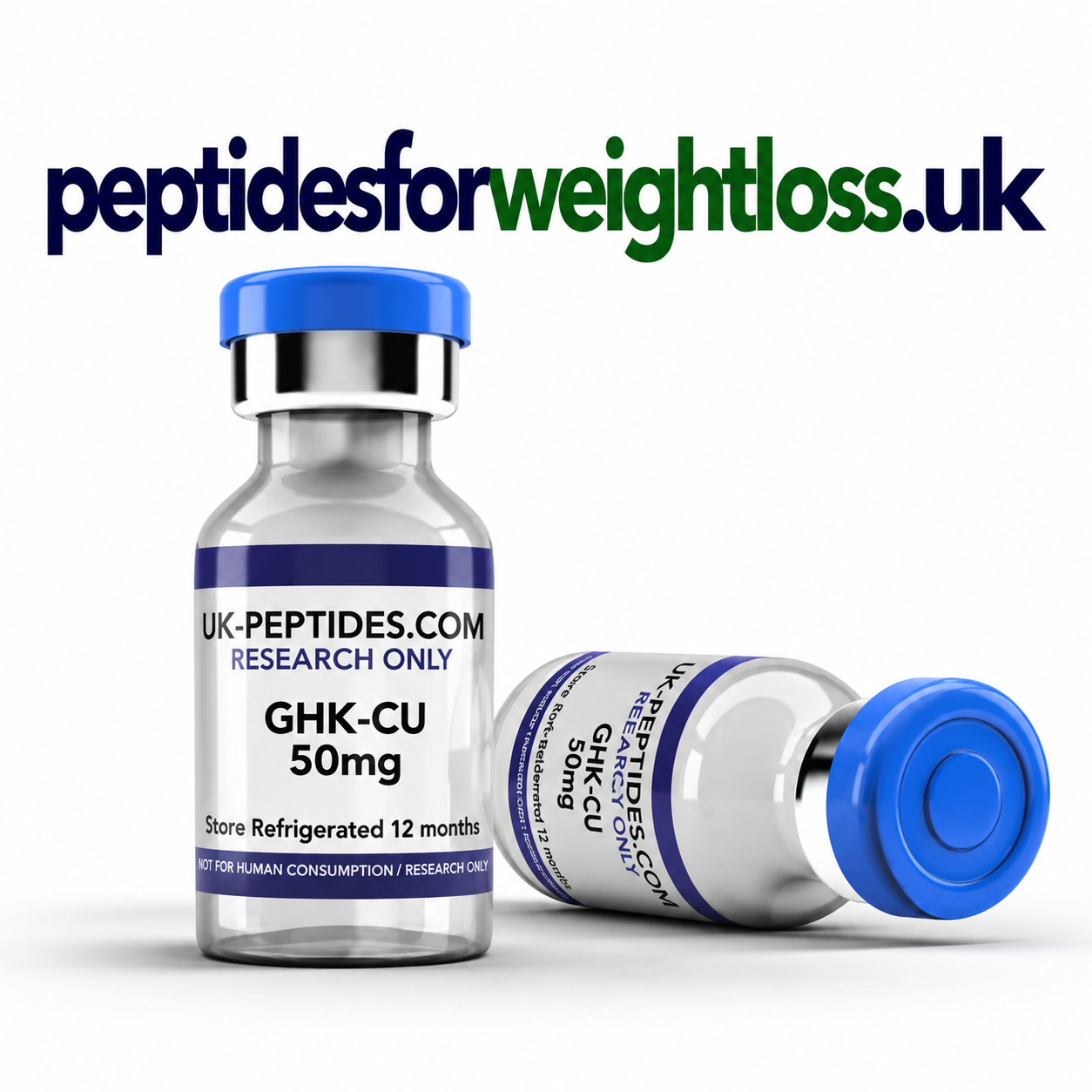
GHK-Cu 50mg Copper Peptide – Research Tripeptide Complex
GHK-Cu 50mg Copper Peptide is a copper-binding tripeptide complex associated with scientific investigations into skin biology, extracellular matrix remodelling, collagen-related signalling and experimental tissue repair. Also known as copper tripeptide-1, GHK-Cu consists of the peptide glycyl-L-histidyl-L-lysine coordinated with copper(II).
GHK-Cu has attracted interest in biochemical, dermatological and biomaterials research because copper ions participate in numerous cellular processes, while the GHK peptide provides a molecular framework capable of binding copper.
Laboratory and animal studies have investigated GHK-Cu in relation to fibroblast activity, extracellular matrix proteins, inflammatory signalling and wound-associated cellular responses. Limited human studies have also evaluated certain topical cosmetic formulations.
However, these findings do not establish GHK-Cu as a clinically proven treatment for skin damage, hair loss, chronic wounds or other medical conditions. The effects of a particular formulation depend on its chemical identity, copper coordination, concentration, stability and route of exposure.
What Is GHK-Cu Copper Peptide?
GHK-Cu is a coordination complex formed when the tripeptide glycyl-L-histidyl-L-lysine binds a copper(II) ion.
The underlying GHK sequence contains three amino acid residues:
- Glycine (Gly): A small amino acid that forms the N-terminal residue.
- Histidine (His): An amino acid with an imidazole-containing side chain involved in copper coordination.
- Lysine (Lys): A basic amino acid forming the C-terminal residue.
GHK has been identified in human biological fluids and studied for its copper-binding properties. The copper-bound form is commonly referred to as GHK-Cu.
Researchers investigate GHK-Cu to understand how peptide-metal coordination may influence biological activity, cellular responses and formulation behaviour.
GHK-Cu 50mg Product Specifications
- Product Name: GHK-Cu 50mg Copper Peptide
- Alternative Name: Copper Tripeptide-1
- Peptide Name: Glycyl-L-Histidyl-L-Lysine
- Peptide Sequence: Gly-His-Lys
- One-Letter Sequence: GHK
- Peptide Length: 3 amino acid residues
- Classification: Copper(II)-complexed tripeptide
- Reference Formula for Free GHK: C14H24N6O4
- Approximate Molecular Weight of Free GHK: 340.38 g/mol
- Reference Formula for 1:1 GHK-Cu Complex: C14H22CuN6O4
- Approximate Molecular Weight of 1:1 GHK-Cu Complex: 401.91 g/mol
- Labelled Quantity: 50mg
- Research Category: Copper peptide and extracellular matrix research
- Research Focus: Skin biology, fibroblast activity, collagen signalling and tissue remodelling
- Purity: Requires batch-specific verification
- Copper Coordination State: Requires analytical confirmation
- Physical Form: Confirm with manufacturer
- Storage: Follow verified manufacturer instructions
- Intended Use: Laboratory research
The reference molecular formula and molecular weight for GHK-Cu describe a simplified 1:1 copper(II)-peptide complex. Actual commercial preparations may contain counterions, water, different coordination species or other formulation components. Researchers should verify the exact molecular identity of the supplied material.
Understanding the Molecular Structure of GHK-Cu
GHK-Cu is chemically different from an ordinary uncomplexed peptide because its biological and physical properties depend partly on metal coordination.
The GHK peptide contains three amino acids connected through peptide bonds.
Its histidine residue contributes to the ability of the molecule to coordinate copper ions.
When copper(II) associates with GHK, the resulting coordination complex may exhibit different chemical properties from free GHK.
These differences can influence solubility, stability, interactions with biological molecules and experimental activity.
The exact coordination environment may depend on pH, surrounding ions, concentration and formulation conditions.
For this reason, researchers should not assume that all products labelled GHK-Cu have identical molecular characteristics.
How Does GHK-Cu Work?
GHK-Cu has been investigated for its possible involvement in multiple biological processes associated with tissue maintenance and repair.
Experimental research has examined relationships between GHK-Cu and extracellular matrix components, fibroblast behaviour, inflammatory responses and oxidative stress.
The extracellular matrix is a network of proteins and other molecules that provides structural support to tissues.
Collagen and elastin are important components of this network, particularly in skin and connective tissues.
Some studies have reported changes in collagen-related processes and cellular activity following exposure to GHK or GHK-Cu.
However, the precise contribution of intact GHK-Cu, unbound GHK and free copper may vary across experimental preparations.
These distinctions are important when interpreting research findings and comparing different copper peptide formulations.
Scientific Research Into GHK-Cu
1. Collagen and Extracellular Matrix Research
Collagen is a major structural protein found in skin, tendons and other connective tissues.
The extracellular matrix contains collagen, elastin, proteoglycans and additional molecules that contribute to tissue structure.
GHK-Cu has been investigated in experimental models measuring collagen-associated activity and extracellular matrix remodelling.
Some laboratory studies reported changes in the synthesis or organisation of matrix-related proteins.
These findings are relevant to research into how cells maintain and remodel connective tissues.
However, results from isolated cells or animal models do not establish that a particular GHK-Cu product reliably reverses skin ageing or repairs connective tissue in humans.
2. Fibroblast Research
Fibroblasts are connective tissue cells involved in producing extracellular matrix components.
They contribute to normal tissue maintenance and responses to injury.
Researchers have investigated GHK-Cu in experimental systems involving fibroblast proliferation, migration and matrix-related activity.
Some studies suggest that GHK-based compounds can influence selected fibroblast responses.
These observations provide a basis for further investigation into peptide-metal complexes and tissue biology.
The clinical significance of these laboratory findings remains uncertain.
3. Skin Biology and Cosmetic Research
GHK-Cu has attracted considerable interest in cosmetic science because of its association with skin structure and extracellular matrix regulation.
Research involving topical formulations has examined skin texture, firmness, fine lines and other cosmetic measurements.
Some small studies reported improvements in selected appearance-related outcomes.
However, the available human evidence is limited, and not all controlled studies have demonstrated objective benefits.
Results from a finished topical cosmetic formulation cannot automatically be applied to an unformulated research peptide.
Product composition, stability and skin delivery are important factors when interpreting these findings.
4. Wound-Healing Research
Wound healing involves inflammation, cell migration, tissue formation and extracellular matrix remodelling.
GHK-Cu has been investigated in experimental models involving several of these processes.
Laboratory and animal studies have examined cellular migration, matrix production and tissue responses following injury.
Some experimental results suggest that GHK-Cu may influence processes associated with tissue repair.
However, clinical evidence remains insufficient to establish GHK-Cu as an effective treatment for chronic wounds or other injuries.
Ongoing clinical investigation should not be confused with established therapeutic effectiveness.
5. Inflammatory Signalling Research
Inflammation is a biological response involved in tissue injury, infection and immune regulation.
Researchers have investigated whether GHK-Cu influences inflammatory mediators in selected experimental systems.
Some laboratory findings suggest changes in inflammatory signalling following exposure to GHK-based compounds.
These results are relevant to basic research into tissue responses and cellular communication.
They do not establish GHK-Cu as a clinically effective anti-inflammatory medicine.
6. Oxidative Stress Research
Oxidative stress occurs when reactive chemical species and biological protective systems become imbalanced.
It is associated with numerous physiological processes, including tissue ageing and responses to injury.
GHK-Cu has been investigated in experimental research involving oxidative stress and cellular defence mechanisms.
However, copper can participate in different redox reactions depending on its chemical environment.
The biological behaviour of a copper peptide preparation may therefore depend on the amount of intact complex and the availability of unbound copper.
Researchers should avoid assuming that every copper-containing formulation produces the same antioxidant effects.
7. Hair Follicle Research
Hair follicles are complex structures influenced by growth factors, hormones, cellular signalling and the surrounding extracellular matrix.
GHK-Cu has been investigated in relation to hair follicle biology and cosmetic hair outcomes.
Some experimental studies have explored effects on follicle-associated cells and tissue structures.
A small controlled human cosmetic study published in 2026 reported changes in eyebrow hair measurements following use of a GHK-Cu-containing serum.
However, the study was limited in size and does not establish GHK-Cu as an effective treatment for androgenetic alopecia or other medical causes of hair loss.
8. Angiogenesis and Vascular Research
Angiogenesis is the formation of new blood vessels from existing vascular structures.
This process contributes to tissue maintenance, development and responses to injury.
Experimental GHK-Cu research has investigated interactions with pathways associated with endothelial cells and vascular signalling.
Some studies have reported changes in markers related to angiogenesis.
However, angiogenesis can have both beneficial and harmful implications depending on the biological context.
These findings should not be interpreted as evidence that GHK-Cu improves human circulation or treats vascular disease.
9. Biomaterials and Drug Delivery Research
GHK-Cu has also been investigated in formulation science and biomaterials research.
Researchers have explored incorporation of copper peptides into hydrogels, polymer systems and other experimental delivery platforms.
These investigations aim to understand stability, release behaviour and interactions between peptide complexes and formulation materials.
An important research challenge is distinguishing the release of intact GHK-Cu from the release of free GHK or copper ions.
Accurate chemical characterisation is therefore essential when comparing experimental formulations.
GHK-Cu vs GHK: What Is the Difference?
GHK and GHK-Cu are related but chemically distinct.
- GHK: The uncomplexed tripeptide glycyl-L-histidyl-L-lysine.
- GHK-Cu: A copper(II)-coordinated form of the GHK tripeptide.
- Molecular Composition: GHK-Cu contains copper as part of its coordination complex.
- Research Considerations: Copper binding can influence chemical properties and experimental biological activity.
- Analytical Requirements: GHK-Cu research benefits from verification of copper content, complex identity and formulation stability.
Research findings involving free GHK should not automatically be treated as evidence for every GHK-Cu preparation.
GHK-Cu vs Pal-GHK: What Is the Difference?
GHK-Cu and Pal-GHK are different derivatives associated with the GHK tripeptide sequence.
GHK-Cu is a copper coordination complex.
Pal-GHK is a palmitoylated peptide in which a fatty acid-derived group is attached to the GHK sequence.
These modifications influence molecular properties and formulation behaviour in different ways.
Although both are discussed in skin-related research, they should not be described as chemically identical or interchangeable.
GHK-Cu and Skin Ageing Research
Skin ageing involves changes in collagen organisation, elasticity, pigmentation and other structural characteristics.
GHK-Cu has been studied because experimental evidence suggests interactions with cellular pathways associated with skin maintenance.
Some small topical cosmetic studies have reported changes in selected appearance-related measurements.
However, the clinical evidence remains limited and does not establish that GHK-Cu reliably eliminates wrinkles or reverses biological ageing.
Researchers should distinguish cosmetic outcomes from claims of medical tissue regeneration.
GHK-Cu and Weight Management
GHK-Cu is not an established weight-loss peptide.
Its primary research associations involve copper coordination, skin biology, extracellular matrix remodelling and experimental tissue repair.
There is insufficient reliable clinical evidence that GHK-Cu produces sustained fat loss, suppresses appetite or treats obesity.
It should not be described as a proven fat-burning or metabolic weight-management treatment.
Understanding the GHK-Cu 50mg Label
The 50mg designation refers to the labelled quantity of research material.
It does not represent a recommended human dose or independently verify the amount of intact copper-peptide complex.
Researchers should confirm whether the stated mass refers to the complete GHK-Cu complex, peptide content or another defined material specification.
They should also verify copper occupancy, counterions, water content and other relevant analytical characteristics.
GHK-Cu 50mg Research Quality and Product Documentation
Important considerations when evaluating GHK-Cu research material include:
- Verification of the Gly-His-Lys peptide sequence
- Confirmation of copper(II) coordination
- Identification of the supplied molecular form
- Batch-specific certificate of analysis
- Analytical purity testing
- Confirmation of copper-to-peptide ratio
- Assessment of unbound or labile copper where relevant
- Mass spectrometry or other suitable identity testing
- Accurate labelled material quantity
- Manufacturer and batch traceability
- Information about counterions and formulation components
- Verified packaging specifications
- Product-specific storage and stability documentation
- Clearly stated research-use classification
These details help researchers distinguish chemically characterised copper peptide complexes from materials identified only by a commercial product name.
Storage and Handling of GHK-Cu
GHK-Cu research material should be stored according to verified manufacturer instructions.
Storage conditions depend on the peptide’s molecular form, formulation, packaging and stability characteristics.
Because copper coordination can be influenced by the surrounding chemical environment, researchers should consider the manufacturer’s documented stability information.
Laboratory handling should follow relevant safety documentation and institutional procedures.
GHK-Cu Safety and Scientific Limitations
GHK-Cu is a biologically active copper-peptide complex.
Although some topical cosmetic formulations have been investigated in humans, the available clinical evidence is limited and cannot establish the safety of every GHK-Cu product or route of exposure.
Potential concerns include skin irritation, hypersensitivity, copper-related toxicity, impurities and formulation-dependent stability.
Research-grade GHK-Cu should not be assumed suitable for injection, ingestion or other human administration.
Evidence involving topical cosmetic products cannot establish the safety of injectable research formulations.
GHK-Cu is not an established approved medicine for wound healing, hair loss, weight management or systemic tissue regeneration.
This information is intended for scientific and educational purposes only and does not provide medical advice, human dosing recommendations or administration instructions.
Frequently Asked Questions About GHK-Cu 50mg
What is GHK-Cu 50mg?
GHK-Cu 50mg is a product listing for a copper-binding tripeptide complex with a labelled quantity of 50mg.
What does GHK-Cu stand for?
GHK refers to glycyl-histidyl-lysine, while Cu identifies copper.
Is GHK-Cu the same as copper tripeptide-1?
Yes. Copper tripeptide-1 is a commonly used name for the GHK-copper complex.
What is the GHK-Cu peptide sequence?
The underlying tripeptide sequence is Gly-His-Lys, abbreviated GHK.
How many amino acids are in GHK-Cu?
The peptide component contains three amino acid residues.
What is the molecular weight of GHK-Cu?
A simplified 1:1 GHK-copper complex has an approximate molecular weight of 401.91 g/mol. Actual supplied forms may differ.
Is GHK-Cu the same as GHK?
No. GHK is the uncomplexed peptide, while GHK-Cu contains coordinated copper.
What is GHK-Cu researched for?
GHK-Cu is studied in skin biology, extracellular matrix research, fibroblast signalling, cosmetic formulation science and experimental tissue repair.
Does GHK-Cu regrow hair?
Small cosmetic studies and experimental research have investigated hair-related outcomes, but GHK-Cu is not an established treatment for hair loss.
Is GHK-Cu a weight-loss peptide?
No. GHK-Cu is not an established treatment for obesity or weight management.
What does GHK-Cu 50mg mean?
The 50mg designation refers to the labelled material quantity, not a recommended human dose.
GHK-Cu 50mg – Product Summary
GHK-Cu 50mg Copper Peptide is a copper(II)-complexed tripeptide associated with scientific investigations into skin biology, extracellular matrix remodelling, fibroblast activity and experimental tissue repair.
Its Gly-His-Lys sequence and copper-binding properties make it an important subject in peptide coordination chemistry and dermatological research.
Although laboratory and animal research has identified potentially relevant biological effects, human clinical evidence remains limited and formulation-dependent.
Researchers should verify the exact molecular identity, copper coordination, purity, batch documentation and storage requirements before selecting GHK-Cu 50mg for laboratory investigation.
Reviews
There are no reviews yet.