
Description
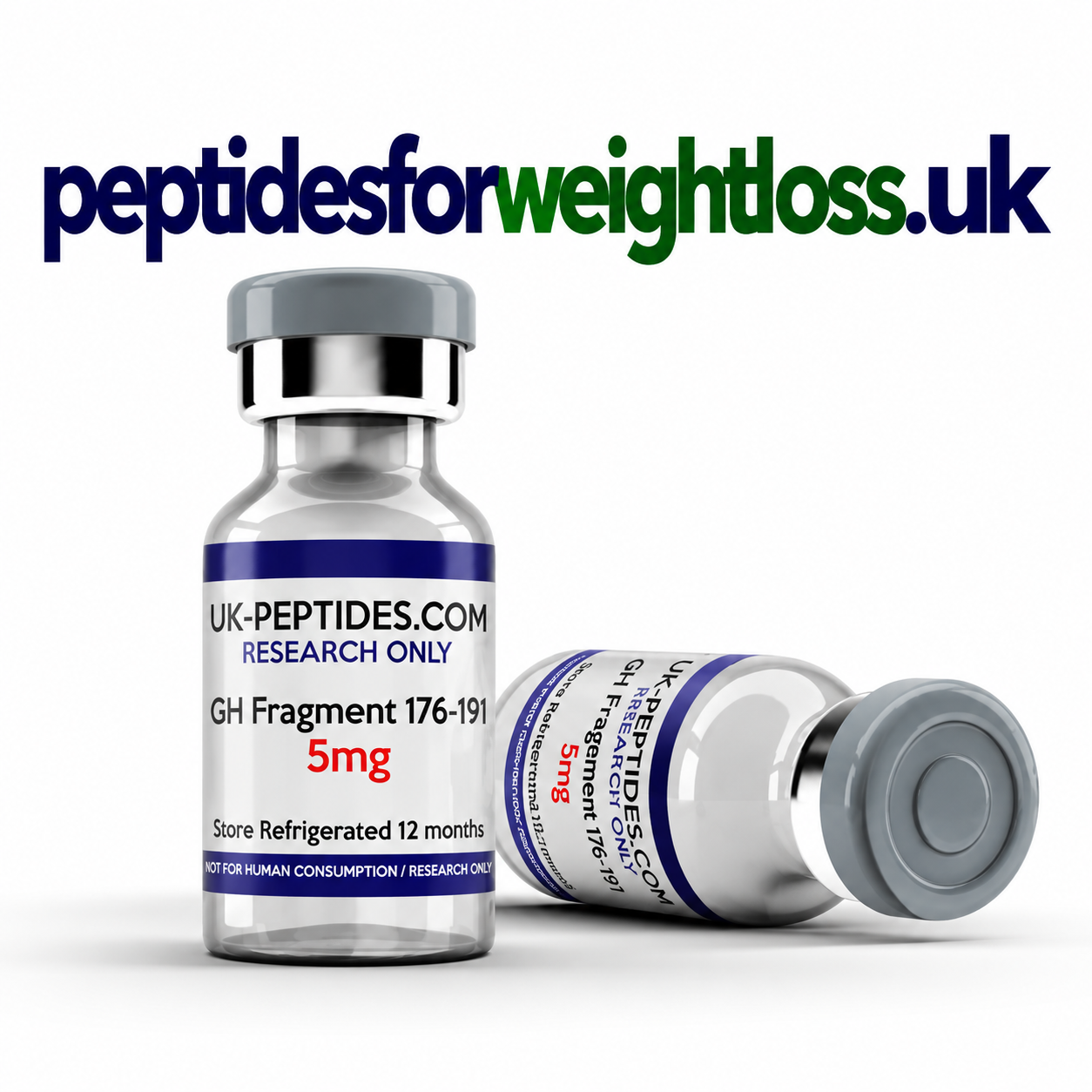
HGH Fragment 176-191 5mg – Human Growth Hormone Research Peptide
HGH Fragment 176-191 5mg is a synthetic research peptide corresponding to the final 16 amino acid residues of mature human growth hormone (HGH). This C-terminal fragment is associated with scientific investigations into growth hormone structure, lipid metabolism, adipose tissue biology and peptide structure–activity relationships.
HGH Fragment 176-191 5mg is of interest to researchers examining whether individual regions of the human growth hormone molecule possess biological activities distinct from those of the complete hormone. Its native amino acid sequence is FLRIVQCRSVEGSCGF, and its disulfide-bonded molecular structure differs from the closely related experimental peptide AOD-9604.
Historical research into growth hormone fragments investigated their potential influence on lipid metabolism and adipose tissue. However, many studies commonly associated with HGH Fragment 176-191 actually examined AOD-9604 or other modified growth hormone-derived peptides. Findings involving those compounds should not automatically be attributed to the native HGH fragment.
HGH Fragment 176-191 5mg remains an investigational research material. There is insufficient reliable human clinical evidence establishing its safety or effectiveness for obesity, fat reduction, muscle growth or metabolic disease.
What Is HGH Fragment 176-191 5mg?
HGH Fragment 176-191 5mg refers to a product labelled as containing 5mg of a synthetic peptide representing amino acid residues 176 through 191 of mature human growth hormone.
Human growth hormone, also called somatotropin, is a 191-amino-acid protein produced by the anterior pituitary gland. It participates in growth, metabolism and the regulation of several physiological processes.
The C-terminal region of this protein became a subject of experimental research because selected growth hormone-derived fragments appeared to influence lipid-related processes in laboratory and animal models.
Unlike full-length growth hormone, HGH Fragment 176-191 contains only 16 amino acid residues and lacks most of the parent protein’s molecular structure.
Its exact chemical identity is particularly important because the native fragment is frequently confused with AOD-9604, which contains a modified N-terminal amino acid.
HGH Fragment 176-191 5mg Product Specifications
- Product Name: HGH Fragment 176-191 5mg
- Alternative Name: Human Growth Hormone Fragment 176-191
- Classification: Synthetic growth hormone-derived research peptide
- Peptide Type: C-terminal hexadecapeptide
- Reference Sequence: Phe-Leu-Arg-Ile-Val-Gln-Cys-Arg-Ser-Val-Glu-Gly-Ser-Cys-Gly-Phe
- One-Letter Sequence: FLRIVQCRSVEGSCGF
- Peptide Length: 16 amino acid residues
- Reference Molecular Formula: C78H123N23O22S2
- Reference Molecular Weight: Approximately 1799.1 g/mol
- Commonly Listed CAS Number: 66004-57-7
- PubChem CID: 16131230
- Labelled Quantity: 5mg
- Research Category: Peptide biochemistry and metabolic research
- Research Focus: Lipid metabolism, adipose tissue and growth hormone structure
- Reference Structural Feature: Intramolecular disulfide bond between cysteine residues
- Purity: Requires batch-specific verification
- Salt Form: Confirm with manufacturer
- Physical Form: Confirm with manufacturer
- Storage: Follow verified manufacturer instructions
- Intended Use: Laboratory research only
The molecular formula and molecular weight above describe the native disulfide-bonded free peptide. A commercial HGH Fragment 176-191 5mg preparation may differ in salt form, oxidation state or formulation. The supplied compound’s identity must be confirmed using appropriate analytical documentation.
HGH Fragment 176-191 Molecular Structure
HGH Fragment 176-191 is derived from the C-terminal region of the complete human growth hormone molecule.
The native amino acid sequence is:
FLRIVQCRSVEGSCGF
This sequence contains 16 amino acid residues, including two cysteine residues capable of forming an intramolecular disulfide bond.
The disulfide bond produces a cyclic structural feature that contributes to the peptide’s conformation.
Researchers studying HGH Fragment 176-191 5mg should distinguish the disulfide-bonded structure from the corresponding reduced form, which has a different molecular mass.
They should also verify the N-terminal amino acid because the native fragment begins with phenylalanine, whereas AOD-9604 begins with tyrosine.
How Does HGH Fragment 176-191 Work?
The biological activity of native HGH Fragment 176-191 remains incompletely characterised.
Historical experimental research investigated whether fragments derived from the C-terminal region of human growth hormone could influence lipid metabolism.
Related peptides have been examined for their effects on lipolysis, lipid accumulation and selected metabolic signalling pathways.
Lipolysis refers to the breakdown of stored triglycerides into fatty acids and glycerol.
However, much of the mechanistic evidence concerns AOD-9604 or other related fragments rather than the exact native HGH Fragment 176-191 molecule.
Researchers should therefore avoid assuming that HGH Fragment 176-191 5mg produces identical metabolic responses.
There is insufficient evidence to establish a clinically validated mechanism for human fat reduction using the native fragment.
Scientific Research Into HGH Fragment 176-191 5mg
1. HGH Fragment 176-191 5mg and Lipid Metabolism Research
Lipid metabolism includes the synthesis, storage, transport and breakdown of fats.
Human growth hormone participates in metabolic regulation, and researchers have investigated whether selected regions of the hormone contribute to its lipid-related effects.
Experimental studies involving growth hormone-derived fragments reported changes in lipid metabolism under certain laboratory conditions.
However, the available evidence does not establish that HGH Fragment 176-191 5mg safely increases fat breakdown in humans.
2. HGH Fragment 176-191 and Adipose Tissue Research
Adipose tissue stores energy and also participates in endocrine signalling.
It contains adipocytes, immune cells, blood vessels and other supporting cellular structures.
Research involving growth hormone-derived peptides has examined how selected molecular fragments influence adipose tissue processes.
These investigations contributed to scientific interest in the C-terminal region of human growth hormone.
However, observations involving modified analogues should not be treated as direct evidence for the native fragment.
3. HGH Fragment 176-191 5mg and Lipolysis Research
Lipolysis is the metabolic process through which triglycerides are broken down into fatty acids and glycerol.
Full-length growth hormone influences lipid metabolism through complex hormonal mechanisms.
Researchers have investigated whether certain growth hormone fragments retain selected lipid-related biological properties.
Experimental results depend on the peptide sequence, biological model and study conditions.
There is insufficient human clinical evidence that HGH Fragment 176-191 5mg produces meaningful or sustained fat loss.
4. HGH Fragment 176-191 and Growth Hormone Structure
Full-length human growth hormone contains 191 amino acid residues and has a complex three-dimensional structure.
The complete protein interacts with growth hormone receptors and influences downstream signalling.
HGH Fragment 176-191 represents only the final 16 residues of the mature hormone.
Its shorter structure makes it relevant to investigations into which regions of growth hormone contribute to specific biological properties.
However, a peptide fragment should not be assumed to reproduce the activity of the intact hormone.
5. HGH Fragment 176-191 5mg and Growth Hormone Receptor Research
The growth hormone receptor is involved in the biological effects of full-length growth hormone.
Its activation influences intracellular signalling associated with growth and metabolism.
The native C-terminal fragment lacks much of the parent protein’s receptor-binding architecture.
Consequently, HGH Fragment 176-191 5mg should not be described as equivalent to growth hormone replacement therapy.
Specific receptor interactions require direct experimental confirmation.
6. HGH Fragment 176-191 and IGF-1 Research
Insulin-like growth factor 1, abbreviated IGF-1, participates in growth hormone-related signalling.
Full-length growth hormone can stimulate IGF-1 production.
However, this does not establish that HGH Fragment 176-191 produces the same response.
Research involving AOD-9604 has examined differences between modified growth hormone fragments and the complete hormone.
Those findings cannot independently establish the IGF-1 effects of native HGH Fragment 176-191 5mg.
7. HGH Fragment 176-191 5mg and Glucose Metabolism
Glucose metabolism is regulated by several hormones, including insulin and growth hormone.
Historical animal studies involving growth hormone fragments investigated changes in glucose and insulin-related measurements.
These findings demonstrate that growth hormone-derived peptides may have complex metabolic properties.
However, the available evidence does not establish predictable or beneficial glucose effects in humans.
HGH Fragment 176-191 5mg is not an established treatment for diabetes or insulin resistance.
8. HGH Fragment 176-191 and Insulin Sensitivity Research
Insulin sensitivity describes how effectively cells respond to insulin.
It is an important component of metabolic health.
Selected growth hormone fragments have been investigated for their influence on insulin-related pathways.
However, the effects observed in experimental models cannot be assumed to occur in humans.
Further research is necessary to clarify the metabolic profile of native HGH Fragment 176-191.
9. HGH Fragment 176-191 5mg and Obesity Research
Obesity is a complex chronic condition influenced by genetics, environment, metabolism and other factors.
Growth hormone-derived peptides have been investigated in experimental obesity research.
However, the major human clinical development programme involved the modified analogue AOD-9604 rather than the native HGH Fragment 176-191 sequence.
AOD-9604 failed to demonstrate sufficient weight-loss effectiveness in its later obesity development programme.
Those results do not establish effectiveness for HGH Fragment 176-191 5mg.
10. HGH Fragment 176-191 and Beta-Adrenergic Signalling
Beta-adrenergic receptors participate in physiological processes involving metabolism and the sympathetic nervous system.
Preclinical research involving AOD-9604 investigated beta-3 adrenergic receptor involvement in selected lipid-related effects.
However, the evidence concerns the modified analogue.
It should not be used as definitive proof that native HGH Fragment 176-191 acts through an identical pathway.
11. HGH Fragment 176-191 5mg and Disulfide Bond Research
Disulfide bonds form between cysteine residues and can influence peptide conformation and stability.
The native HGH Fragment 176-191 sequence contains two cysteine residues.
These residues can form an intramolecular disulfide bond.
Researchers should verify the oxidation state of HGH Fragment 176-191 5mg because the reduced and oxidised forms have different molecular characteristics.
12. HGH Fragment 176-191 and Peptide Stability
Peptide stability depends on amino acid composition, formulation, storage conditions and chemical structure.
The presence of a disulfide bond may influence the structural properties of HGH Fragment 176-191.
However, the shelf life and stability of a commercial preparation cannot be established without product-specific testing.
Researchers should follow verified manufacturer instructions.
13. HGH Fragment 176-191 5mg and Molecular Identification
Accurate molecular identification is important when researching closely related peptides.
Native HGH Fragment 176-191 and AOD-9604 differ by a single amino acid substitution.
This produces a difference of approximately 16 Da in molecular mass.
Suitable analytical methods, including mass spectrometry, can help distinguish the compounds.
Researchers should confirm the identity of HGH Fragment 176-191 5mg using batch-specific documentation.
14. HGH Fragment 176-191 and Structure-Activity Relationships
Structure-activity relationship research examines how changes in molecular structure influence biological properties.
The difference between native HGH Fragment 176-191 and AOD-9604 provides an example of a single amino acid substitution.
Although these peptides are closely related, their biological activity cannot be assumed identical.
Researchers should interpret experimental findings according to the exact compound used.
15. HGH Fragment 176-191 5mg and Research Reproducibility
Scientific reproducibility depends on consistent experimental methods and accurately characterised materials.
Differences in peptide identity, oxidation state, salt form and purity may affect experimental results.
Because the HGH Fragment 176-191 name is sometimes used inconsistently, verifying the complete sequence is particularly important.
Researchers evaluating HGH Fragment 176-191 5mg should maintain clear records of analytical identity and batch characteristics.
HGH Fragment 176-191 5mg vs AOD-9604
HGH Fragment 176-191 and AOD-9604 are closely related but chemically distinct research peptides.
- Native HGH Fragment 176-191: FLRIVQCRSVEGSCGF
- AOD-9604: YLRIVQCRSVEGSCGF
- Primary Difference: Native HGH Fragment 176-191 begins with phenylalanine, while AOD-9604 begins with tyrosine.
- Native Fragment Molecular Weight: Approximately 1799.1 g/mol
- AOD-9604 Molecular Weight: Approximately 1815.1 g/mol
- Clinical Evidence: AOD-9604 underwent human obesity trials, while comparable evidence is not established for native HGH Fragment 176-191.
These distinctions are important when reviewing scientific literature or verifying research material.
HGH Fragment 176-191 5mg vs Full-Length HGH
Full-length human growth hormone and HGH Fragment 176-191 are different molecular entities.
Full-length HGH contains 191 amino acids and has established receptor-mediated biological functions.
HGH Fragment 176-191 contains only 16 amino acids and lacks most of the complete hormone’s structure.
Consequently, research involving prescribed growth hormone medicines should not be used to claim equivalent effects for HGH Fragment 176-191 5mg.
HGH Fragment 176-191 5mg vs HGH Fragment 176-191 2mg
The HGH Fragment 176-191 5mg and 2mg product listings differ in labelled quantity.
- HGH Fragment 176-191 5mg: Labelled quantity of 5mg.
- HGH Fragment 176-191 2mg: Labelled quantity of 2mg.
- Expected Molecular Identity: Both should correspond to the same native peptide sequence when accurately labelled.
- Research Considerations: Purity, oxidation state, salt form and batch characteristics must be verified separately.
A higher labelled quantity does not establish greater purity, biological activity or suitability for human administration.
HGH Fragment 176-191 5mg and Fat-Loss Claims
HGH Fragment 176-191 5mg is frequently discussed online in relation to fat-loss research.
However, there is insufficient reliable human clinical evidence demonstrating that the native peptide safely reduces body fat or produces meaningful weight loss.
Much of the research commonly cited in product marketing involves the modified analogue AOD-9604.
These findings should not be presented as direct proof of effectiveness for native HGH Fragment 176-191.
HGH Fragment 176-191 5mg and Muscle Growth
HGH Fragment 176-191 5mg is not an established muscle-building treatment.
The fragment lacks most of the structure of full-length growth hormone.
There is insufficient reliable evidence that the native peptide safely increases muscle mass, strength or athletic performance in humans.
HGH Fragment 176-191 5mg Research Quality and Documentation
Important considerations when evaluating HGH Fragment 176-191 5mg include:
- Confirmation of the native FLRIVQCRSVEGSCGF sequence
- Verification of the N-terminal phenylalanine residue
- Distinction from the tyrosine-containing AOD-9604 analogue
- Confirmation of the 16-amino-acid structure
- Verification of the disulfide-bonded molecular form
- Confirmation of the expected molecular mass
- Identification of the supplied salt form
- Batch-specific certificate of analysis
- Appropriate analytical purity testing
- Mass spectrometry or another suitable identity method
- Confirmation of the labelled 5mg quantity
- Assessment of synthesis-related impurities
- Manufacturer and batch traceability
- Verified packaging specifications
- Product-specific storage and stability documentation
- Clearly stated research-use classification
Storage and Handling of HGH Fragment 176-191 5mg
HGH Fragment 176-191 5mg should be stored according to verified manufacturer instructions.
Storage requirements depend on the peptide’s physical form, salt form, formulation and packaging.
Researchers should not assume that all HGH Fragment 176-191 preparations have identical stability or shelf-life characteristics.
Laboratory handling should follow relevant safety documentation and institutional procedures.
HGH Fragment 176-191 5mg Safety and Scientific Limitations
HGH Fragment 176-191 5mg is an investigational research material without an established human clinical safety profile.
There is insufficient reliable clinical evidence demonstrating its effectiveness for obesity, fat loss, muscle growth or metabolic disease.
Historical animal studies involving growth hormone fragments investigated effects on glucose and insulin-related measurements.
These observations demonstrate why metabolic safety cannot be assumed.
Additional uncertainties include long-term toxicity, immune responses, human pharmacokinetics and the effects of repeated exposure.
HGH Fragment 176-191 is not an established approved UK medicine for obesity or weight management.
Research-grade material should not be assumed suitable for human administration.
The labelled 5mg quantity does not represent a recommended human dose.
Frequently Asked Questions About HGH Fragment 176-191 5mg
What is HGH Fragment 176-191 5mg?
HGH Fragment 176-191 5mg is a product listing for a synthetic 16-amino-acid research peptide derived from the C-terminal region of human growth hormone.
What is the HGH Fragment 176-191 peptide sequence?
The native reference sequence is FLRIVQCRSVEGSCGF.
How many amino acids does HGH Fragment 176-191 contain?
The native peptide contains 16 amino acid residues.
What is the molecular formula of HGH Fragment 176-191?
The reference formula for the native disulfide-bonded free peptide is C78H123N23O22S2.
What is the molecular weight of HGH Fragment 176-191?
The reference molecular weight is approximately 1799.1 g/mol.
What is the CAS number for HGH Fragment 176-191?
A commonly listed CAS number is 66004-57-7.
Is HGH Fragment 176-191 the same as AOD-9604?
No. Native HGH Fragment 176-191 begins with phenylalanine, while AOD-9604 begins with tyrosine.
Does HGH Fragment 176-191 burn fat?
There is insufficient reliable human clinical evidence that the native fragment safely produces meaningful fat loss.
Does HGH Fragment 176-191 increase growth hormone?
The native fragment is not established as a growth hormone secretagogue and should not be assumed to reproduce the effects of full-length HGH.
Does HGH Fragment 176-191 increase IGF-1?
Its effects on IGF-1 in humans have not been adequately established.
Is HGH Fragment 176-191 approved for weight loss?
No. HGH Fragment 176-191 is not an established approved UK weight-loss medicine.
What is the difference between HGH Fragment 176-191 5mg and 2mg?
The difference is the labelled quantity of material. The intended molecular identity should be the same when both products are accurately labelled.
Does 5mg represent a recommended dose?
No. The 5mg designation describes the labelled quantity of research material and is not a human dosing recommendation.
HGH Fragment 176-191 5mg – Scientific Product Summary
HGH Fragment 176-191 5mg is a synthetic research peptide corresponding to the native C-terminal 16-amino-acid sequence of human growth hormone.
Its reference sequence is FLRIVQCRSVEGSCGF, with a molecular weight of approximately 1799.1 g/mol in its disulfide-bonded free peptide form.
Research involving growth hormone fragments has investigated lipid metabolism, adipose tissue biology and molecular structure–activity relationships.
However, much of the available evidence concerns related fragments or the modified analogue AOD-9604 rather than the exact native peptide.
Human therapeutic effectiveness and long-term safety remain insufficiently established.
Researchers evaluating HGH Fragment 176-191 5mg should verify the peptide sequence, molecular identity, purity, salt form, labelled quantity and batch-specific analytical documentation.

Reviews
There are no reviews yet.