
Description
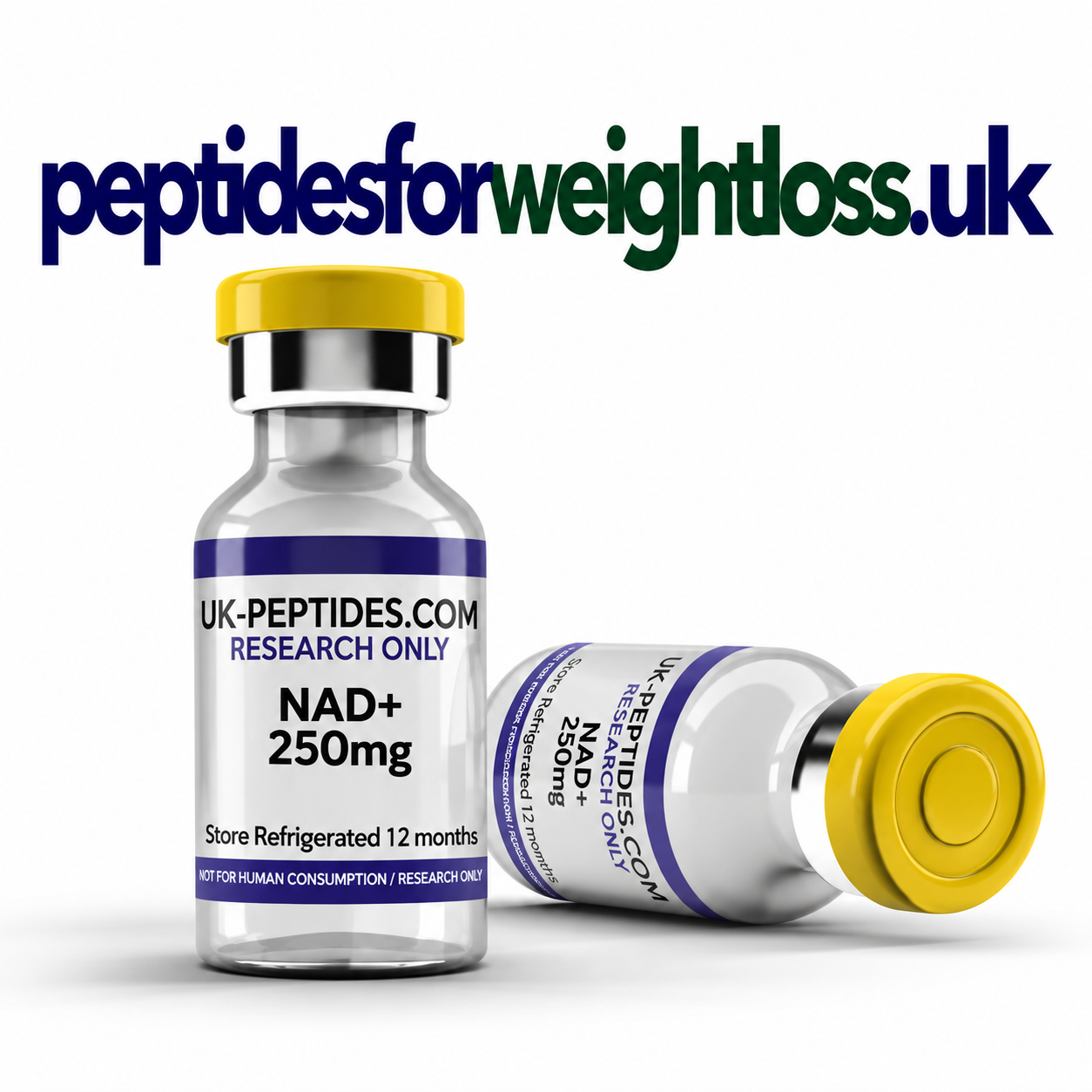
NAD+ 250mg – Nicotinamide Adenine Dinucleotide Research Compound
NAD+ 250mg is a biochemical research product containing nicotinamide adenine dinucleotide in its oxidised form. NAD+ is an essential cellular coenzyme involved in energy metabolism, oxidation-reduction reactions, mitochondrial function and NAD-dependent enzyme signalling.
Nicotinamide adenine dinucleotide is found throughout living cells, where it helps transfer electrons during metabolic reactions. It also acts as a substrate for enzymes involved in DNA damage responses, protein regulation and cellular stress signalling.
NAD+ 250mg is relevant to laboratory investigations involving cellular metabolism, mitochondrial bioenergetics, sirtuin activity, poly(ADP-ribose) polymerases (PARPs), redox balance and age-associated metabolic changes.
Although NAD+ has attracted considerable interest in ageing and wellness research, its essential cellular functions do not establish that externally supplied NAD+ improves human energy levels, reverses ageing, enhances physical performance or produces weight loss.
NAD+ 250mg is presented as a biochemical research material. Its exact chemical form, purity, formulation and batch-specific specifications should be confirmed through manufacturer documentation.
What Is NAD+ 250mg?
NAD+ 250mg refers to a product labelled as containing 250 milligrams of oxidised nicotinamide adenine dinucleotide.
NAD+ is a naturally occurring dinucleotide coenzyme that participates in hundreds of enzyme-associated biochemical reactions.
Its principal metabolic role involves accepting reducing equivalents during oxidation reactions, producing the reduced form known as NADH.
NADH can subsequently donate electrons to other biochemical systems, including mitochondrial energy-producing pathways.
NAD+ is also consumed by certain signalling enzymes, linking cellular metabolism to protein regulation, DNA damage responses and stress-related signalling.
Unlike peptide research compounds, NAD+ is not composed of a chain of amino acid residues.
NAD+ 250mg Product Specifications
- Product Name: NAD+ 250mg
- Scientific Name: Nicotinamide Adenine Dinucleotide
- Alternative Names: Oxidised NAD, Beta-NAD, Beta-Nicotinamide Adenine Dinucleotide
- Classification: Dinucleotide coenzyme
- Chemical Form: Oxidised NAD+
- Reference Molecular Formula: C21H27N7O14P2
- Reference Molecular Weight: Approximately 663.43 g/mol
- Reference CAS Number: 53-84-9
- Reference PubChem CID: 10897651
- Labelled Quantity: 250mg
- Primary Research Area: Cellular energy metabolism
- Additional Research Areas: Mitochondrial biology, redox balance, sirtuins and NAD-dependent enzymes
- Related Compounds: NADH, NADP+, NADPH, NMN and Nicotinamide Riboside
- Purity: Requires batch-specific verification
- Salt Form: Confirm with manufacturer
- Physical Presentation: Confirm with manufacturer
- Storage: Follow verified manufacturer instructions
- Intended Use: Laboratory and biochemical research
The reference chemical specifications above describe beta-nicotinamide adenine dinucleotide. Commercial materials may contain different salts, counterions or hydrates, which can change their molecular weights and the relationship between total material mass and NAD+ content.
NAD+ Molecular Structure and Chemical Composition
NAD+ consists of two nucleotide units connected through a pyrophosphate linkage.
One nucleotide contains an adenine base, while the other contains a nicotinamide group.
The nicotinamide component is responsible for the molecule’s important redox properties.
During an oxidation-reduction reaction, NAD+ can accept a hydride equivalent and become NADH.
This conversion allows the molecule to participate in many enzyme-catalysed reactions.
Because NAD+ is a coenzyme rather than a peptide, it does not have an amino acid sequence, peptide chain length or peptide-specific disulfide structure.
How Does NAD+ Work in Cellular Metabolism?
NAD+ has two broad categories of biological activity.
Redox Coenzyme Activity
In metabolic pathways, NAD+ functions as an electron acceptor.
Enzymes transfer reducing equivalents from metabolic substrates to NAD+, generating NADH.
The NADH produced can participate in additional metabolic reactions and mitochondrial electron transport.
NAD-Dependent Enzyme Activity
NAD+ also serves as a substrate for enzymes that consume the molecule during cellular signalling reactions.
These include sirtuins, poly(ADP-ribose) polymerases and CD38-related enzymes.
Their activities connect NAD metabolism with protein modification, DNA damage responses and cellular signalling.
However, increasing the amount of NAD+ available in an experimental system does not necessarily produce a predictable improvement in cellular function.
Scientific Research Into NAD+ 250mg
1. NAD+ 250mg and Cellular Energy Production
Cellular energy production depends on interconnected metabolic pathways that process carbohydrates, lipids and other nutrients.
NAD+ participates in reactions that transfer electrons between metabolic intermediates.
Its conversion into NADH supports the movement of reducing equivalents through these pathways.
However, the importance of NAD+ in energy metabolism does not demonstrate that externally supplied NAD+ improves physical energy or reduces fatigue in humans.
2. NAD+ and Mitochondrial Function
Mitochondria are cellular organelles involved in oxidative phosphorylation and other metabolic functions.
NADH generated during metabolic reactions can donate electrons to mitochondrial respiratory complex I.
This contributes to the processes involved in ATP production.
Researchers study NAD+ and NADH to investigate mitochondrial redox balance, respiratory function and metabolic regulation.
3. NAD+ 250mg and Glycolysis Research
Glycolysis is a metabolic pathway in which glucose is converted into pyruvate.
NAD+ is required by glyceraldehyde-3-phosphate dehydrogenase, an enzyme involved in this process.
During the reaction, NAD+ is reduced to NADH.
Regeneration of NAD+ is necessary for glycolysis to continue.
4. NAD+ and the Citric Acid Cycle
The citric acid cycle generates reducing equivalents from metabolic intermediates.
Several enzymes in the cycle use NAD+ as an electron acceptor.
These reactions produce NADH, which can subsequently contribute electrons to mitochondrial oxidative phosphorylation.
NAD-related metabolites are therefore important markers in studies of cellular energy metabolism.
5. NAD+ 250mg and Redox Balance
Redox balance describes the relationship between oxidation and reduction processes.
The NAD+/NADH ratio is an important measure of cellular metabolic state.
Different cellular compartments may maintain distinct NAD-related redox environments.
Researchers examine these relationships to understand changes in metabolism, oxygen availability and cellular stress.
6. NAD+ and Sirtuin Research
Sirtuins are NAD+-dependent enzymes involved in protein modification and cellular regulation.
Several sirtuins remove acyl groups from protein substrates through reactions that consume NAD+.
These enzymes have been studied in connection with metabolic regulation, mitochondrial biology and stress responses.
However, NAD-dependent sirtuin activity does not establish that NAD+ supplementation reverses human ageing.
7. NAD+ 250mg and DNA Damage Responses
DNA damage responses involve multiple enzymes and signalling proteins.
Poly(ADP-ribose) polymerases, or PARPs, use NAD+ as a substrate in reactions associated with DNA damage signalling.
High PARP activity can influence cellular NAD+ availability.
Researchers study this relationship to understand how DNA damage responses interact with metabolism.
These findings should not be interpreted as evidence that externally supplied NAD+ directly repairs human DNA.
8. NAD+ and CD38 Research
CD38 is an enzyme involved in NAD metabolism and the production of certain signalling molecules.
Researchers have examined how CD38 activity influences NAD+ consumption.
CD38-related pathways have also been investigated in immune and ageing biology.
However, experimental observations do not establish a therapeutic role for NAD+ 250mg.
9. NAD+ 250mg and Ageing Biology
NAD metabolism is an active area of ageing research.
Some experimental studies have reported changes in NAD-related metabolites with advancing age.
However, human evidence for a consistent age-associated decline in NAD+ across different tissues remains limited.
Human clinical studies of NAD+ precursors have also produced mixed results for health-related outcomes.
Therefore, NAD+ 250mg should not be described as a proven anti-ageing treatment.
10. NAD+ and Metabolic Health
NAD-related pathways participate in carbohydrate, lipid and protein metabolism.
Researchers have investigated whether altering NAD metabolism influences metabolic health.
Some animal experiments have reported improvements in selected metabolic outcomes following NAD-related interventions.
However, human evidence remains mixed and does not establish that NAD+ 250mg treats obesity, insulin resistance or diabetes.
11. NAD+ 250mg and Neurological Research
Neurons depend on tightly regulated energy metabolism and cellular signalling.
NAD-related pathways have been investigated in studies of neuronal survival, axonal degeneration and neurological disease models.
These investigations contribute to understanding how metabolic processes influence nervous system function.
However, they do not establish that externally supplied NAD+ improves memory or cognitive performance in humans.
12. NAD+ and Oxidative Stress
Oxidative stress involves an imbalance between reactive species and cellular protective mechanisms.
NAD-related metabolic pathways contribute to cellular redox regulation.
NADPH, which is chemically distinct from NADH, has especially important functions in several antioxidant defence systems.
Researchers should distinguish the roles of NAD+, NADH, NADP+ and NADPH when interpreting experimental findings.
13. NAD+ 250mg and Immune Cell Metabolism
Immune cells undergo metabolic changes during activation and differentiation.
NAD-dependent enzymes and NAD-related pathways have been investigated in immune cell biology.
Research examines how changes in metabolic state interact with cellular signalling.
However, the evidence does not establish that NAD+ 250mg is an effective treatment for inflammatory or immune disorders.
14. NAD+ and Metabolomics
Metabolomics is the study of small molecules and metabolic intermediates in biological systems.
NAD+ and NADH are important analytes in investigations of cellular metabolic state.
Analytical methods such as liquid chromatography and mass spectrometry may be used to characterise NAD-related metabolites.
Careful sample handling is necessary because metabolite measurements can be affected by sample processing and stability.
15. NAD+ 250mg and Research Reproducibility
Reliable biochemical research requires accurately identified and characterised materials.
NAD+ preparations may differ in purity, chemical form, counterion composition and formulation.
Researchers should verify that the supplied compound is oxidised NAD+ rather than NADH or a related precursor.
Batch-specific analytical documentation supports reproducibility and interpretation of experimental results.
NAD+ 250mg vs NAD+ 500mg
NAD+ 250mg and NAD+ 500mg refer to different labelled quantities of the same underlying coenzyme, assuming both products contain the same chemical form.
The 250mg and 500mg labels do not indicate different molecular structures or mechanisms of action.
The larger labelled quantity does not establish greater biological effectiveness or a recommended human dose.
Researchers should compare the chemical form, purity, formulation and batch documentation of each preparation.
NAD+ 250mg vs NADH
NAD+ is the oxidised form of nicotinamide adenine dinucleotide.
NADH is its reduced form.
The two compounds participate in reversible oxidation-reduction reactions.
Although closely related, they are chemically distinct and should not be treated as interchangeable research materials.
NAD+ 250mg vs NMN
Nicotinamide mononucleotide, or NMN, is a precursor involved in NAD+ biosynthesis.
NAD+ is the coenzyme produced through NAD-related metabolic pathways.
Research involving NMN supplementation should not automatically be attributed to direct NAD+ exposure.
NAD+ 250mg vs Nicotinamide Riboside
Nicotinamide riboside, abbreviated NR, is another NAD-related precursor.
Human studies have demonstrated that oral NR can increase certain NAD-related biomarkers.
However, improvements in biomarkers have not consistently translated into meaningful clinical benefits.
Evidence involving NR does not establish equivalent outcomes for NAD+ 250mg.
NAD+ 250mg vs NADP+
NADP+ is a related coenzyme containing an additional phosphate group.
Its reduced form, NADPH, participates in biosynthetic pathways and cellular antioxidant defence.
NAD+ and NADP+ have overlapping structural features but distinct biochemical functions.
NAD+ 250mg and Weight-Loss Research
NAD+ participates in metabolic reactions involved in processing nutrients and producing cellular energy.
However, its central metabolic role does not establish that externally supplied NAD+ causes body fat reduction.
Human research involving NAD-related interventions has produced mixed results for metabolic outcomes.
There is insufficient reliable clinical evidence that NAD+ 250mg safely produces meaningful weight loss or treats obesity.
NAD+ 250mg and Anti-Ageing Research
Experimental studies have investigated NAD metabolism in relation to cellular ageing, mitochondrial biology and stress responses.
However, a 2025 review in Nature Metabolism highlighted important limitations in the human evidence.
A 2026 systematic review also concluded that clinical effectiveness for anti-ageing and wellness outcomes remains inconclusive.
NAD+ 250mg should not be marketed as a proven longevity or age-reversal treatment.
NAD+ 250mg and Energy Claims
NAD+ is essential for normal energy-producing metabolic reactions.
However, there is insufficient reliable clinical evidence that externally administered NAD+ 250mg improves fatigue, endurance or physical performance.
Biochemical activity and demonstrated human therapeutic effectiveness are different forms of evidence.
NAD+ 250mg Research Quality and Documentation
Important considerations when evaluating NAD+ 250mg include:
- Verification of oxidised NAD+ identity
- Confirmation of the reference chemical structure
- Identification of the supplied salt or hydrate form
- Confirmation of the labelled 250mg quantity
- Clarification of total material mass versus NAD+ content
- Batch-specific certificate of analysis
- Suitable analytical purity testing
- Assessment of degradation-related impurities
- Manufacturer and batch traceability
- Documentation of formulation components
- Product-specific storage and stability information
- Clearly stated research-use classification
Storage and Handling of NAD+ 250mg
NAD+ 250mg should be stored according to verified manufacturer instructions.
Stability depends on the chemical form, formulation, temperature, moisture exposure, packaging and other conditions.
Researchers should not assume that all NAD+ products have identical shelf lives or storage requirements.
Laboratory handling should follow institutional procedures and product-specific safety documentation.
NAD+ 250mg Safety and Scientific Limitations
NAD+ is a naturally occurring coenzyme essential for cellular function.
However, this does not establish that externally administered NAD+ preparations are safe or effective for treating human conditions.
Human clinical evidence for direct intravenous or intramuscular NAD+ administration for anti-ageing and wellness outcomes remains insufficient.
Research-grade material should not be assumed sterile, pharmaceutical grade or suitable for human injection.
Potential risks depend on formulation, impurities, exposure route and other factors that require appropriate evaluation.
The labelled 250mg quantity is not a human dosing recommendation.
Frequently Asked Questions About NAD+ 250mg
What is NAD+ 250mg?
NAD+ 250mg is a research product designation for a labelled quantity of 250 milligrams of oxidised nicotinamide adenine dinucleotide.
What does NAD+ stand for?
NAD+ stands for nicotinamide adenine dinucleotide in its oxidised form.
Is NAD+ a peptide?
No. NAD+ is a dinucleotide coenzyme, not a peptide.
What is the molecular formula of NAD+?
The reference molecular formula is C21H27N7O14P2.
What is the molecular weight of NAD+?
The reference molecular weight is approximately 663.43 g/mol. Different salts and hydrates may have different molecular weights.
What is the CAS number of NAD+?
The commonly referenced CAS number is 53-84-9 for beta-nicotinamide adenine dinucleotide.
What is the difference between NAD+ and NADH?
NAD+ is the oxidised form, while NADH is the reduced form.
Is NAD+ the same as NMN?
No. NMN is a precursor involved in NAD biosynthesis, while NAD+ is the coenzyme itself.
Is NAD+ related to vitamin B3?
Yes. NAD+ contains a nicotinamide component and is connected to vitamin B3 metabolism.
What is the difference between NAD+ 250mg and NAD+ 500mg?
The names indicate different labelled quantities of material. If the chemical forms are identical, they refer to the same underlying coenzyme.
Does NAD+ support cellular metabolism?
Yes. NAD+ is essential for numerous metabolic reactions, including those involved in cellular redox balance.
Does NAD+ reverse ageing?
There is no reliable clinical evidence establishing that NAD+ supplementation reverses human ageing.
Does NAD+ 250mg help with weight loss?
There is insufficient reliable human clinical evidence demonstrating that NAD+ 250mg safely produces weight loss.
Is NAD+ 250mg suitable for injection?
Research-grade material should not be assumed sterile or suitable for human administration.
What does the 250mg label mean?
The label refers to the stated quantity of material. The exact chemical form and NAD+ content should be confirmed through product documentation.
NAD+ 250mg – Scientific Product Summary
NAD+ 250mg is a biochemical research compound containing oxidised nicotinamide adenine dinucleotide, an essential coenzyme involved in cellular energy metabolism and NAD-dependent enzyme activity.
Its reference molecular formula is C21H27N7O14P2, with a molecular weight of approximately 663.43 g/mol for the specified chemical form.
NAD+ research includes investigations into mitochondrial bioenergetics, redox balance, sirtuins, PARPs, cellular ageing and metabolic regulation.
However, its essential biochemical functions do not establish the clinical effectiveness of externally supplied NAD+ for weight loss, anti-ageing, fatigue or other human conditions.
Researchers evaluating NAD+ 250mg should verify chemical identity, purity, formulation, labelled quantity and batch-specific analytical documentation.
Reviews
There are no reviews yet.