
Description
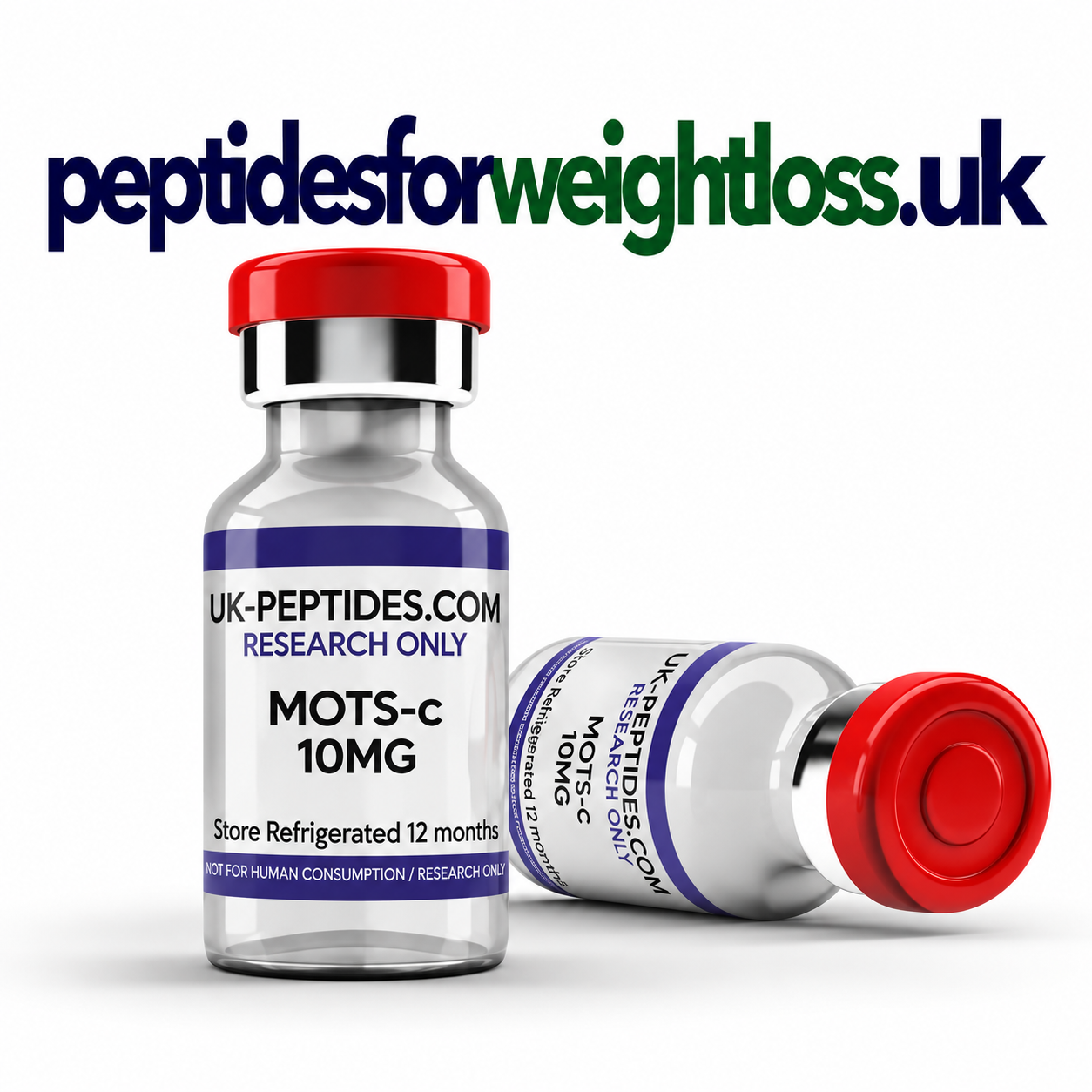
MOTS-C 10mg – Mitochondrial-Derived Metabolic Research Peptide
MOTS-C 10mg is a mitochondrial-derived peptide research product associated with investigations into cellular energy regulation, metabolic homeostasis, skeletal muscle function and stress-responsive signalling pathways. MOTS-C is a naturally occurring 16-amino-acid peptide encoded by a short open reading frame within the mitochondrial 12S ribosomal RNA region.
The scientific name MOTS-C stands for Mitochondrial Open Reading Frame of the 12S rRNA Type-c. This peptide belongs to the mitochondrial-derived peptide family, a group of signalling molecules that contribute to communication between mitochondria and other cellular systems.
Published studies have investigated MOTS-C in relation to AMP-activated protein kinase (AMPK), glucose metabolism, insulin sensitivity, skeletal muscle adaptation and age-associated physiological changes.
In experimental animal models, MOTS-C has been associated with improved metabolic measurements and physical performance. Researchers have also observed increases in endogenous MOTS-C following exercise in humans.
However, these findings do not establish that externally administered MOTS-C 10mg safely produces weight loss, improves endurance or treats metabolic disease in humans.
MOTS-C 10mg is intended for laboratory research and should be evaluated using verified product specifications and batch-specific analytical documentation.
What Is MOTS-C 10mg?
MOTS-C 10mg refers to a research product labelled as containing 10 milligrams of the mitochondrial-derived peptide MOTS-C.
MOTS-C is a 16-amino-acid peptide encoded by a short open reading frame associated with the mitochondrial MT-RNR1 gene region.
Unlike most cellular proteins, which are encoded by nuclear DNA, MOTS-C originates from a sequence within the mitochondrial genome.
Its discovery expanded scientific understanding of mitochondria as signalling organelles rather than structures involved only in energy production.
Researchers investigate MOTS-C because it appears to participate in cellular responses to metabolic stress and changing energy availability.
Although it is naturally produced in the body, synthetic MOTS-C research preparations should not be assumed to have established human safety or therapeutic effectiveness.
MOTS-C 10mg Product Specifications
- Product Name: MOTS-C 10mg
- Scientific Name: Mitochondrial Open Reading Frame of the 12S rRNA Type-c
- Alternative Names: MOTS-c, MOTS C, Mitochondrial-Derived Peptide MOTS-C
- Classification: Mitochondrial-derived peptide
- Peptide Length: 16 amino acid residues
- Reference Sequence: MRWQEMGYIFYPRKLR
- Reference Molecular Formula: C101H152N28O22S2
- Reference Molecular Weight: Approximately 2,174.62 g/mol
- Reference CAS Number: 1627580-64-6
- Reference PubChem CID: 146675088
- Reference UniProt Entry: A0A0C5B5G6
- Encoding Region: Mitochondrial 12S rRNA region (MT-RNR1)
- Primary Research Area: Cellular metabolic regulation
- Associated Signalling Pathway: AMPK-related metabolic signalling
- Additional Research Areas: Skeletal muscle biology, glucose metabolism, metabolic stress and ageing research
- Labelled Quantity: 10mg
- Purity: Requires batch-specific verification
- Salt Form: Confirm with manufacturer
- Physical Presentation: Confirm with manufacturer
- Storage: Follow verified manufacturer instructions
- Intended Use: Laboratory research only
These specifications describe the reference MOTS-C peptide. Commercial preparations may differ in salt form, counterion composition, water content, purity and formulation. Researchers should verify the exact composition of the supplied material.
MOTS-C Amino Acid Sequence and Molecular Structure
MOTS-C is a short peptide composed of 16 amino acid residues.
Its reference one-letter amino acid sequence is:
MRWQEMGYIFYPRKLR
The corresponding amino acids are:
- Met – Methionine
- Arg – Arginine
- Trp – Tryptophan
- Gln – Glutamine
- Glu – Glutamic acid
- Met – Methionine
- Gly – Glycine
- Tyr – Tyrosine
- Ile – Isoleucine
- Phe – Phenylalanine
- Tyr – Tyrosine
- Pro – Proline
- Arg – Arginine
- Lys – Lysine
- Leu – Leucine
- Arg – Arginine
The reference molecular formula is C101H152N28O22S2, with a molecular weight of approximately 2,174.62 g/mol.
The peptide contains two methionine residues, which account for the sulfur atoms in its molecular formula.
Researchers should verify the complete amino acid sequence and expected molecular mass when assessing MOTS-C research material.
How Does MOTS-C Work?
MOTS-C has been investigated as a signalling peptide involved in cellular responses to metabolic stress.
Early research demonstrated that MOTS-C can influence the folate cycle and de novo purine biosynthesis under selected experimental conditions.
These changes were associated with increased levels of the metabolic intermediate AICAR and activation of AMP-activated protein kinase, commonly abbreviated AMPK.
AMPK is an important regulator of cellular energy balance.
Additional research has examined how MOTS-C can influence nuclear gene expression during metabolic stress.
However, the precise biological effects depend on experimental conditions, cell type and model system.
These findings do not establish a predictable therapeutic effect from externally supplied MOTS-C in humans.
Scientific Research Into MOTS-C 10mg
1. MOTS-C 10mg and Mitochondrial Signalling
Mitochondria are important organelles involved in energy metabolism and cellular communication.
MOTS-C is one of several peptides encoded by short open reading frames associated with mitochondrial DNA.
Its discovery demonstrated that the mitochondrial genome can encode signalling molecules with effects beyond the mitochondrion itself.
Researchers study these peptides to understand communication between mitochondrial and nuclear systems.
2. MOTS-C and AMPK Research
AMP-activated protein kinase, or AMPK, is a central regulator of cellular energy status.
AMPK activity can influence glucose metabolism, lipid metabolism and cellular adaptation to energy stress.
Published studies have associated MOTS-C activity with AMPK-related signalling.
However, activation of AMPK in experimental models does not establish that MOTS-C is a safe or effective treatment for metabolic disease.
3. MOTS-C 10mg and Glucose Metabolism
Glucose metabolism involves pathways that process glucose for energy production and biosynthesis.
Researchers have investigated how MOTS-C influences glucose utilisation in cell-culture and animal models.
Experimental studies have reported changes in glucose-related metabolic pathways.
However, these findings do not establish that synthetic MOTS-C improves blood glucose control in humans.
4. MOTS-C and Insulin Sensitivity Research
Insulin sensitivity describes how effectively tissues respond to insulin signalling.
Early MOTS-C studies reported protective effects against diet-associated insulin resistance in mice.
These findings contributed to interest in the peptide’s potential role in metabolic regulation.
However, controlled human evidence has not established MOTS-C as a treatment for insulin resistance or diabetes.
5. MOTS-C 10mg and Skeletal Muscle Research
Skeletal muscle is a major tissue involved in glucose utilisation and physical activity.
Research has identified skeletal muscle as an important site of MOTS-C-associated metabolic responses.
Experimental investigations have examined changes in muscle metabolism and adaptation to cellular stress.
These observations contribute to understanding the relationship between mitochondrial signalling and muscle physiology.
6. MOTS-C and Exercise Biology
Exercise produces changes in energy demand and cellular signalling.
A 2021 study published in Nature Communications reported increases in endogenous MOTS-C in human skeletal muscle and circulation following exercise.
The same study investigated synthetic MOTS-C in animal models of physical performance.
However, increased endogenous MOTS-C during exercise does not demonstrate that administering synthetic MOTS-C improves exercise performance in humans.
7. MOTS-C 10mg and Physical Performance Research
Physical performance depends on interactions among cardiovascular, muscular, neurological and metabolic systems.
Experimental studies have reported improved physical performance in MOTS-C-treated mice of different ages.
These findings support continued investigation into mitochondrial-derived peptides and muscle physiology.
However, they do not establish human performance-enhancing effectiveness or safety.
8. MOTS-C and Age-Associated Physical Decline
Ageing can involve changes in skeletal muscle function, metabolic regulation and physical capacity.
Researchers have examined MOTS-C in relation to age-associated physiological changes.
Animal studies have reported improvements in selected physical performance measurements following experimental MOTS-C treatment.
However, these results do not establish that MOTS-C slows human ageing or extends lifespan.
9. MOTS-C 10mg and Metabolic Stress
Metabolic stress occurs when cellular energy supply and demand become imbalanced.
MOTS-C has been investigated in experimental models involving nutrient restriction and other metabolic challenges.
Researchers have examined changes in cell survival, gene expression and metabolic adaptation.
However, the biological response depends on the experimental model and conditions.
10. MOTS-C and Folate Cycle Research
The folate cycle participates in one-carbon metabolism and supports several biosynthetic pathways.
Early MOTS-C research reported changes in folate-related metabolism.
These effects were associated with altered purine biosynthesis and AMPK-related signalling.
Researchers continue to investigate how mitochondrial-derived peptides interact with these metabolic networks.
11. MOTS-C 10mg and Purine Metabolism
Purine metabolism involves the synthesis and processing of molecules important for cellular function.
Experimental MOTS-C studies reported changes in de novo purine biosynthesis.
These changes were associated with accumulation of AICAR, a metabolite linked to AMPK activation.
However, the findings do not establish a therapeutic benefit in humans.
12. MOTS-C and Nuclear Gene Expression
Gene expression regulates the production of RNA and proteins.
Research has demonstrated that MOTS-C can influence nuclear gene expression under certain metabolic stress conditions.
These findings are relevant to mitochondrial-to-nuclear communication.
However, specific responses depend on cell type and experimental conditions.
13. MOTS-C 10mg and Adipose Tissue Research
Adipose tissue participates in energy storage, endocrine signalling and metabolic regulation.
Animal studies have investigated MOTS-C in relation to diet-induced obesity and fat accumulation.
Selected experiments reported reduced fat accumulation in treated mice.
However, these findings do not establish that MOTS-C safely reduces body fat in humans.
14. MOTS-C and Cellular Stress Responses
Cells activate protective and adaptive pathways when exposed to metabolic challenges.
Researchers have investigated MOTS-C in relation to metabolic and oxidative stress responses.
Experimental studies have examined changes in cellular viability and stress-associated gene expression.
However, these findings should not be interpreted as proof of clinical protection against human disease.
15. MOTS-C 10mg and Research Reproducibility
Reliable MOTS-C research requires accurate identification and characterisation of experimental materials.
Researchers should verify the complete 16-amino-acid sequence, molecular mass and supplied chemical form.
Differences in purity, salt form, oxidation state or formulation may influence experimental results.
Batch-specific analytical documentation supports reproducibility.
MOTS-C 10mg vs MOTS-C 5mg
MOTS-C 10mg and MOTS-C 5mg refer to different labelled quantities of the same peptide, provided both products contain the same molecular structure and chemical form.
The difference in labelled quantity does not change the peptide’s amino acid sequence or proposed biological mechanism.
A larger labelled quantity does not establish greater effectiveness or a recommended human dose.
Researchers should compare the chemical form, purity, formulation and batch-specific documentation of each preparation.
MOTS-C 10mg vs SS-31
MOTS-C and SS-31 are distinct research peptides associated with mitochondrial biology.
MOTS-C is a naturally occurring mitochondrial-derived signalling peptide encoded by mitochondrial DNA.
SS-31, also known as elamipretide, is a synthetic mitochondria-targeted tetrapeptide.
Their molecular structures and research mechanisms differ.
Evidence involving SS-31 should not automatically be attributed to MOTS-C.
MOTS-C 10mg vs Humanin
MOTS-C and Humanin are both members of the mitochondrial-derived peptide research family.
However, they have different amino acid sequences and biological research profiles.
MOTS-C has been investigated extensively in metabolic regulation and skeletal muscle research.
Humanin has been investigated in research involving cellular stress responses and neuroprotection.
Results involving one peptide should not automatically be attributed to the other.
MOTS-C 10mg vs NAD+
MOTS-C and NAD+ are different types of biological molecules.
MOTS-C is a mitochondrial-derived peptide.
NAD+ is a dinucleotide coenzyme involved in cellular redox reactions and NAD-dependent enzyme activity.
Both are relevant to metabolic research, but they have distinct molecular structures and biological roles.
MOTS-C 10mg and Weight-Loss Claims
MOTS-C has been investigated in animal models of obesity and metabolic dysfunction.
Some studies reported reductions in diet-associated fat accumulation and improvements in insulin sensitivity in mice.
However, these findings do not establish that synthetic MOTS-C 10mg safely produces clinically meaningful weight loss in humans.
MOTS-C should not be marketed as a proven fat-burning or obesity treatment.
MOTS-C 10mg and Anti-Ageing Research
MOTS-C has attracted interest in ageing biology because of its involvement in metabolic signalling and experimental physical performance.
Animal studies have reported improvements in selected age-associated physiological outcomes.
However, there is insufficient reliable clinical evidence demonstrating that synthetic MOTS-C reverses human ageing or extends lifespan.
MOTS-C 10mg and Exercise Performance Claims
Research has shown that endogenous MOTS-C levels can increase during and after exercise in humans.
Animal experiments have also reported changes in physical performance following MOTS-C treatment.
However, these findings do not establish that synthetic MOTS-C improves endurance, strength or recovery in humans.
MOTS-C 10mg Research Quality and Documentation
Important considerations when evaluating MOTS-C research material include:
- Verification of the complete 16-amino-acid sequence
- Confirmation of the expected molecular mass
- Identification of the supplied salt form
- Batch-specific certificate of analysis
- Suitable analytical purity testing
- Mass spectrometry or another suitable identity method
- Assessment of peptide-related impurities
- Evaluation of oxidation-related degradation
- Confirmation of the labelled 10mg quantity
- Manufacturer and batch traceability
- Product-specific storage and stability documentation
- Clearly stated laboratory research classification
Storage and Handling of MOTS-C 10mg
MOTS-C 10mg should be stored according to verified manufacturer instructions.
Stability depends on chemical form, formulation, packaging and environmental conditions.
Researchers should not assume that all MOTS-C preparations have identical storage requirements or shelf lives.
Laboratory handling should follow institutional procedures and product-specific safety documentation.
MOTS-C 10mg Safety and Scientific Limitations
MOTS-C is an experimental research peptide without an established long-term human safety profile for weight loss, metabolic disease or performance enhancement.
Although MOTS-C is naturally produced in the body, this does not establish that externally administered preparations are safe.
Human pharmacokinetics, dose-response relationships, adverse effects and long-term outcomes remain insufficiently characterised.
Research-grade material should not be assumed sterile, pharmaceutical grade or suitable for human administration.
The labelled 10mg quantity is not a recommended human dose.
Frequently Asked Questions About MOTS-C 10mg
What is MOTS-C 10mg?
MOTS-C 10mg is a research product designation for the mitochondrial-derived peptide MOTS-C with a labelled quantity of 10mg.
What does MOTS-C stand for?
MOTS-C stands for Mitochondrial Open Reading Frame of the 12S rRNA Type-c.
How many amino acids does MOTS-C contain?
MOTS-C contains 16 amino acid residues.
What is the MOTS-C amino acid sequence?
The reference sequence is MRWQEMGYIFYPRKLR.
What is the molecular formula of MOTS-C?
The reference molecular formula is C101H152N28O22S2.
What is the molecular weight of MOTS-C?
The reference molecular weight is approximately 2,174.62 g/mol.
What is the CAS number of MOTS-C?
The commonly referenced CAS number is 1627580-64-6.
Where is MOTS-C encoded?
MOTS-C is encoded by a short open reading frame associated with the mitochondrial 12S rRNA region.
Is MOTS-C a mitochondrial-derived peptide?
Yes. MOTS-C belongs to the mitochondrial-derived peptide family.
Does MOTS-C activate AMPK?
Experimental studies have associated MOTS-C activity with AMPK-related signalling pathways.
Does MOTS-C help with weight loss?
Animal studies have reported changes in fat accumulation and metabolic outcomes, but human weight-loss effectiveness has not been established.
Does MOTS-C improve exercise performance?
Some animal experiments reported improvements in physical performance. Equivalent benefits have not been established in humans.
Does MOTS-C reverse ageing?
There is no reliable clinical evidence demonstrating that MOTS-C reverses human ageing or extends lifespan.
Is MOTS-C approved for human weight management?
MOTS-C is not an established approved medicine for human weight management.
What does MOTS-C 10mg mean?
The designation refers to a labelled quantity of 10mg of research material, not a recommended human dose.
MOTS-C 10mg – Scientific Product Summary
MOTS-C 10mg is a mitochondrial-derived peptide research product containing a labelled quantity of 10 milligrams of the 16-amino-acid peptide MOTS-C.
Its reference sequence is MRWQEMGYIFYPRKLR, with a molecular formula of C101H152N28O22S2 and molecular weight of approximately 2,174.62 g/mol.
Published research has investigated MOTS-C in relation to AMPK signalling, glucose metabolism, skeletal muscle biology, metabolic stress and ageing-associated physical function.
However, human therapeutic effectiveness and long-term safety remain unestablished.
Researchers evaluating MOTS-C 10mg should verify molecular identity, purity, chemical form, labelled quantity and batch-specific analytical documentation.


Reviews
There are no reviews yet.